Tuesday, August 20, 2019

Pathfinder 2e - First Read-through


    So I broke down and got the new Pathfinder 2nd Edition Core Rulebook and the Monster Manual.  About $100 worth of books, though I was lucky and got a sale, on top of all the books my friends and me have purchased for the 1st Edition.  I have not yet had a chance to run it, but I want to do a few articles with my first impressions, and some character creation.

My Background With the Series

    I came to Pathfinder a little late, a few years after it came out.  I co-ran a rotating GM campaign that went from levels 1 to 12, played the Rise of the Runelords campaign all the way through (to level 18), and ran a lot of 1-shot adventures.  So I have a good amount of experience with the 1st Edition, and we have a communal pile of books that include every hardback that Paizo published, and the Ultimate Psionics because that book totally rocks.
    As for what I think about Pathfinder, I don't like it as much as I used to.  I initially liked it a lot, I thought it did a good job of building on the old Dungeons and Dragons 3.5.  And at first it was neat to see the new options in each book, but soon it started to become a lot to keep track of.  One of the turning points was when talking to a friend and one of us made the comment that, "it's more fun to make a character than to play a character."  With so many options, such intricate feat chains, it takes a lot of effort to plan out your character to be effective or take advantage of a particular mechanic - which makes actually playing them a bit of a letdown.  Worse, the proliferation of options means that the quality of those options varies wildly.  Some feats are so specific that you wonder if you'd ever use them - and others seem like things anybody should be able to do, or should be covered by a skill or part of another feat.  Which means you have to wade through a ton of options and throw out lots of them to try and find the little gold nuggets.
    Still, while it is not my favorite system (none is at the moment, I like DnD 5th overall but it has some serious problems in my opinion) I have run games for it recently, and keep up on what's happening.  When I heard about the playtest I was optimistic.  I would love a simpler, more streamlined Pathfinder.  I got the Playtest Pdf and I was not impressed.  Like with DnD 5e I think it's a great idea to have fewer abilities to keep track of (and plan for), but I also think that if you're going to have fewer abilities then they need to be broader and more generally useful so you don't feel like you're wasting anything.  Which neither DnD or the Playtest seem to agree with.  So I didn't follow all the twists and turns of the Playtest, and didn't run out to buy the new 2e book.  Still, I couldn't resist (I'm weak-willed, I'll admit it), and thus we are where we are.

What I Don't Like After Reading Over The 2e Core Rulebook

    In no particular order...

1) The layout is weird to me

    The 2e book is about the same size as the 1e book, 623 to 568 counting to just before the character sheets and index/glossary.  Now, the page count only matters to me because I'm paying for it - the bigger the book the more it costs.  So I really don't want to pay for anything useless.  Let's look at the new (left) and old (right) pages of class abilities side-by-side (and I apologize for my phone camera pics, I couldn't find a Pdf to screenshot so had to do it by hand)...

    Okay, so having the name of the ability larger is a good thing, but the space under the name for the keywords (which I'll rant about next) has a lot of wasted whitespace.  Here's another sample page, from the Fighter's class feats...
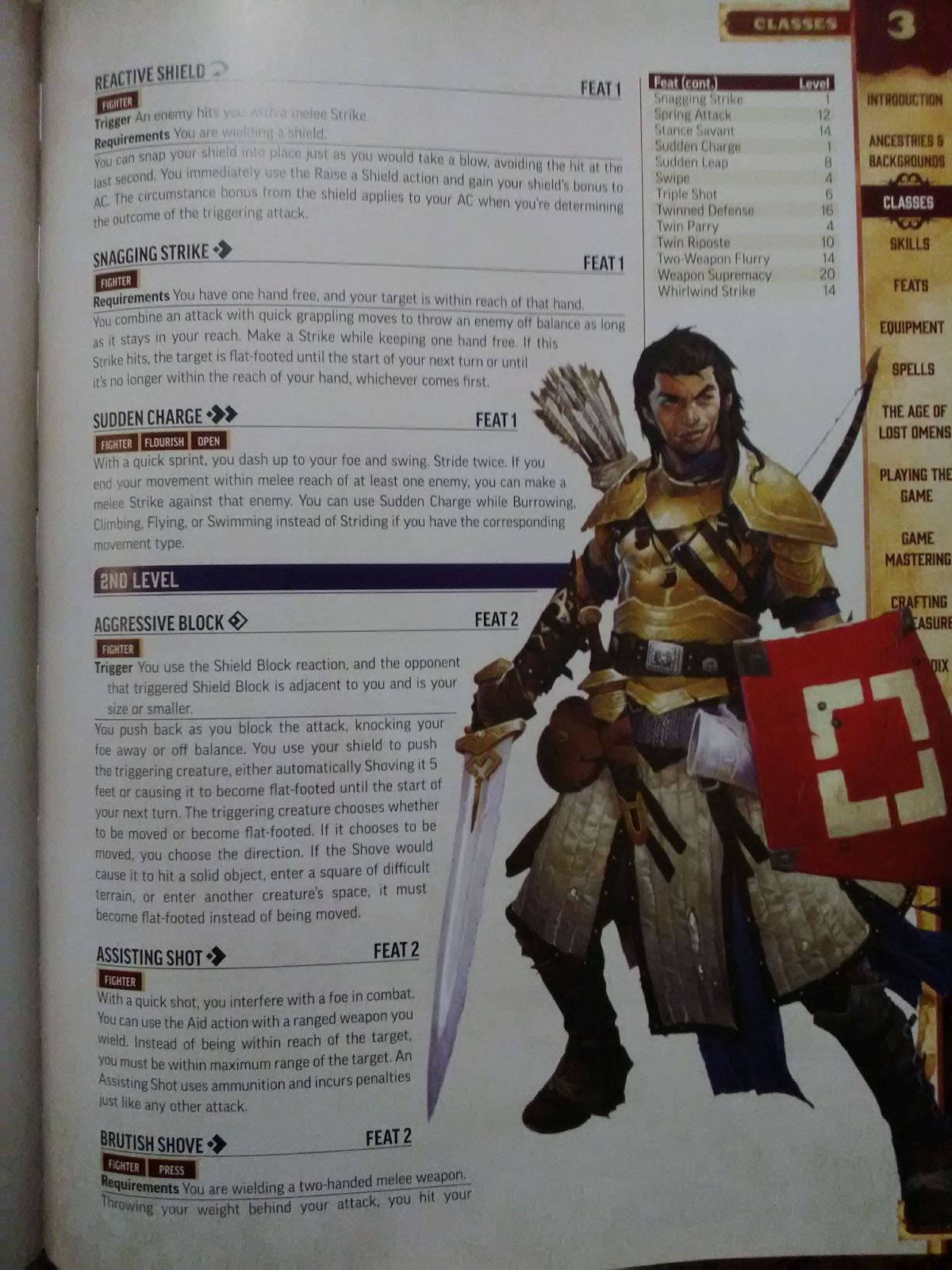

     Having artwork scattered throughout the book gives your eyes a break from all the text, but it also takes up space that could be used by the text.  The art doesn't tell you anything about the game or how to play it, so it is low-value to me as a GM.  Likewise the sidebar on every right-hand page listing the major chapters of the book is kind of useful, but it also takes up space.  This book is about $60, which is $10 more than the last book, but with the layout I feel like I've paid more for less game.

2) I am not a computer

    I mentioned the keywords above, they are on everything.  Every ancestry (race) and feat has them, take a look at some fighter feats...

    I really, really hate this.  This is computer-speak.  I, as a sentient being, know that if I am reading the list of Fighter Feats, then all of these feats belong to fighters.  I don't need you repeating it EVERY TIME.  The example above at least has some other keywords, the Concentrate, Stance and Flourish keywords do at least refer to specific rules.  It's kind of annoying to have to flip back to the page that defines those rules, but eventually they'll get memorized so that's not a big deal.
    What pisses me off is insulting my intelligence by telling me that Halflings have the keywords of "Halfling and Humanoid."  No s**t Sherlock.  It says Halfling on the box, and a Humanoid is anything human-shaped.  Maybe you might have to define humanoid in the glossary, but it is not hard to figure out.  If you want to write computer rules for your game, put them in a separate document.  One of the things I love about RPGs is the human element, so computer-speak is not welcome at all, in the slightest.  Again, I'm paying for each page, so me paying you to insult me is not cool bro.

3) People have said the book contains "everything you need to play" and that is incorrect

    NO MONSTER RULES, AT ALL.  So the 1e Core Rulebook didn't have any monster creation rules either, but it did at least have 7 pages on creating NPCs.  Not much, and I'm not saying it's praise-worthy, but at least it had something.  With this book I can only make monsters as PCs, which is more work than I want to do and I'm not sure how well it would balance in the long run.  In 2e, no monsters for you, go buy the $50 book with them (Spoiler Warning- there are no monster creation rules in there either, maybe those will be in the next $80 book).  Come on people, this is a basic thing you need to run a game.  If you're going to make one super-huge and expensive book then at least make it complete.
    I have a suggestion for where those monster rules could go - in the 25 pages of useless background.  Oh yeah, who cares about stupid rules for building monsters, what you really need is a broad and so-vague-it's-worthless setting.  Here is an image for the "Inner Sea" region, note the desert area called "Golden Road" in the middle-ish...


    Now here is the entry for the "Golden Road" country/region...

      This description is crammed into the bottom-half of the page (who needs more text or a close-up map when you can stare at the lovely picture of camels?) and is full of names that mean nothing and hints at story that boil down to "like Egypt and the Silk Road."  The little setting material here is not enough to do anything meaningful with - and totally zero value to me since I'm not paying another $100 for stuff I can write on my own (or with my players).  Even for those who do want a setting, this is not enough to start writing campaigns.

4) The art is different, but not in a good way

    This is a pretty small complaint, but I'm talking about all of my first impressions here so I'm including it.  Look at this...

     I know my phone picture is bad, but this has a kind of cartoon-y feel that is at odds with the more realistic style in the last book and elsewhere in this book.  Just a random, minor complaint.  Back to more pressing issues...

5) Who the hell designed that character sheet, and why haven't they been publicly beaten with a stick?

    This is the sample character sheet in the back of the book...

     (to mis-quote Crow T Robot) I'm a color-blind robot and even I know you don't use Burnt Umber as a background color!
   

6) I was really hoping for a lot more innovation, I'm not sure who this game is written for

    Here's a page out of the combat section...


    There's the good old grid.  Hope you don't like that artsy story-game "theater of the mind" crap.  Okay, so some out there are saying/ thinking, "well, the first edition only had a grid" and they are right.  So who is this game for?  Is it only for the people who liked the first edition? (and in that case, why would they re-spend all their money for this instead of playing the game they already like?)  Why can't it also accommodate new players and styles of play?
    Here's an easy example.  In 2e, just as in 1e, all living creatures move in exactly 5-foot increments.  And if you like that, great.  But what about this extra rule...

Gridless Combat (optional rule)
    If you don't use a grid, then divide all speeds by 5, so the standard 30' movement become a "Speed 6" value.
    When using skills, if multiple characters are racing each adds their Speed value to their Acrobatics roll.
    In combat, you can spend 1 action to move towards or away from a foe that is near you (GMs call), or 2 actions to close to melee if the foe is far away (again, ask your GM about this).  With or in place of that, you can spend one action and divide your Speed value as you see fit as a bonuses to either your AC, Attack roll or Damage roll (representing your moving for an advantageous position during the turn).


    There, simple, takes as much space as one picture and gives some options to those people who don't like playing on a grid.  So why can't Pazio do that?  Why isn't this edition trying to reach a broader audience and be better than the last?
    The funny thing about reading this rulebook is that I don't see why I would recommend this to someone who either hates or likes the first edition.  If you hate the crunch, this is still pretty crunchy and is likely not going to add anything new that your current game doesn't do.  If you liked the crunch then this is likely going to be too simple, and a lot of the new stuff you could house-rule yourself into your current game (take out the stupid rule to change all of an anchetype's abilities or none, instead pick and choose from the same level or lower - and bam, you're got almost all the extra flexibility in character creation; then simplify everything down to 1, 2 or 3 actions, maybe drop or consolidate any skills you don't like - there you have it) (ie, use the stuff in Pathfinder Unchained and some elbow grease).

7) If you're going to say that Encounters, Exploration and Downtime are the 3 major pillars of play then you should organize your rulebook around them

    This one really drives me nuts.  So the rules divide the game into those 3 phases above.  Which means the game is supposed to flow between them.  So you would think the rules would be laid out around them.  Nope.  Let's look at one phase, Downtime.  Now, the "official" Downtime section - the one with the chapter title of "Downtime Mode," is on page 481.  And just page 481, that's it.  not much to go on.  Well, those are not all the Downtime rules though.  Page 294 has the table with the Costs of Living.  Pages 236-237 have the "Earn Income" skill action and the table for how much you earn based on how well you roll.  Page 240 has the "Subsist" skill action.  Pages 244-245 have Crafting (pages 577-579 have the rules for normal and special materials).  Pages 500-502 have some more downtime rules in general.  And finally page 248 has "Treat Disease" and page 251 has "Create Forgery" and I don't know how many pages have downtime-related feats.  So that's at least 9 non-contiguous blocks of rules for what is supposed to be 1/3rd of the game.
     Who wrote this?  Who proof-read it and thought it was good?  You create a system to help guide the game, for both players and GMs, from the large background stuff to the moment-by-moment stuff and back, and you decide to cut it up and scatter it across your book instead of committing to it and build on it?  Why create it in the first place?  Again, not a computer, I know that crafting a sword and swinging a sword are two different time-frames, I don't need you to call them "Downtime" and "Encounter" - don't make up these divisions unless you want to actually use them.


What I Like After Reading Over The 2e Core Rulebook

    Okay, so the whole thing isn't bad, there is stuff I like (again, in the order it came to me)...
   

1) You Build Your Attributes Over Your Background

    Rolling for attributes is no longer the default method.  Instead all attributes start at 10.  When you pick your Ancestry (used to be called Race, I'm okay with that change too) you get a +2 bonus to 2 attributes, usually a -2 to one, and then one +2 that can't go in your boosts, but can go anywhere else.  So from your culture and your free time you built up some of your abilities.  Then you pick a Background and it gives you one boost chosen from two skills, and one more boost that can't go to the one you picked.  Again, your first job gave you some abilities.  Your Class has a key ability score that gets a boost.  And finally you have 4 more boosts, they just have to be applied to 4 different attributes.
    I really like this because your character's attributes now align with their history.  If your Wizard has an 18 Strength then it's because you've been sinking every free boost (and your character his/her free time) into developing Strength.  No more all-18s from the dice gods or rolling set after set after set trying to get the scores you want.  Love this, it will be mandatory in all games of 2e I GM.

2) Multiclassing is closer to my ideal

    I have always loved multiclass characters, but I've always hated the systems.  If I want to play a Fighter/Wizard hybrid it's because I want some of both classes - like the Fighter's Melee abilities and the Wizard's spells that enhance melee.  I don't care about Charm Person or Teleport, I'm a fighter who uses magic to be a better fighter.  But in 1e (and other systems) you have to take a whole level, getting all that Wizard stuff I don't want and diluting the character instead of enhancing it.
    Now, sadly the 2e system is not exactly at that ideal (actually I should have put some of it in the stuff I don't like, but I don't fell like editing this even more - I'll address it in another post), but it is a lot closer.  You can choose individual (mostly) abilities and combine them with fewer wasted options.

3) Things have been simplified

    Bulk is a good thing to import from Starfinder.  The 3 action system is pretty good (with some exceptions, "Raise A Shield" is a f***ing joke).  I like the Arcane, Divine, Occult, Primal divide of spells and some abilities (again, some issues with it).  Choosing an ability each level instead of a fixed class and interminable anchetypes is a good change (though as I said above, you could house rule it into 1e).


Mostly Though, It's A Mix

    From what I've read I've got a few "damn"s and a few "cool"s and a lot of "meh"s.  I don't think it's a bad game, I don't think it's a good game.  I think it's a confused game, that doesn't know who it wants to appeal to or what it wants to be good at.  I think some work and house rules could make it a lot better, I'm not sure if I would want to do that work though.  Going to keep reading it, not sure if I want to run it.


    So those are my first impressions, and I'm sure I left out a lot of stuff.  So I'm going to be making some characters and looking at the rules in more detail in the future.  Let me know in the comments if you've read or run it and what you think.


Tuesday, June 4, 2019

Skirmish Combat part 1 - above "party" below "mass"

    Overall I've been enjoying running the "Adventures in Middle-Earth" RPG that brings Tolkeen's works to DnD 5e.  I've even been using the published campaign "Wilderland Adventures" and I don't normally like published adventures.  Sadly, the good times have come to an end - I really, really hate the last 2 adventures, and how I want to re-write the ending for my party does not work well with 5th Edition.  Why?  Because my story ends with a big set-piece battle, the party defending a town from a band of orcs/etc.
     Dungeons & Dragons has always been written and balanced around party combat.  Most RPGs are.  But that level of detail quickly breaks down when you double or triple the number of combatants.  The scenario I want is not a full-blown army vs army encounter.  DnD doesn't have any native "mass combat" rules anyways, but lots of people (and I believe an Unearthed Arcana article) have tried making some.  No, I'm looking for something like a few dozen NPCs backing up the PCs as they fight against a few dozen bad guys and a few stand-out bad guy NPCs.  Which I haven't seen anything for.
      So I need to make my own rules.  In fact, I have, and I just had a chance to playtest them a little recently.  So if you are like me and want to do a set-piece battle that isn't quite army vs army, hopefully this will help you too.  I'm going to start by outlining the system in general, the next post will fill in the mechanical details.


How Should This Feel Different From Normal Combat?

    Let's be honest, most RPG combat turns into miss, miss, miss, I hit it with my axe, miss, miss, miss, I hit it with my axe.  Boring.  You're waiting on the other players' turns, waiting on the monsters' turns, and then a brief moment in the sun when you actually get to do something, followed by frustration if you miss or back to the waiting cycle.  This Skirmish Combat system is designed for more active, grander combats.  For when a lot is on the line, the fate of a city, stopping an invasion before it can start (or starting one).  For when the players are leading dozens of allies into battle.  And this style of combat is meant to be more engaging, to keep the players interested in the combat itself - not just the loot drop after or getting past an obstacle.


Highlighting The Logistical Layer Of Combat

    I once heard logistics defined as "having the right thing at the right place at the right time."  This dynamic nature, different things that need to be in different places at different times, is what makes larger combats engaging.  Archers are strong at range, but weak in melee - so you need to get your melee troops to the enemy's archers, or keep the enemy melee troops away from your archers.  This exists even in party-scaled combat, like the MMO trinity of Tank, DPS and Healer, and it exists in RPGs like DnD.  I think the big problem with RPG combat though is the level of detail and game design that goes into creating individual abilities, which steals the focus from how those individual abilities can chain together and work in coordination.  One of the big things I want this Skirmish level to do is strip away some of the detail on the individual and put more emphasis on how individuals interact and can support each other.  In party combat you can usually survive with each person acting on their own, but in group combat (like this Skirmish or full Mass combat rules) all the individuals have to work together or else they will be defeated (called a "defeat in detail," when a large force is beaten one piece at a time, usually because that force did not stay together).
    There is something to look out for however, and that's the fact that not all role-players are also war-gamers.  Skirmish combat needs to be simple enough that its principles are easy to understand by those who are casually picking it up, and also needs to look as much like regular RPG party combat as possible so the player doesn't have to memorize a ton of extra rules.  That's going to be a tricky balance to maintain.


Player-Focused

    Another thing about this system, I'm using this for when the players are the ones leading the battle.  This is designed for the players to be heavily involved and invested in the turn-by-turn flow of the fight.  That means they have to be leaders, have to be driving the combat.  If the PCs are just in the fight but not driving it, then you don't need rules for all the battle stuff going on, just narrate it in the background, like you would a storm or fire behind the PCs while they struggled with another goal.
    Because of this, every unit in the Skirmish system is generally made up of 2 parts: the Captain and the Supports.  Captains are characters, PCs or NPCs, while Supports are abbreviated/streamlined groups of lower-level/lesser background characters.


Turning Characters Into Captains

    By and large PCs work the same way as Captains as they do in regular party-level combat.  They have the same hit points, and use their usual attacks.  Defense is a bit different.  When dealing with 12 vs 12 combats, there is no such thing as nobody getting hit.  While a few attackers may miss, others will hit, enough so that on average some amount of damage is always dealt.  Seeings how damage is already being randomized by rolling dice, that will represent how many hit out of the group.  So Armor Class needs to be re-worked.  What we do is convert it to Damage Reduction.  A Captain's DR is just a lowered form of their AC.  Any Energy Resistance works normally.
    Another big change is that Captains get a Resolve Modifier.  Since there are groups of people all working together in the fight, we need to measure how well the unit is acting as a whole.  In real life many battles have been won, or turned decisively, when a group dissolved into individuals and lost their will to fight.  I didn't want to call this Morale like in other versions of DnD or other games, I'm using this in my own way after all, so I call it "Resolve."  A unit's Resolve DC is the number a Captain has to roll to keep the unit together and following orders.  We don't use it a lot, if a unit charges a superior force in what looks like a suicidal maneuver there is no Resolve check as long as they have a Captain.  After all, combat is dangerous and so the Supports know they might be killed.  That's just to cut down on the amount of dice-rolling; I want the players spending more time thinking about and analyzing the battlefield than juggling dice.  Also, it means that breaking an enemy unit's resolve is something the players have to plan for, and they don't have to worry about their own soldiers running away at random.  Captains don't check Resolve for themselves, under the principle that the GM/system should not force a player's actions or take away their agency.  Likewise NPC Captains are under the GM's control (and the GM is always free to throw an even/odd die if they want to leave it in the hands of fate).
    Lastly, Captains can also have special abilities.  I'm not sure about exactly how to so this one.  Normally I'd say that a Captain Ability would be for characters who took the Leadership feat or such.  But that isn't as big of a thing in DnD 5e, and I don't want to limit non-fighter-centric characters from being able to contribute.  So I'm tempted to make a list of 5 or so abilities for each class, and then let every character pick one every 4-5 levels from their classes.  Speaking of abilities, since this is group combat a character's abilities need to be re-examined.  In order to effect the combat as a whole a character needs to use an ability that effects multiple people and lasts for minutes or more.  So some class abilities may not have a noticeable effect.  And spells have to be re-examined as well, which I'll talk about later.  I haven't sat down yet to pour over the books and figure out which class abilities should do what.
    Oh yeah, Captains can also lead more than one support depending on their level.


Cannon Fodder... er... I mean... Supports

    Now the real meat of the system, the Supports, the people (and maybe animals) that are following our heroic players into battle.  We can't track each supporting individual, well, individually, since that would be tons of extra bookkeeping.  But we can turn them into a special kind of character.  Now, I don't really like the mass combat systems out there that just reduce every army unit to a character.  That seems to be over-simplifying things.  But in this case, I think it can work with one change to how characters work.  In party combat each character is perfectly and fully capable in combat until they totally drop out of combat at 0 HP.  So I think if we make a Support like a character, compacting several individuals into one set of numbers, but - with Supports as they lose members they also loose effectiveness.  Supports have 3 tiers: Coherent is around full HP.  Shaken starts at about 66% HP.  And Faltering is from 33% HP to 1.  Of course 0 HP means the unit has been totally Destroyed.  For each tier the Support's attack damage gets lower, the Resolve DC gets higher, and units that depend on each other for defense (like a phalanx) lose defense as well.
    Most Supports also have a special ability, which is the main function of that unit.  So Calvary can Charge, Archers might have a Barrage, stuff like that.  Speaking of which, Supports have a class, like players, so Infantry, Calvary, Artillery.  And they have a level, since they need to scale with the players in order to stay relevant.
    Supports do just that, they Support the Captain and each other.  So each Support has a damage rating (for both melee and ranged) that gets added to the Captain's regular damage.  This creates one damage total for all the units.  However, Supports can act without a Captain, they just will do their own damage and have a flat d20 roll for their Resolve, so they will not be as effective as a Captain/Support combo, and they will be more likely to fail Resolve checks.


The Flow Of Combat

    Speaking of damage, let's go over the combat turn in general.  In party combat each round is 6 seconds long.  For Skirmish combat, each round is 1 minute.  Party combat also measures everything in feet, while Skirmish uses "zones."  A zone is a general area that's big enough for several units, say about 9 units of any number of Supports each.  Just because two units are in the same zone does not mean they are engaged in melee combat (zones are big).  By default personal ranged weapons can reach to an adjacent zone, while artillery usually reaches 3-4 zones.  A Support's movement speed is how many zones it can cover in one turn.
    The first thing is to set the battlefield.  The GM needs to know what enemies are involved and where the battle will take place.  The players need to know what Supports are available to them, and decide on who is commanding what.  Also the players need to pick a starting position for their forces, from wherever the GM allows.
    Because the goal is to get the players more involved in combat, initiative is handled differently.  The players always go first.  Whenever a player interacts with an NPC unit they both roll damage (even if one side totally destroys the other, there will still be some blows from both sides - in 12 v 12 combat the odds of "instant death" are pretty slim).  Once a player has finished commanding all their units, that player then chooses the next player to act.  Again, this is to try and reinforce teamwork between the players.  Once all the players have gone, if there are any NPC units that haven't acted the GM moves them.
    On a turn units can move once and attack/ use an ability once.  Or the unit can move twice, not attacking or using any abilities.  Other things might use an action like climbing ladders/ stairs.


Warmages and Battlepriests

    Magic is a tricky thing in general, but it gets more difficult in Skirmish combat.  Because of the longer time for each round, and the fact that multiple characters are involved, some spells (and abilities, these guidelines could work for both) would not logically have much of an impact.  Take "True Strike," a cantrip that gives the caster Advantage to hit on the next attack roll.  From a Skirmish standpoint, this spell is useless, a single attack with advantage to hit is not a big enough change to effect the round.  But from a game design standpoint, saying that a character's abilities are useless is not a good thing, we don't want players to get frustrated.  So at the moment (and this may change a little or lot with playtesting) I'm going to strike a compromise.  Some spells are useless, like True Strike.  But lets look at another spell, "Mage Armor."  As a 1st level spell that grants AC to any single character not wearing armor and lasts 8 hours, we have some room to play with here.  So, the core principle of Skirmish magic is: lowering one type of effect can be used to bolster another effect.  So that 8 hour duration is long, too long.  A first level spell should not last the entire battle.  But the single target is too weak, like with True Strike, buffing a single character is useless in group combat.  So lets create the Warmage version of the spell - by dropping the duration from hours to a single Skirmish turn we can increase the effect to cover the Captain and all attached Supports.  We don't do AC, just DR, so we'll say the spell is a DR bonus, like +2 (or +caster Int mod?), but it's supposed to only effect unarmored targets, so we'll say the DR bonus only applies to Captains or Supports with a DR of 3 or less.  Now the spell can be useful, but it is still kind of weak - which makes sense given that this is just a 1st level spell.
    So, single-target spells need a long duration to lower to make then effective.  Spells that already hit a group, like a combat spell that has a Line or Cone of effect work normally (since they are already designed to hit multiple targets).  I'm tempted to say that Burst spells, like a Fireball that hits everything within range, would actually get a bonus to damage since they completely cover their area of effect.  Skirmish combat doesn't use saving throws, this is just to reduce the amount of bookkeeping, so some spells that have a save might use a Resolve check instead.  Which brings us to...


Resolve Checks

    Every support has a Resolve DC, like 11+.  This is a d20 roll with no modifiers if the Support is acting alone, or with the Captain's Resolve Modifier if the Support has an attached Captain.  Special abilities by Supports and Captains will have a specific effect if the Resolve check succeeds or fails.  Sometimes the effect on a failed check is that the Support becomes "Broken."  Resolve represents how well the Support is acting as a single force, so when a Support's Resolve fails they have stopped acting together.  A Broken Support does half damage, has half their DR (rounded down, minimum of 0 for both), and will move away from combat as quickly as possible.  Once the Support has gotten out of combat they will stop and hold their position, only moving again to escape enemy forces.  Any Captain can move next to a Broken unit any try to re-form them with a Resolve check.  On success the Support loses the broken condition and acts normally, on a failure the unit remains broken.
    Resolve is a powerful effect.  Historically there have been many battles where units have lost their resolve and turned the tide of battle.  Penalties to Resolve also stack during the same turn.  For example, one player has a special ability that forces the enemy to make a Resolve check at -2.  The enemy passes the check.  The player hands the turn off to another player, who has the same ability.  Now the enemy has to make a check at -4, because the stresses of combat are piling up.  This is to encourage the players to work together.
    Resolve isn't just a weapon, some abilities that buff friendly units will call for a Resolve check too.
   
   
    So that's an overview of my Skirmish system/ house rules.  This was designed for DnD 5e, since that's what I'm running at the moment, but I think it shouldn't be too hard to adapt this to other systems.  Next post I'll get into the details of how the system works so you can try it yourself if you want.


You can find the rest of this series here

Monday, May 27, 2019

New post later this week

With it being Memorial Day and me having a big get-together with friends there isn't going to be a post today, should be around Wednesday.

Monday, May 20, 2019

Mobile Game Review - Marvel Puzzle Quest


    I will long curse the day my friend introduced me to the evil Marvel Puzzle Quest (or MPQ).  It looked so enticing at first, a match-3 casual game with cool superheroes from the Marvel comics and films.  It was fun in the beginning, a nice way to kill a little time.  But then, after being seduced by it's neat artwork and interesting spin on the old match-3 system; it shed its sweet demeanor and showed it's true villainy, it's horrific microtransactions and pay-to-win mechanics.  I should have know better, but sadly it got its digital fangs into me and nearly drained all hope and joy from my life.  So I am here to warn you, dear reader, of this wolf-in-colorful-spandex so that you can avoid the mistakes I made.

    Okay, so my opening might have been just a touch melodramatic (if there is such a thing for a term that innately means to excess?) but there is some truth to how MPQ has hurt me.  I've never been a big fan of mobile games: which I will call this even though I played it on my Windows 10 laptop through Steam (my screenshots are from a phone emulator though).  The mobile mindset seems to be to make a game fun enough to get someone interested, and then not fun at all unless they pay money, and the more they pay the better things are for them.  That horrible generalization (though perhaps not unfounded) describes MPQ very well.  For proper perspective, I am not against paying for games, I know from my own projects that programming a game is hard, hard work.  And having artistic talent is something that you should be rewarded for using.  But as someone who's lived most of his life below the poverty level I am very keen about getting a good return for my limited money.  And MPQ does not give you nearly enough for how the game is deliberately designed to constantly suck the cash/ Steam gift cards out of your wallet.  That said, let's take a look at how the game works.


Match 3 pop-culture-style, or, Bejeweled with Eye Beams

    So I remember the release of Bejeweled by Pop Cap Games back in 2001, it was a monster.  Everyone I knew was losing hours upon hours to that damn game.  I resisted for a while, but even I gave in (and this was back on a Windows 98 desktop computer).  It was fun, I will give it that.  Oddly, it was also the only "match 3" game I played until MPQ.  The match 3 format is easy enough, usually you move two adjacent pieces to make a match of 3 or more in the same colored pieces.  The matched pieces disappear, and new ones drop into place.  It's a simple mechanic, it's really just about pattern recognition and some luck.  Easy to get into, and engrossing enough to be fun.
    MPQ takes that basic formula and adds it's central concept, superheroes.  Each match you make earns "Action Points (AP)" for each tile matched (so matching 3 red tiles gives 3 red AP).  You choose up to 3 heroes, and each has up to 3 abilities.  Some abilities are passive, so they are always in effect, while the rest have an AP cost.  For example Iron Man's Repulsor Blast power costs 10 red AP to use.


    Your heroes and your opponents (also up to 3 at a time) each have health points.  The goal is to reduce the other guy's health to 0, which knocks them out of the fight.  Each hero (I use the term generally, there are playable villains like Doc Ock) does a different amount of damage for each color, so out of your group the hero who does the highest damage will 'move to the front' after each match (making them the one to take damage).  In addition to doing damage from each tile matched most abilities also do damage or create special tiles.

    Special tiles change a tile of a certain color on the board into a new hybrid tile.  So Iron Fist can make a Green Attack Tile, which means a green tile on the board - that is not already special - gains a fist symbol and automatically does a certain amount of damage at the start of Iron Fist's side's turn.  Luke Cage can make a Red Protect Tile, which reduces the damage his side (whoever's in front, not just him) takes by a certain amount. 
    The most common special tile though is the Countdown Tile.  This makes a counter that decreases each turn, and when it hits 0 it triggers some effect.  Because all of these special tiles alter ones on the board a big part of the game is trying to match away your opponenet's special tiles while protecting your own.


    Having these powers adds a whole extra dimension to the basic match 3 game.  You don't want to make a match that includes one of your special tiles (you destroy your own if you match them).  Likewise, you may not need a certain color, but make the match to get rid of an opponent's special tiles.  So there's an extra layer of decision-making to each turn, and strategically there are some heroes who work better with others.  Since most powers cost AP, you don't want a lot of heroes who have the same colored powers since you won't be able to use them all.  And some abilities just combine in very useful ways.
    Also, the artwork is good and most of the powers look pretty cool with their short animations.


Why Hulk No My Friend?

    Sadly, it is in this cool concept, having a roster of heroes, where the evil creeps in.
    You get a few free heroes at the start of the game.  And they all have a "Level" that determines their overall power and "Covers" that determine what powers they can use and how strong (combined with the hero's Level) those powers are.  You have to gain covers to increase a hero's maximum level, but you win covers at random from earning "Tokens" that you turn in for a random hero from a pool of them.  These tokens can be won, but usually just the least powerful - heroes themselves are rated by "Stars."  A 1 Star hero is the lowest and least powerful, with a low maximum level.  5 Star heroes are the most powerful and can be upgraded the most.  This makes it hard to talk about characters, since there is a 1 Star Iron Man, a 3 Star Iron Man as well as 4 and 5 Star versions (each with different art).  I have no idea why there isn't a 2 Star Shellhead though.


    Confused yet?  Yeah, it's kind of hard to describe (for being pretty simple really).  Anyways, so you can earn tokens for playing the game and even just for logging in.  But, those are almost always lesser 1 or 2 Star heroes.  Each token has a small chance (sometimes just 1% or so) of giving you a higher-Star hero's cover, so occasionally you'll get a great deal.
    To review, you get heroes at random, and the free heroes are the least powerful ones.  Then it gets better.  Each hero can have up to 5 covers in each of it's 3 powers, but can only have a total of 13 covers.  So you cannot get all 5 covers in all 3 powers, you'll have to choose some to under-power.  And after you've gotten those 5 covers in one power, or 13 covers in one hero, all the same covers are useless.  You can 'sell,' or really convert, them into purple currency (ISO?  I forget, I always called it "purple crap" for how useful it was).  Purple Crap is spent to level up a hero, which you cannot do unless/ until you get a cover, within their limits, so it is really easy to get Purple Crap.  I usually had at least 300,000 points of the stuff (my friend was always over 1 million).  It was hard to get a lot of heroes to level up.


    One of the biggest reasons why it was so hard was the game's other system designed to screw over the players, your limited Roster size.  You can only have a number of heroes up to your Roster size.  So at the beginning of the game you have around a 6-hero sized Roster.  Once you get all 6 slots filled you have to sell off ones you have to make room for different heroes.  In order to increase your Roster size you have to spend real money (called Hero Points) - and the kick in the pants is that It Gets More And More Expensive The More Heroes You Buy!!!  So you just started the game, the tutorial pretty much filled your roster, and you like the game so you decide to buy some more character slots.  Well, look, it's only 300 Hero Points for 3 slots.  That's pretty good, like under a dollar per slot, not too bad.  So you fill those up.  No big, only spent a few bucks on the game, I'll buy some more.  Oh, wait, now it's 350 points for 3 slots.  And then 500 points for 3 slots.  And then 400 points for 2 slots.  And eventually 700 points for 1 slot.  And the cost just keeps on rising.


    This is crap.  It is total, 100% scum-sucking garbage CRAP!  The longer you play the game the higher the tax on playing.
    Well, no problem, I'll just get rid of any characters I don't really like, and I'll slowly buy slots with the few free Hero Points I can get from playing.  Yeah, that kind of works.  But you see, some tokens stay good forever, and some are limited-time events (called "Vaults" to drive home how they're stealing your money), and once you open a token and get a cover a timer starts.  You can only hold onto a cover for 14 days, at the end it is automatically converted to Purple Crap.  So over and over you're going to keep losing covers, and watching all the tokens you don't have room for pile up, and then you'll need to open those higher-level tokens to keep up with the game, but what if it has a cool character you don't have any room for?  Either you shell out ever-increasing money or say goodbye to a hero you might not see again for months (remember, the tokens produce random covers) or just get disappointed because you didn't want that hero in the first place.  Literally whatever the outcome is it's bad, unless you have a lot of money to burn.


I Hate Myself For Loving You

    And that sucks, because the game itself is pretty damn fun.
    It's got just the right amount of complexity to be interesting without becoming so hard that it loses the 'casual game' appeal.  It's actually pretty fun to play, but every second in-between matches is filled with the frustration of managing your roster.  The joy of getting a new token quickly becomes the disappointment of it not being the hero you need to go with the other one you've got, or the frustration of not having enough space.  And it's not one of those games you can just spend a little on, the cost keeps going up and up and up the longer you play.  There are over 300 heroes total, I cannot imagine just how much real money it would take, or hundreds of hours of playing, to be able to poke-catch them all.
    Adding insult to injury, most of the gameplay revolves around events.  These are a pool of opponents that change every 3-4 days.  Each match you win in the event gives you points.  And there are rewards for the top 100-500 players of each difficulty.  These are covers, so you can get exactly who you want - if you can out-score other people.  Which really means the people who play the most have the best chances of getting better characters.

    The other thing you can do is "PvP."  This is not real PvP, I don't know a good term for it, I've seen a few games do this same thing.  What happens is that the servers look for another player, pick 3 random heroes in that player's inventory, and those are your opponents.  The computer is controlling them, you never directly face another live person.  And this is the other way to try to get good covers, except the match-making algorythm is so terrible you will often be fighting level 255 enemies when your highest hero is level 70.  So good luck.  And whenever the computer picks one of your teams and someone defeats them you lose points/ standing - unless, of course, you pay real money for a 'shield' to protect yourself a day or two or three.
    Crap.

    I really want to like this game.  I like the Marvel heroes, I like the gameplay and the graphics are solid.  I like having a game I can log into for a few minutes and not have to really commit to playing, it gives me a break in-between other (admittedly more productive) things.  But the suck-you-dry business model that never gets any better is just too much to put up with.  I respect myself and value my time more than that.  If you like match 3 games and either have money to burn or a high frustration tolerence then give it a try - but my advise to most people is don't bother, and don't reward this company for being so disrespectful to it's players.


Wednesday, May 15, 2019

Looking at the 5th Edition SRD - part 13 - Discovery, Manipulation and Communication Actions

    I've been using a system that breaks a game's rules into 5 categories: Exploring, Investigating, Manipulating, Communicating and Fighting.  Last post I looked at what Exploring rules the 5e SRD has.  This post I am going to try to go through the next 3 types, because I'm pretty sure there isn't a lot to talk about in any one of them, I know Fighting has the most page count (so it will be next post).

Discovery Challenges

    So Discovery is all about learning information, as you might guess from the title.  This is different from Perception, which is actually a part of Exploring.  Perception is about noticing the environment, the things around you weather living or not (well, as used in the SRD, I personally don't think perception should be a separate skill as I mentioned in one of my posts).  Discovery is about understanding something, about seeing it deeper than the surface level.  This is the core challenge type in a mystery story (seeing what happened is not the problem, look at that big blood stain, it's interpreting what you see, what weapon did that/ who did that, is the challenge), and also encompasses riddles and puzzles.  Things that have a deeper, hidden complexity by nature.
    What kinds of skills does the SRD have for this type of challenge?  Well...
  • Arcana
  • History
  • Insight
  • Investigation
  • Medicine
  • Nature
  • Religion

    And what sections of the rules cover this type?
None, none at all really

    This type is rough in the SRD because while there are a few skills in the system, there is nothing at all about how exactly to use them.  If I want to use Religion to identify the type or abilities of an undead creature, can I?  What's the DC?  What information can I get?  If there is a puzzle about moving rings or a riddle about carrying geese and foxes and beans across a pond is that just a plain Intelligence check?  Again, what DC?  Or are we supposed to "role-play" it only and if I can't personally figure it out then I'm tough out of luck?
    Mysteries and puzzles are some of the hardest things to pull off in an RPG, it's too bad that the SRD doesn't give you any help with them.


Manipulation Challenges

    Exploring set the environment, and let you see and interact with the surface of the things around you.  Discovery let's you see under the surface.  And then Manipulating is about changing that inner nature of things and people.  Crafting is changing raw material into items, healing is changing a damaged body back into a whole one, so both are Manipulation.  An adventure that focused on Manipulation challenges would be something like a hacker in a heist or cyberpunk story - manipulating security - or creating a forgery to replace an item with, or trying to stop a plague.  Of course, while I categorize the challenges to try to organize related skills, abilities and rules together- in a typical adventure there would be a mix of challenge types.

    So what skills are there in the SRD?
        Well, none of the skills really apply except for Medicine
        Mostly this is the area of Tool Proficiencies, which I haven't really addressed until now because the SRD itself doesn't really address them at all, so now's as good a time as any.

Tool Proficencies
    Tools are a strange thing in the SRD.  They feel like an afterthought, like somebody designed the rules and then went, hey, wait, we totally forgot about crafting items, and we don't really know how we want to handle crafting items, and we don't want to add more skills so let's make them skills that are not skills so we can say they're there and hopefully nobody will really care or notice that we totally had no idea about what we were doing.
    Okay, I'm being hostile, actually there is a sort of sense to the skill vs tools system.  If skills are things you can do innately, and tools profs are things you cannot do on your own, then there is a sense in dividing them.  The problem is that they don't really divide that way cleanly.  Take Stealth, that should be a skill because you can hide any time you want, right?  But then what about camouflage clothing?  A black ninja outfit?  Those should help you hide (in the appropriate environments at least) weather you're personally 'good' or 'skilled' at hiding or not, right?
    An easy way to see this is in the system itself.  There is the Medicine skill and the Herbalist Tools, or the Perform skill and Musical Instrument tools. Heck, there are even tool kits, like woodworking and the forger's kit - which overlap if you want to make a forgery of a wooden carving.  So if you only have one of these (kit or skill) can you do the same things?  And what if you have both?
    Now, the system did try to clarify some of this in Xanathar's Guide To Everything.  The thing is though, they didn't add any of that material to the SRD (as of this writing).  Right now I'm not reviewing DnD, I'm reviewing just the SRD, the part of it that you can use to build your own games (which I intend to do down the road).  So for the purposes of this review, these are all questions with no answers.

    Okay, back to the SRD.  So most of Manipulating is in the Tool Proficiencies, but what other rules are there?

Diseases are just over a page, with 4 examples, and no useful advise or guidance at all for creating your own or how to treat them

Madness is another just-over-page of random tables.  I hate random tables in madness/ sanity systems- trauma is not random, it is very much based on whatever the triggering event was (though, granted, it can pop up at seemingly random times/associations)

Objects is a 1 page section that gives you some basic guidelines to dealing with inanimate stuff, okay for being so short

Poisons is a little over a page, and has the same problems as in earlier editions of the d20 system.  Poison tends to be over-priced for the effects, the save DCs are pretty low so they're mostly just good against low-level monsters, and there are no DCs or steps mentioned for how to cure them with either the Medicine skill or Herbalist Kit Proficiency (in fact, neither the skill nor kit say they can actually be used to cure a poison or disease, only to "diagnose" for medicine or "create antitoxin" for herbalist)

    So basically the SRD has very few rules and most of them are useless.


Communication Challenges

    Manipulation deals with the player/ active character making changes in something else.  Talking between two sentient creatures falls into it's own category, Communication.  People are complex, and layered in their motivations and actions, so this subject is worth its own Challenge Type.
    Sadly, just as with Manipulation there is a lack of any sort of rules.  There are a whopping 5 skills related directly to Communication:
  • Insight - used to figure out what a character is thinking/ feeling
  • Deception - for lying to people, including disguise (though, of course there is also a disguise kit)
  • Intimidation - to threaten someone
  • Performance - to entertain someone/ a group
  • Persuasion - to 'play nice' with others (almost its exact description)

    And in terms of rules there are none at all.  No guidance whatsoever on how to set up or run a conversation or an adventure that relied on interpersonal interactions.  No DCs or what should be/ shouldn't be possible.  So if you wanted to run a Game of Thrones-inspired campaign good luck with all the politics and drama.

    Okay, so we've covered 4 of the 5 Challenge Types, and while these have had few useful rules at least the last one I know has some detailed material, because we're going to wrap things up with a look at Fighting - next post.


You can find the rest of this series here


Thursday, May 9, 2019

Looking at the 5th Edition SRD - part 12 - Exploration Actions

A Quick Side Note- this post did not come out, as the last predicted, a week later :(  In fact it's been several months since I last updated this series.  I want to apologize for that, and say that I'm re-committing on finishing this series as quickly as possible while still being worth reading.


    Having looked over the attributes, and how skills modify them, let's look at the rules for different types of actions.  In my 5-fold system for describing RPG actions/ challenges my categories are: Exploring, Investigating, Manipulating, Communicating and Fighting.
    That list starts with Exploring because it covers how the character interacts with the game world.  This is the very first starting point, you need a world to inhabit to do anything/ exist in after all.  This category includes both "natural" and "man made" environmental factors.  So traps are a part of the Exploring rules here.  So is stealth, since it's not really about the person looking for you as it is your ability to 'blend in' with the environment somehow (same way Perception is the ability to identify your environment).  Survival, tracking, movement - both gross like running and swimming, and fine like acrobatics - are also Exploration, obviously, since they move you through the environment.

    Here are the skills that I put as being exploring-
⦁    Acrobatics
⦁    Animal Handling
⦁    Athletics
⦁    Perception
⦁    Sleight of Hand
⦁    Stealth
⦁    Survival

    And here are the sections of the SRD that I think go along with those:
⦁    some of the Attributes & Skills
⦁    Time & Movement
⦁    The Environment
⦁    Traps

    I don't consider objects a part of Exploring, because I put working with/ changing objects as a part of "Manipulation."  Traps are in Exploring however because a trap denies access to a place/ items.  And movement, ie changing places, is a part of Exploration.  Likewise poisons and diseases can afflict a character from a trap or location, but treating or removing them is also Manipulation (that is, manipulating bodies, ie healing).
    So these are the core things to Exploring challenges, in my own system (which I use here only because the 5e SRD has no system at all, and I want to have a logical and well-constructed discussion [as opposed to just listing all my thoughts alphabetically, like too darn many RPG books])...
⦁    Perception / Stealth (stealth hides your whole being while sleight of hand hides your actions)
⦁    Movement
⦁    Access and Barriers (incld. Traps)
 ⦁    Weather/ Environmental Effects (including falling) [while healing these may be in Manipulation, taking them in the first place works best here]

    With that as a filter, just how many rules are there and what are they like for Exploring challenges?  Well, we have about 4 pages in 'The Environment' section, 2 pages of 'Time and Movement', and 4 pages of 'Traps' - and let's say 2 pages from the 'Abilities and Skills' section, for about 12 pages of Exploring-styled rules: out of 403 pages total (though a lot of that is characters, spells and monsters).  There are maybe 50 pages of rules on running the game (estimating generously).  Looked at that way the Exploring rules take up a decent proportion of the total rules.
    So what all do we get in those 12 pages?  Well, let's look at each section.
   
    In the Abilities and Skills we have the skills I listed above.  There are some examples of what each attribute/ skill might be used for, but as I mentioned in my last post there are no examples of DCs - weather each action might be easy or hard.  While that does give the GM flexibility it also sucks if you're a new GM and don't feel comfortable with the DC system, or you're a player and the GM hides your DCs, in which case you have no idea how likely an attempt might be, and thus weather it could be worth any potential risks.  Something is better than nothing, but I wouldn't call this section very useful.
    Let me give you an example of what I mean.  There is a little sidebar in the Dexterity section that talks about hiding.  It has exactly one sentence about hiding while invisible, "An invisible creature can always try to hide.  Signs of it's passage might still be noticed, and it does have to stay quiet."  Okay, now how does that tell you anything you wouldn't have figured out on your own when thinking about invisibility and hiding?  Instead of being written by Captain Obvious, how about we get a game designer to write about this - because a game designer would say something like: invisible creatures don't need to make Stealth checks unless the environment might give them away (ie, leaves or twigs that could break), or maybe, invisible creatures always have advantage on Stealth checks, or maybe, if an invisible creature makes noise/ tracks other characters who rely on sight still have Disadvantage to attack or interact with them, or anything that might actually help you adjudicate an invisible player/ monster at the table?  I'm not saying the game needs precise rules, just some quick advise to the GM about how to use the system. A good thing to have, even in a "rules light" styled game.

    Time and Movement is next.  Time in RPGs is always screwy.  No matter how detailed your rules it's impossible to simulate reality enough to measure things in exact seconds.  And it's useless to try.  The most valuable thing is figuring out who gets a task done first, or arrives at a location first.  And given that DnD has always used identical numbers for a group (ie, all Humans move at exactly 30 feet per round) (DnD Olympics must suck), then it's really important to say what gets checked in a contest.  If two players are having a foot race what do they roll to determine the winner?  Dexterity?  Strength?  Constitution?  Wisdom, what ?!?!  That's the only really useful thing at the table, counting minutes and seconds is actually more of a waste of time than anything else.
    Sadly the 5e SRD doesn't have a lot of useful information.  And again it is very wasteful of its word count.  Pretty much the entire Movement section can be boiled down to this:

Walking: choose a pace-
    Fast- covers the most distance (automatically beating/ arriving before any slower creatures), but Disadvantage to Perception
    Normal - the default speed, cannot use Stealth
    Slow - the slowest speed, automatically beaten by all others, but can use Stealth
*Forced March - can treat your speed as 1 category higher, but have to make a Constitution save or gain 1 level of Exhaustion
*Difficult Terrain - move at half speed

Climbing and Swimming: move at half your normal speed

Jumping:
    Vertical - can jump roughly half your height from standing, or just over your height with a running start
    Horizontal - with a running start you can jump your Strength score in feet, half that from a standing start
*difficult or longer jumps require an Acrobatics check

    What the rules miss (IMHO) are:
        Flying creatures ignore ground terrain (and hazards), and will beat any ground characters at the same Pace.  High winds may count as difficult terrain (headwind) or a free 'forced march' (tailwind) for fliers however.
    Short-term movement is a contested Acrobatics check to determine a winner in the same Pace.  Long-term movement is a Constitution save/ check.
    Normal Pace should allow Stealth, just at disadvantage, while at Fast Pace Stealth is impossible (without a special ability).  Also a Fast Pace may impose Disadvantage to other skills than just Perception (like Survival to track).
    Hazardous Terrain (like Desert, Arctic, Volcanic) requires a save, typically Dex (? Con?) but could be another attribute, or the creatures take damage (use the Trap tables for save DCs and ignore attack roll, just apply damage).  For ease of bookkeeping Hazardous terrain should only be applied once per journey, ie a Desert may be a Con Save vs the heat to the Oasis, then another Hazard check from the Oasis to the City the PCs were headed to (making checks for every day seems like it would just slow the game, no way to heal the damage though so that's the state you arrive in).  Proper equipment/ abilities may negate Hazardous terrain, like being Fire Resistant may reduce or ignore hot environments, and using camels and buying extra water (or hiring native guides) may negate the hazards from the Desert example above.
    Characters may need extra supplies (like food and water) if they travel at a Slow Pace, or fewer supplies traveling at a Fast Pace.  Not having enough supplies requires a Con save (like for a forced march, but without the speed boost; and forced march w-low supplies is Con save at disadvantage).
    Since a Forced March represents moving when others are normally resting, ie at night or just by making a smaller camp and shorter rest/ sleeping breaks, then any creatures moving this way need to be able to see in the dark, or else make any Hazard checks at Disadvantage.
    Animal Handling - animals and the AH skill are usually either used to ride a mount or direct a carriage, or as a save against an animal hazard (ie, you recognize the dangerous animal's signs and avoid them).
    Again, this list has my personal house rules, the book doesn't say anything about them.  I only mention my thoughts to show how much the SRD is missing that might be needed at the table.


    The Environment section has a decent amount to unpack, so I'll hit on each element in order:

    Falling - as in previous editions falling damage is 1d6 per 10 feet, which works for me.  While I'm not a fan of exact foot measurements, ten foot increments are broad enough and not too hard to approximate (you could say 1d6 per 'floor' or 'story' I guess).  Hit Point inflation does make this wonky, but that's another problem.

    Suffocating - the SRD says a creature can hold it's breath for it's Con modifier in minutes, min of 30 sec (with a 0 mod).  I decided to try a scientific (I wrote it down, like Adam Savage said to do :) test and held my breath three times.  I got 0:29, 0:33 and 0:28 - I'm a middle-aged overweight guy, no Con mod here, so I'd say the low end sounds about right.  I kind of feel like it should be an extra 30 sec for your Con mod, a full minute seems like a long time - I seem to remember hearing that brain damage occurred around 6 minutes without oxygen.  This sounds logical overall, and I'm not sure just how often it will come up, but the rule makes sense and is short and sweet, so I like it.

    Vision and Light - again the SRD gets excessively wordy, basically there are 3 possible visibility levels: Normal, Lightly Obscured and Heavily Obscured.  Lightly Obscured can be caused by dim light (the edge of the torch, twilight, full moon), patchy fog or light/mod foliage and gives Disadvantage on Perception checks relying on sight.  Heavily Obscured can be caused by darkness, full fog or heavy foliage and creatures gain the 'blinded' condition.  That's simple enough and works. (though, overly-bright light could have similar effects I guess)
    Then the book talks about other types of perception, which gets a little odd.  Blindsight lets a creature perceive it's surroundings within a radius, but that's all the SRD says.  What kinds of details can it perceive?  Can it sense colors?  Can it detect a limb moving while the main body is standing still?  Read lips?  You really have to work this out on your own.  Darkvision makes Heavily Obscured into Lightly Obscured instead, and only sees in black and white.  That's detailed enough.  Truesight lets a creature see, well everything, which works since it tends to be a high level ability.

    Food and Water - like suffocating I'm not sure just how often this will come up at the table, but the rules deal with hunger and thirst by gaining levels of exhaustion.  On page 358 is the conditions list, and there are six levels of exhaustion, with level 6 being death.  That means you could survive 4 days without any water, which I think is pretty "realistic" (as weird as that gets when dealing with an RPG), I remember it being 3 days.  For food you can go 3 + Con Mod (min 1) and then gain 1 level of exhaustion each day, for a minimum of 10 days and a max of about 14 - I seem to remember 30 days being the average you could survive without food (it was 3 min w/o air, 3 days w/o water and 30 days w/o food, and I don't remember where I heard that from).  So I might house rule gaining a level of exhaustion every 2 days, but again I'm nit-picking something that might not ever come up.
   
    The last section is about traps.  Traps are a huge topic, there have been books written about traps and using them in RPGs.  I don't want to get into it here, that will be a post for another day, but I will just say that the 5e SRD rules are okay.  They're fairly detailed, they tell you to think about what the players are doing and the circumstances and not just rely on die rolls.  There are not a lot of sample traps, but there are a few tables as guides and I think enough to get your house ruling pointed in the right direction.

    Okay, so we've covered 1/5th of my Challenge categories, next post we'll cover some more.

   
You can find the rest of this series here


Wednesday, May 8, 2019

A Thank You during my "dark" time

    So I've been wrapped up in my own head, and then dragged into some of my friends' troubles, and thus the blog has not started off the new year with a grand re-opening as I was hoping for at the end of last year.  In fact, I've hardly even looked at it in months.  So I was very surprised to see just how many hits I've gotten when I popped into my dashboard this morning.
    I really want to say a deep and heartfelt "Thank You" to everybody who's visited the blog during these many months of inactivity.  I'm ashamed that I haven't been sharing more and working on the oh-so-many ideas in my head.  I'm not sure just when I'll get back to a regular schedule, but I do have some reviews written (just need to mix in all the screenshots) and a few more articles about 5e DnD.  So there is likely only going to be 1 or 2 posts a week coming up - I do have a big project I want to tackle, but it would mean putting the other projects on hold; not that they're going anywhere at the moment :(
    So, if you've stuck around I really, really appreciate it.  There is going to be some more stuff coming soon.  And if there are any specific topics you want me to talk about - like, anything at all - drop a comment and I will definitely get working on it.  It's nice to know that some people are interested and I like sharing my crazy disjointed thoughts with anyone foolish enough to listen :)