Showing posts with label RPG. Show all posts

Friday, February 5, 2021

In Progress - RPG Tactical Zones Theater of the Mind Combat Aid


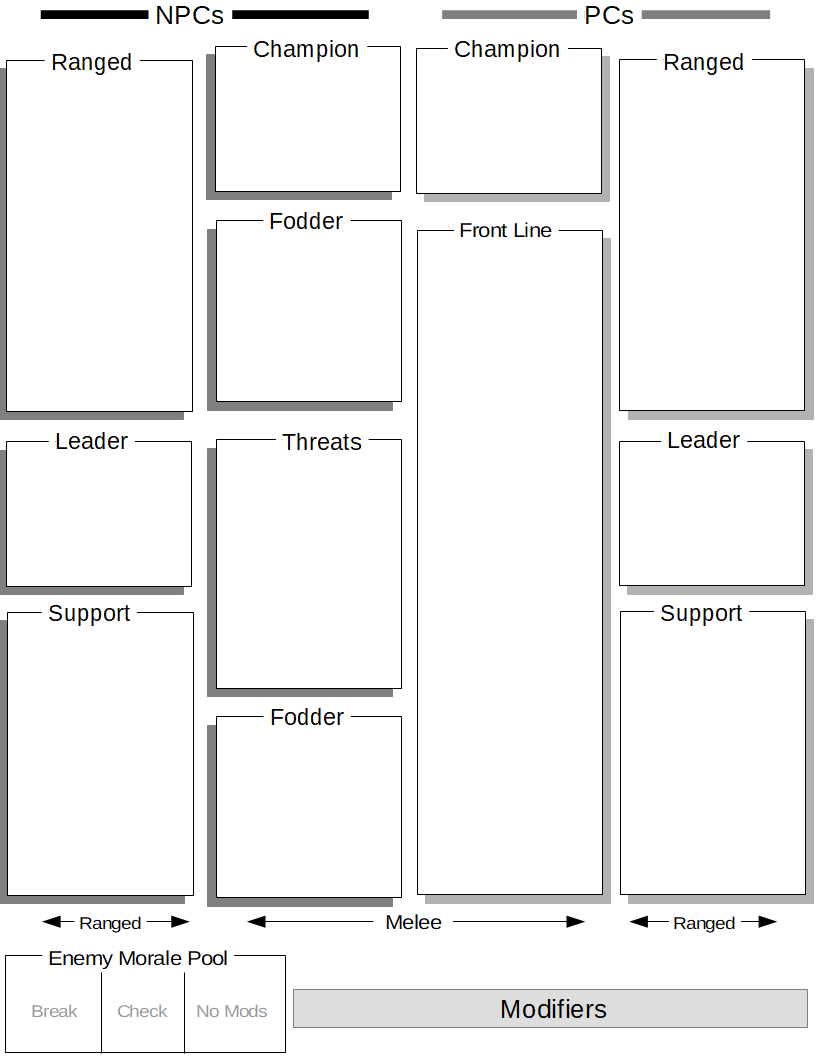
    I usually run "theater of the mind" styled combats.  I'm not a fan of grids for tabletop RPGs, I love dedicated wargames like Battletech or Warhammer 40k but don't usually run RPG games that focused on combat.  It's kinda hard to run good combats off of the rough sketches I make however, so I started wondering if there was a better way to represent a battlefield that was not super-detailed.

    What I came up with is pictured to the side, dividing up the battlefield by the roles involved.  This is not a totally original idea, The One Ring RPG by Cubicle 7 uses something similar (a little from the D&D 4th ed combat roles too).  I'm adapting it in a more free-form way however.  You can just use the boxes without worrying about the roles to have a good idea of where everybody is, put your miniature or token in the corresponding space.  Or you could get more detailed, adding bonuses or penalties to each role to help make combat more tactical without the foot-counting precision of a grid.

    I'd love to come up with a full set of house rules for several systems, like the D&D 5th ed I usually run, but also Fate and any other game that could use a semi-structured combat.  Something for those like me who enjoy tactical choices but doesn't want to get too in-depth.  I'm still working on ideas though, and with 2020 my group has had a hard time meeting to play of course.  So I'm not sure when I'll be able to craft something detailed - but I decided to go ahead and throw this out there and see if anyone found it helpful.

    EDIT 1/10/2023: Due to current confusion about the upcoming OGL v1.1 and how that might relate to the previous OGL 1.0a that I was using, I have removed all links to my previous documents.  I will try to alter and re-upload them in the near future.

    I have a few more ideas like this, visual aids for some common challenges, that I am going to be posting in the near future as well.  I always welcome comments (it's nice to know somebody's reading this, inconsistent as I am about it).

Monday, August 3, 2020

Pathfinder Second Edition: The Fall of Plaguestone - Review & Recap

    I finally ran my first Pathfinder 2ed adventure - one of my payers had bought The Fall of Plaguestone adventure, so we figured we could test out the new rules and see what the writing quality was like. It was a very mixed experience. There were some things in both the rules and adventure that I liked, but there were also some rage-inducing issues. It did not leave me looking forward to playing P2e again, either to finish the adventure (we got 2/3rds through it) or to make/run my own adventures for the new system.

    For this review I’m going to start by talking about P2e and the characters I made for it (some players didn’t have the book, so I made pre-gens), then go through the adventure itself (there will be light spoilers), and give some final thoughts on the system.

1) Making Characters
     In theory the new system is very easy: pick your Ancestry, a Background, and a Class. Choose a feat for the Ancestry and Class, note the Skill Feat your Background gave you. Assign your Attribute Picks. Buy gear, everybody gets 150 silver. Then wrap up the details and fill out a character sheet.

    In practice this took a lot more work than I expected. Some of that is learning a new system, though I had made a character before (in this post) so I wasn’t completely new to the system. 8Some of it came from the difficulty of choosing a worthwhile option. For example, the Wizard has 6 level 1 Class Feats…

  • Counterspell - counter a foe from casting the same spell you have prepared
  • Eschew Materials - you don’t need a spell component pouch
  • Familiar - you have a bonded small animal, which can give you a small bonus (but not fight)
  • Hand of the Apprentice - you gain a focus spell of the same name. You can make a ranged attack with a melee weapon, once in a fight, and you have to be able to take a 10 min rest before using it again
  • Reach Spell - by adding 1 action to the casting you can extend the range of a spell by 30 feet
  • Widen Spell - you can add 5-10 feet to the radius of a burst or length of a cone/ line

    So Counterspell is mostly useless. You can only counter a spell you have prepared, and you lose the prepared spell to do it. So I can counter a magic missile, which might sometimes save a companion from dying, but I lose the spell myself and only have 3 spells for the day total, so now 2. Eschew Materials is useless, how many times have you lost your spell pouch? (or, how many times has your GM forgotten that you even have spell pouch to begin with?) The Familiar is a semi-decent spy and useless otherwise. Hand of the Apprentice is useless, it’s got a slighly better chance to hit than using a crossbow, damage is the same as your melee (so, pathetic for most low-Str Wizards) but you can only do it once per fight. Reach Spell is the only clear great to have ability, since you can attack with some of those touch spells from a safe distance instead. Widen Spell is maybe okay sometimes if you’re using a battle-mat, but I run “theater of the mind” fights and it’s incredibly hard to translate a slight bonus (5 feet to 10 feet) into a more abstract system like that.

    And too many feat choices are like that, a lot of reading new rules for how things work in excange for a bunch of crappy options that may or may not ever see play. Granted, 1st edition had the same problem, there were a whole heaping bunch of crappy options and edge-cases, but at least then you got so many abilities that there was usually one good thing in the lot. In 2nd edition you don’t get as many abilities overall (at least it doesn’t seem like it, and I really don’t want to go through the effort of making several characters to compare).

    Adding to the time, I did have to fight with some new character sheets. I absolutely love Dyslexic Studio’s website, but the sheets were not loading properly for me in Firefox (my preferred browser), and the PDFs are not edit-able, so I had to use Edge and download the HTML files, and then everything worked fine (bugs he fixed a few days later, lol). That slowed me down. Still, it took me about three hours to make 3 characters, and it felt a lot longer. It did not seem to be any more streamlined than 1st ed and I did not feel like my final characters were comparable to 1st ed versions. Wizards lose the bonus spells for high Int, no longer get the Scribe Scroll feat extra, and the bundle of Racial Abilities have been cut-up and strung-out in the new Ancestry Feats system (where you only learn how to be a proper Elf around 7th level).

    Again, I haven’t sat own and done a point-by-point comparison - but the initial impression was that I was doing a lot of work for little return, and I would have been better off making a DnD 5th character, or just going back to Pathfinder 1e. There was nothing new that made character creation a better experience.

2) The Adventure
     I’m going to try and keep the profanity to a minimum, but the adventure was garbage. There were a few okay spots, but overall I was not impressed by the quality of writing Paizo was charging me for. Now, here is where I may vary a whole lot with most other GMs. For example, I had heard tons and tons of great things about the Rise of the Runelords campaign, but when I played/GMed it I thought it was crap. The main villain and overarching plot (ie, the Runelords) are really a side-note lost and forgotten in a bunch of pointless side-quests, most of the big set-pieces like the haunted house and giants attacking the city were boring, there’s a lot of stupid crap where you’re told to make your players “care about” a place or people - yet nothing in the game gives them anything to care about (and that really should have been done before the game by giving each character some hook into the people/ places), and just the overall feel was amateurish - I’ve crapped out campaigns as good or better at 4am without advance warning. For a published product I expected something more.

    So with that in mind (that I’m a grumpy old b-stard) I did not like several parts of The Fall of Plaguestone. The characters are explicitly paid customers in a caravan, trying to get to a certain city, when a murder breaks out half-way there and they get roped into solving it and trying to save the town. That’s nothing to write home about, it’s the same kind of plot contrivance GMs have been shoving PCs into since the hobby began. The fight opens with an attack by wolves, several “Creature 0” wolves and one “Creature 2” Caustic Wolf.

    Here is the Number One thing I hate about this adventure and Pathfinder 2nd edition - the new CR system sucks @(!$!($#@%(!$^)@%(^@^@ !!!!!!!!!!!!!!!!!!!

    I only had 3 players, one of them bowed out at the last minute. So the party was a Cleric, Rogue and Wizard. There was no front-line fighter-type/ tank. I wasn’t sure what the combat was going to be like, being new to this adventure and the game in general. I figured I’d run the combat “by the book” so I could see how it worked, even if it made the fights a little hard, I was just going to be very generous about death saves and recovery time if needed. And I needed it. The Cleric’s limited spells and no Wis bonus meant there was very little healing the party could do. So I thought. Actually, I was remembering the old healing skill from 1st edition, the new Medicine skill (which the Wizard had) is actually very good at healing people - arguably better than the Cleric Heal spell (well, no, it is better - and wands are useless to low level characters, potions are expensive - a 1d8 heal potion is 40 silver or your starting 150).

    So healing sucks, no big deal if the PCs have decent Armor Classes, right? Problem is, while the CR0 wolves had only +6 to hit (which was pretty good), the CR2 caustic wolf had +11 to hit - which is incredible. For my Cleric PC they had a +3 attribute, and another +2 for being trained with a weapon, so +6 to hit at 1st level. At second level that would go up to +7. At 3rd level +8. 4th level +9. 5th level they get an attribute boost, so +11. The Rogue was slightly better, with an 18 Dex and a finesse weapon, so he had +7 at 1st level. Then +8, +9, +10 up to 4th level. At 5th he got the attribute bonus and went Expert with his weapons, so a whopping +14 to hit at 5th level. Which means the CR2 monster was hitting like a 4th or 5th level PC - but they were fighting it at 1st level.

    And that adventure did it constantly. There is supposed to be a CR2 boar that attacks in the town. Well, the PCs figured town was safe, and so they split up to investigate a murder, which meant only a single character was there for the boar fight. They would have died. Period. They could have ran away, but what good is that? They live, they don’t get any xp since they didn’t defeat/ neutralize the enemy, and all we did was waste several minutes at the table. A non-winnable fight is only good for flavor (you guys are in a very scary place) or to kill the PCs. Otherwise it’s a time-sink.

    Which there was too much of already. There is a murder the first night at town, and the PCs have to solve it so the movie can happen. It the murder the plot? No, the plot is somebody trying to kill the town. Which, had the bad guys just done that and not tipped their hand with the random murder, would have succeeded and all the PCs would be dead. Literally the bad guys derailed their own plot, it wasn’t the quick-thinking work of the PCs.

    So the first act has 14 enemies CR 0 or 1 and 5 enemies CR 2 or 3. A quarter of the fights need all the players, and still might get someone killed. Remember though- this act is framed as a murder mystery, not a combat slogfest. There are also 5 traps, and 4 bonus xp actions. Which all told comes out to 862 XP per player at the end of act 1. It takes 1,000 XP to level up. The party needs 4 more on-level encounters (CR 1) to hit next level. And they really need to level up, because in act 2 there are 8 CR 0s (no prob), 6 CR 2s (decent fights), 2 CR 3s (hard fights) and 2 CR 4s (really, really hard fights). I don’t count xp, so I had everybody level up to 2nd and gave one player a Ranger (also level 2) to give the party some more combat power. Even still, the last CR 4 fight they had to run away from because they were losing it badly. As level 1s? They wouldn’t have made it to the last fight.

    Finally, as GM the writing was meh. It usually told me what I needed to know, though some spots are not laid out well. You have to own the Bestiary for some of the monsters, and flip to the back form some of the stat blocks, which I hate. Wish they had just added 5-10 pages and printed everything in the book, I was overcharged anyways. The story isn’t that interesting, the pacing is off (act 1 is too long and slow, act 2 too short), the characters are boring (I re-wrote some NPCs on the fly to make them more interesting to me, since I had to act them out). For the players the Cleric was mostly useless, the Wizard had somewhat better cantrips for damage-dealing, the Rogue had a ton of skills, but the skills don’t always come into play. The special “Exploration actions” didn’t get used, I forgot about them and the adventure didn’t remind me or help me incorporate them. So if this is your first time as a GM or PC, not very helpful.

3) Pathfinder 2e and Me
     Why the hell did I pay $100 for this? That was just for the Core Rulebook and Bestiary, my player added another $23 for the adventure. And it’s mediocre at best. I cannot find anything in this game to convince me to play it instead of Pathfinder 1e or Dungeons and Dragons 5e. The few things I like (attribute picks, streamlined action economy, a few spells and spell mechanics) could all be house-ruled into either of those two games for little effort. I was excited when they said they were working on a second edition, even with the massive time and money sink we had in the dozen+ 1e books. Then when I saw the playtest materials I was doubtful. Having now made 4 characters and GMed 2/3rds an adventure, I don’t want to play it again. Maybe I’ll steal a few things for house rules, maybe I won’t bother, but this game is not getting any more money or time from me.


Tuesday, September 10, 2019

Ultramodern5 Review part 2 - combat and final thoughts

    With a second adventure under the belt, and testing the combat system, I have my final thoughts on the Ultramodern5 RPG.  And I think all those thoughts can be summed up by looking at one character, not mine, our friend Andi's Heavy "Bubbles."

    Bubbles sounded like a really cool character.  The Heavy class focuses one using the really big guns, so Bubbles shoots the minigun (aka Rotary Cannon).  Andi took the class abilities where Bubbles adds to the armor class of allies nearby - which was perfect for our party of 4, the Face was not a strong combatant and the Techie has a slightly better offense than defense, while my Gunslinger/Martial Artist was designed to run into melee range.  Bubbles' other ability was improved Overwatch, so if needed he could hold our flank and blast any number of baddies who tried to sneak up on us.  In the team or solo Bubbles looked like a good character.  But didn't play that way.
    Our first adventure was a building infiltration, it was a lot of planning and talking but no shooting.  Bubbles was able to get hired on as a guard, which gave us an "inside man" and valuable intel.  But the class didn't have any non-combat capabilities.  This is half the fault of DnD 5e, which is sadly lacking in anything non-combat, and half the fault of the Ultramodern5 team, who should have realized this limitation and tried to correct it.  So adventure one was a little disappointing, but we knew adventure 2 would be combat-focused, so finally Bubbles would get his chance to shine.
    Sadly it was not to be.  The Heavy class is all about those heavy weapons, but we found some problems.  The rotary cannon always fired multiple bullets, which meant it could hit a 10' cube and targets had to make Dex saves and took no damage on a successful save, or full damage on a failed save.
    Problem #1.  Ten feet right in front of you and ten feet a hundred feet in front of you are two very different arcs.  Let me use a diagram...


So here's my biggest problem with the square-grid system DnD and others use, things do not line up well at all.  I would much rather use a hex map, and allow objects to stand in-between hexes, which gives better positioning.  Still, 10' is two squares, which I'm spreading over 3 squares because that makes more real-world sense.  The 10' right in front of the shooter (played by the GIMP mascot) is a huge angle, while the furthest 10' is a very tiny angle.  Now, there is some validity to the concept that at close range you can cover a large angle because the targets are so close you're not likely to miss, while at a long range you have to keep to a narrower angle so that you can hit the smaller targets.  Which I can buy, with something like a machine pistol that has a relatively small ammo supply.  But something like the minigun, which carries hundreds to thousands of bullets, seems like it should be able to fill any angle with a potentially lethal amount of firepower.  So in the end the minigun just doesn't feel like it's hitting enough targets.
    Problem #2.  Weapons in U5 with "auto" fire have 2 damage values, one for firing a single bullet and one for firing auto.  Those numbers are always 1 die type apart.  So a Machine Pistol does 1d4 single, 1d6 auto.  An Assault Rifle does 1d8 single, 1d10 auto.  The "Rotary Cannon" cannot fire single shots, only auto, so how much damage do you think it does?  I'll give you a second...
    The answer is 1d10.  Yup, the same damage as an Assault Rifle.  What !?!?  The thing that fires a thousand bullets does the same damage as the thing that can, at best, fire 30 bullets?  As I mentioned in the last post, a 2-handed Greatsword does 2d6 damage.  So this is just insultingly low for such a huge weapon.  Not only is that damage low, is could be zero.  According to the rules when you auto fire (which the minigun has to) you don't roll to attack, the enemies roll Dex saves.  And on successful saves they take no damage.  The DC for that save is either 8 + Dex mod + Proficiency Bonus (if proficient) or 15, whichever is higher.  Your Ladder can get 1 attribute up to 22, or a +6 bonus max, and the max Proficiency Bonus is also +6, for a maximum possible DC 20.  That's pretty low.  Especially given that a successful save negates all damage.  I believe Bubbles had a +2 Dex (Heavies are Str builds), and we were level 5 so we had +3 Prof Mods - that's just a DC 13, below the minimum DC of 15.  And a creature with no Dex mod can beat a DC 15 save 30% of the time.  Again, that might be fine if we were talking about a machine pistol or other "small arm" - but we're not, we're talking about a huge, fire-breathing, bullet-spewing monster of a minigun!
    Problem #2a.  We played it so that Bubbles rolled his to-hit and it was applied among the number of targets the GM determined.  The other problem with making them saves is that the player now doesn't ever roll to hit, only the GM rolls for the monsters, which sucks for the player since he doesn't get the fun of rolling anything and sucks for the GM because he has to make 12 rolls for all the Small drones in that 10' cube.

    The sad story of Bubbles is that of missed expectations.  From everything we read in the book the expectation was of a hard-hitting, hard-to-kill tank.  The reality was that Bubbles was hard to kill, but while he had the advantage of being able to hit multiple opponents, did not do a lot of damage to any of them.  With my Gunslinger and Martial Arts mix I was able to do just over 100 points of damage in 3 rounds - about triple what Bubbles could do.  That's just not right.
    The other problem of our adventure is again inherited from DnD but overlooked by the U5 team - interacting with technology.  Our adventure was supposed to be a zombie outbreak (it's in the book), but one of our players doesn't like the living-impaired so the GM changed it to an android/robot outbreak.  Something so common it's cliché in the SF field.  But with only the "Computer Use" and "Engineering" skills, and literally no sample DCs, trying to figure out if something could be hacked, how hard that would be, and what modifications could be made was left entirely on the GMs shoulders.  That's extra work on the GM, and it means the payers can't read a rule to set their expectations, instead it's a big question mark until it comes up.  Which, in a science-fiction setting, anyone with a functioning brain knows it is going to come up!  And I'll illustrate that with something the U5 team did right.  My character took the "Runner" Ladder, and one of my abilities was that I could move 10' and then spend the rest of my move as a climb speed (so no Acrobatics roll needed).  That said to me that I was really good at climbing stuff.  So when we were attacked by a robo-forklift I had a crazy thought - since I was a melee-based character, could I climb on top of the forklift to do my melee attacks?  The GM decided it was just crazy enough to be plausible, and that I would make a Dex save to avoid getting run over, but if successful could climb on top without another check.  That was perfect, the Dex save gave that bit of risk and uncertainty but skipping the Acrobatics check kept it from being so uncertain it might not be worth trying.  No where in the book did it say I could climb an evil forklift, but it did say enough to logically and reasonably determine if it should be possible.  Which is where the computer use and engineering fall short, they don't have enough detail to extrapolate from, as a player trying to formulate a plan or as a GM trying to set the appropriate difficulty.


    After a second adventure my impressions have been reinforced - I don't think this is a very well-written game, and I wouldn't recommend it to anyone.  There are lots of other games that were designed for modern/ SF/ urban fantasy and do it a lot better.  None of us wanted to play a third adventure, though we might someday try converting our characters to another system, who knows?
    Doing some research I did find that the U5 team is working on Ultramodern Redux, and had a successful Kickstarter campaign earlier this year (2019), so who knows, maybe the next book will be awesome?  I hope they do learn from this version and can give those who like DnD 5e a good modern/SF system to use.
    There is going to be one more post on the game though, next I'll put up my character.


You can read all the posts in this series here

Friday, September 6, 2019

Ultramodern5 Review part 1 - An Outline of the Game

    A few months ago some friends found Ultramodern5 from Dias Ex Machina at a con and asked me to look at it.  It's a modern/sci-fi DnD 5th-compatible RPG, apparently the original Ultramodern was built for 4th.  I like SF games, I've played lots of Star Frontiers, Rifts, Battletech, Star Wars and more.  I was a little skeptical though since DnD is not just a fantasy game but also built on fantasy tropes, the whole tank/healer/dps that was codified in MMOs was really started with DnD - and that gets a little harder to model with real-world combat without magic (or super-science that equals magic).  So I did not go into the book with a lot of enthusiasm, and my first quick read-through did not make me want to read it in more detail.  Still, our friends wanted to try it, so I drafted another friend to run the thing and we had our first adventure over the last weekend.
    Our adventure was a little odd.  The book has 2 adventures but the GM came up with his own idea.  It was open-ended for us to either fight or talk our way through, and to his surprise we ended up talking in a sort-of-Leverage-styled heist.  This is not an ideal first adventure to judge the game buy just because everything not fighting is weak in DnD, I think weaker in 5th than earlier versions even.  So we really did not interact with a lot of the rules.  Still, it was enough to get a taste of the system, and our next adventure is going to be more traditionally combat focused and the GM was going to use/adapt one of the adventures in the book.  I feel like I understand the system enough after playing it and reading through it in more detail to give a basic review, but I expect this review to be in several parts as I explore more of the system.  I'm also going to post about how I made my character later.
    Okay, I think I'm just going to walk through the book and comment on it in order.  Let's start at the beginning...


Setting and Misc Rules

    U5 does not have it's own setting.  There are apparently two other books, Amethyst and NeuroSpasta by the same publisher.  Haven't read them so I can't comment on them.
    There are no rules for magic in U5, so if you want an "urban fantasy" setting you'll have to use the DnD 5e rules.  Which might be tricky, does a "mending" spell that fixes objects work on a computer?
    There are only a few new rules.  One is for auto and burst fire, which I am not a fan of on reading, but I'll comment on them after we play the combat rules.  The other is the addition of "Computer Use" and "Demolitions" skills.  I kind of want to say that with the design of 5e these should both be Tool Proficiencies, but that's more semantics than anything.  I really wish they had added some more skills, or at least how to use existing skills.  Some of the classes have things like "Tool Proficiencies: All ground vehicles and aircraft" - wow is that vague... so can I drive a tank?  MechaGodzilla?  A 747 jet airplane?  You guys really have to be more specific than that.  I'm disappointed that they didn't put any work into this, into updating the fantasy of 5e into a modern/futuristic setting.  Since they ignored important things like this, the GM has to do the work - so why bother buying a book if you have to write the rules yourself?  Right?
    The only place that does talk about piloting is the feats.  There is an "Exo-Armor Proficiency" feat.  Exo-Armor is defined on page 99, I'm on page 8 (it seems to be what most games would call "Power Armor" and mecha).  There is not a dedicated section that talks about skills, the new skills and feats are stuck in the first 8 pages of the book.  Again, crap layout - there should be a dedicated section to explain this stuff.  Page 112 also has 5 categories of vehicles: light ground, heavy ground, super-heavy ground, aircraft and watercraft.  That's a little better division (though not by much), and again why the hell isn't it in a section about proficiencies?  (why not have a 'Military Training" feat that lets you apply your proficiencies to vehicles and weapons with the "military" descriptor?)  The few feats are "meh" at best, honestly I forgot they existed when making my character.


Races

    There is one race, Human.  This is fine in a modern setting, but aliens and genetically altered humans (even animals) are staples of lots of SF, so I'm a little bummed that they didn't address creating non-humans at all.  The equipment in the game goes up to laser weapons and mini-nukes, so this is designed for modern to far-future sci-fi after all.
    All Humans get a "genetic benefit" that can give you something like "Eidetic Memory" or "Light Sleeper."  That adds a touch of the diversity from fantasy races, but it is not much.  And some of the benefits seem like they might not get used very often (Nimbleness- you can move through the space of any creature that is a size larger than you), while others seem a little overpowered (Toughness- you have DR 2 against slashing and piercing damage; so you take 2 less damage from all guns?  Wow).
    Here is a good place to mention something that has driven me nuts about this book - the naming conventions.  "Toughness" has been a feat that gave you an extra hit point per level since DnD 3, and there is a genetic benefit that gives you those extra HP, it's just called "Extreme Fortitude" instead.  One of the components to your character is called a "Ladder."  What do you think that would add to your character?  Anything come to mind?  Well, it's kinda an archetype, but where 5e uses archetypes to provide variations to a class, 5U uses them as kind of but not quite background options.  One Ladder is the "Runner" who starts off with an extra 5' of speed as the name would suggest.  But on later levels they actually become parkour masters and general acrobats - either of which would be better names.  There are Archetypes too, but they are more like the 'Prestige Classes' of Pathfinder.  One of them is named "Cleaner."  Now, I've mostly heard the word (in a profession/ability context) to refer to a type of criminal who 'cleans up' after other criminals, destroying evidence of wrongdoing.  But the archetype is really an assassin, someone who specializes at killing people with one shot, or in one round of combat.  I haven't looked into the background of this company, but the book reads as if they do not speak English as a primary language and only got a semi-competent translator.


Backgrounds

    In 5e you don't get much from your Background, just a few skills/ tools/ languages and a few tables with role-playing suggestions.  U5 manages to give you even less, removing the role-playing stuff.  So honestly you could just let people pick 2 proficiencies and take an extra $50 and drop this entire section.  This is mostly crap in 5e and I'm sad that the U5 guys didn't improve on something that needed some love.


Lifepath

    Oh boy, the Lifepath tables.  A series of random rolls to discover your character's background.  These are an old part of gaming, really big in the 80s-90s with Traveller (maybe the most famous, in  your background you could be killed, and thus have to make a new character before you even finished your first character) and Cyberpunk 2020, Star Trek, Mechwarrior and several other games.  DnD has never used them in a core game, but they've cropped up a few times in supplements.  Lifepath tables are hard to do right, you need a system that gives you at least a semi-coherent story and some sparks for your imagination to build on.  These are not that.  Frankly, the U5 Lifepath tables pretty much suck.  It can give you some funny results (one friend's character has a bunch of failed relationships, I have 5 enemies and only 2 friends) but I'd rather adapt a different game's tables.
    Why not tie this to the Background system?  Maybe you have 4 Background picks, and each has a related table.  So take a pick as a Merchant and maybe you did great with your sales and start with extra money, take a pick as a Soldier and maybe you got promoted, or wounded in combat?  Then have a few random tables for your family and friends and stuff?  That would at least tie the benefits to the Background system instead of them being a world unto themselves, and then they would, you know, describe your background.


Ladders

    So you select a Ladder at 1st level, then at 4th (and every 4 thereafter) you can take another ladder ability instead of a feat or attribute increase.  So really these are feat chains/trees.  They are also designed to give you some power spikes to make up for the fact that SF stories usually don't gain and throw away special equipment like DnD/epic fantasy.  There are 7-
  • Born Leader - get bonuses to skills as long as you don't fight or cast a spell, help your allies
  • Juggernaut - get extra hit points/ damage reduction
  • Runner - move faster, AC bonuses
  • Savant - some skill bonuses and random stuff
  • Survivor - take damage, kinda weirdly similar to the Juggernaut in a way
  • Veteran - get a pool of re-rolls
  • Warrior - power up to OVER 9000!!!!!!!!!!!!!!!!!!  (well, to 5 at least)
    Virtually every Ladder lets you change the attribute you use for attack and damage rolls, which kinda makes the point of having different attributes pointless.  The powers you get from the Ladders cover the whole spectrum of useless to really strong/ maybe OP.  And others are just weird.  Here is an ability from the Born Leader... after taking a long rest, if you wear no armor and wield no weapons, you gain a +2 bonus to Charisma or Intelligence (select one) until you make an attack roll or cast a spell. Select either Charisma or Intelligence as your primary born leader ability.
    Ummm... what?  You are smarter or more likable until you attack someone or cast a spell, then you have to sleep to become smarter or more likable again?  What the hell kind of sense does that make?
    I don't like the ladder system.  Some of the abilities are fine, but as a whole it just seems stupid.  It's mechanics over logic.


Classes

    The heart of and DnD based system, there are 10 classes...
  • Face
  • Grounder
  • Gunslinger
  • Heavy
  • Infiltrator
  • Marshal
  • Martial Artist
  • Medic
  • Sniper
  • Techie
    The classes are complicated enough I need to talk about them individually.

Face
    You're kind of a Bard.  You get an ability to roll a DC 15 Wis/ Perception each turn and gain 1 extra action, that can't be used for an attack.  Then you get to choose a few abilities, most of which can't really be used in combat.  And there are some very questionable abilities like Polyglot (you learn 3 additional languages, and gain more over time) and Possible Sociopath (you have resistance to psychic damage and Advantage on saves vs effects that sense your emotions or read your thoughts).  Languages usually are not very important (and they can be pretty boring, you really have to purposefully build an adventure around language barriers to keep them from being more annoying than dramatic).  And if you're not using magic (which again is not in this book) then the psychic damage resistance is useless - why not add Advantage on Deception rolls or something to make this more broadly applicable?
    You also get a vehicle worth up to $30,000 and an Armored Personnel Carrier costs $8,000 while a Tank is $25,000.  Ummm.... yeah....  Somebody did proofread this, right? (as a side note, not many characters get a vehicle, so I guess public transportation in really, really good in the future)

Grounder
    You're the generalist fighter.  You can focus on using automatic or single-shot weapons.  You can also select from a pool of abilities.  Some are okay, like being able to move and fire a rifle/ 2H gun without attack penalty.  Some are borderline useless.  Like Combat Ineffective (if an ally goes to 0 HP gain Advantage to attack the foe who did it) and Comrades In Arms (if ally takes a critical hit, gain Advantage to attack the foe who did it).  Just how often are either of those things going to happen?  Some abilities are pure magic, like Jump In Front (if you and 1+ allies are hit by an effect of up to 60' across, push all of them out of the way and take as many hits as the allies you moved) which allows you magically teleport and throw full-grown adults several stories with no damage to any of them.  Not a bad class overall, but kinda strange in places.

Gunslinger
    Specialize in 1 or 2 pistols.  This was one of the classes I took (my character is a multi-classed Gunslinger/ Martial Artist) and there are 3 abilities I really like.  Classic Tumble lets you take 1/4 damage from an attack or failed Dex save.  Limber Up gives you Advantage on Dex and Str rolls for one turn.  And Kinesics lets you ignore difficult terrain, movement doesn't provoke attacks of opportunity and all attacks against you have Disadvantage.  So you can flow through the battlefield for one turn.  I ended up making my character based on John Preston from Equilibrium, the gun and melee hybrid who can stand in the middle of a crowd and kill everybody.  It's actually a pretty cool class, and one of the best in the book.

Heavy
    You fire the really big guns.  This is another good class.  You get to pick from a couple of abilities, but most of them are useful and fit the class concept.  Imposing Frame means you're so scary that allies near you get an AC bonus and have cover.  Easy Target (which has a bad name, I'd call it 'Monster Hunter') means you do extra damage the larger your target is (up to a +8).  Some of them are kinda "meh" - Overwatch makes your automatic attacks hit a 10' larger area, which is not always useful and only really applies if you're using a battle grid.  Shrapnel does your Dex or Str mod in damage to a foe within 5' of one you hit - again, not always useful unless your enemies like to bunch up (and by what magic do you make your normal bullets explode?).

Infiltrator
    The Rogue, not in the 'super skilled' sense but rather in the 'assassin' sense.  This class is very strange, it is literally the only class that doesn't get to make any choices.  Every other class has some sort of pool of abilities, but Infiltrator only get fixed powers.  They aren't terrible, you can do extra damage and are harder to hit, but it's an odd design choice to make them so limited.

Marshal
    Also the Bard, at least for the stuff that buffs the party.  A weird class because every single ability applies to your allies, none of them help you.  So a Marshall by themself is basically helpless.

Martial Artist
    Another good class.  Their main mechanic is the Combo Chain.  Each successive hit does more damage and unlocks special finishing moves, which can do extra damage, push/ knockdown enemies, or attack all nearby enemies.  A good amount of flexibility, a unique core mechanic, good design.  While I think this is one of the best classes, it still shows the strange errors that run rampant throughout the book.  The MA has two powers, I'm going to quote them below, see if you can spot the problem-

Gun-Something-Something
You treat one-handed small arms as melee weapons when attacking targets at 5 feet or closer
  and
C-C-C-Combo Breaker
You treat one-handed small arms as melee weapons when attacking targets at 5 feet or closer. Additionally, all ranged attacks with one-handed small arms made against targets 5 feet or closed can be considered melee attacks.

    If you answered "the second power does everything the first one does and more, thus there is no reason to ever take the first power" give yourself a cookie, and apparently you're smarter than the editors.  (bonus if you noticed the "closed" should be "closer")

Medic
    Another support class like the Marshal, but this one can actually act on its own.  Oddly, this is pretty much a spellcaster, which feels super out of place with the class design so far (and logic).  You get spell slots, but not many of your abilities are as powerful as spells.  Also, some of your spells require a "medical kit" which has 50 uses, but at 1st level you have a whopping 2 slots.  So the kit doesn't have the medicine, you magically charge the kit to do something.  Though you do have your "cantrips" to use at-will.  Not a bad class, but the magic masquerading as technology makes my head hurt - pick a lane guys (also you have some powers to kill people with, so much for the Hippocratic Oath).

Sniper
    Decent class.  A sniper focuses on doing damage at long range, which the game shortens to 25' or more - not a bad decision given how close most RPG combats tend to be.  I'd personally make the sniper a feat or class ability for making far shots, not sure it works that well as a class, again just because of it's narrow focus.  Still, this one seems like it would work fine.

Techie
    With a name like "Techie" I'd expect the class to be good with all technology, maybe even things like computer hacking.  Nope.  This class should really be called something like "Gunsmith" since the main abilities only boost a firearm.  At 12th level you can actually make an Engineering check to create an improvised tool, which seems like something anybody should be able to do and not a special class ability.  Not a great class, even for the limited thing it does.

    The classes are a strange mix, some very good and with solid design work, some that just make no sense.  I will admit that the class design work in 5th edition is kinda spotty, so the foundation is not great, but I'm surprised at how many weak abilities and classes there are.  I'd say it's good enough, but could really, really use a re-write.


Archetypes

    These are much like Ladders, a small collection of related abilities, and kinda like Classes in that each one has some niche it's meant to enhance.  There are 25 of them total, so it's a pretty broad range.  With so many I really don't want to break them all down.  I'll say that personally I think the majority of them are middling to garbage.  A few are pretty good.  While the "Cleaner" is badly named, it makes a great Assassin, doing big bonus damage (your level x 4) to a single target, which is only usable once but if you down your target you regain a use - so the more you kill the better you kill.  The "Grandmaster" is a cool idea, you pick a specific style of martial arts and gain bonuses, but the actual effects can be weak in some cases.  "Machine of War" is cool since every time you attack someone within 30' you heal 1 HP, so you like killing and it makes you happy, which is just awesome with the right kind of character.  "Militarist" is funny since you gain points when bad things happen, like an ally rolls a natural 1, that you can then spend for bonuses.  A lot of extra bookkeeping and attention to detail, but I do really like the concept.


Equipment

    Wow, so this is the section that I hate the most.  You're lucky you can't hear all the screaming I have done at this book so far, and this chapter elicits a lot of them.  Ultramodern5 wants to be everything non-fantasy, it's designed to go from present-day tech to far future laser guns.  That poses a pretty big challenge.  And they totally drop the ball on it.  The thing they get right is using Tech Levels, broad categories of related technologies.  So Tech Level 0 is steam power, early firearms, and generally 1800s.  I kinda hate that, just because this is the lowest tech in the game, there were a ton of technological innovations before the 1800s for crying out loud.  That's a small gripe though.  So Tech Levels go up to 5 which is antigravity, disintegration and "complete body reconstruction."  With those broad categories you'd think that each TL would have it's own sub-chapter in the Equipment section, that would be the smart thing to do.  But no, instead everything is just lumped together in one big table with the TL a tiny footnote at the end of each line.  The lack of organization sucks big time, and makes it a chore to buy your gear since you have to read line by line to find which items might apply to you.  And they don't even use the TL system right.  The book says that any item without a TL is TL0 - so 1800s tech.  But the Machine Pistol and Assault Rifle don't have a TL listed; and I don't think the Pony Express rode with AK-47s!
    Prices are also all over the place.  There is Capsicum Spray (aka Mace, Bear Spray, Pepper Spray) that costs $55.  Damn!  I can buy that stuff from the dollar store.  Now there is a note that if your setting is TL1 or higher, all items of that TL and lower are half price, except for TL0.  What?  So now it's an even bigger pain in the butt because I have to divide all the prices after I figure out which ones I can try to purchase.  Come on guys, get a clue.  That makes some things even worse though - there is a dart gun, does no damage, but one of the darts for it does 12 damage (which is a lot for a single attack) and only costs $10 !!!!!!!!!  And it has no TL listed, so it's 1800s TL0 !!!!!!!!!  WTF
    There are also some really big oversights.  There is no backpack, they apparently don't exist in this alternate dimension.  No rope.  There is a Pillow (thank god) but no Bed Sheets (which I could turn into a rope) but there is Duct Tape (which even mentions it can be used to make rope) (though I've watched Mythbusters so I know that's a time-consuming process) (miss that show so much).
    Damage is another really bad thing.  We have the DnD hit point inflation, so you need to be able to do a lot of damage at higher levels (unless you like your entire 4 hour game session to be one fight).  But something as huge as a Minigun (called a "Rotary Cannon" bizarrely) does only 1d10 damage - a DnD 5e Greatsword does 2d6 for crying out loud!
    There are some vehicle rules, thank goodness since I don't think the 5e rules have anything.  Again prices are all over the place.  Military vehicles like tanks and APCs are listed alongside passenger cars with no reference as to who should be able to own what.  That is something the GM should be watching over, but they could at least acknowledge it.


NPCs and Adventures

    The last section of the book has the "monsters" and two sample adventures.  The adventures are a little weird since they are designed for level 4 and 14 characters, nothing for a basic starting character.  I can't comment on these sections because I haven't looked at them.  I'm not the GM, so I'll wait until our next adventure is over (I'm not really planning on playing this character past one more).  I do like that they included some sample characters, which are 4 and 14 to go with the adventures.  Down the road when I've had a chance to go over these I'll post on them.


Final Impressions
    This is an okay system.  There is a lack of modern/ SF material for DnD 5e, at least that I've seen, so I guess something mediocre is better than nothing.  I really don't think the book was well-written or designed.  I'm surprised that I liked the character I made so much, and our first adventure was okay, but I have no desire to play this system in the long term.  Would I recommend it?  No.  Get Shadowrun or Star Frontiers, Cyberpunk 2020, Rifts, Gamma World, Mechwarrior, Alternity - almost anything else has a more developed and focused system.

Tuesday, June 4, 2019

Skirmish Combat part 1 - above "party" below "mass"

    Overall I've been enjoying running the "Adventures in Middle-Earth" RPG that brings Tolkeen's works to DnD 5e.  I've even been using the published campaign "Wilderland Adventures" and I don't normally like published adventures.  Sadly, the good times have come to an end - I really, really hate the last 2 adventures, and how I want to re-write the ending for my party does not work well with 5th Edition.  Why?  Because my story ends with a big set-piece battle, the party defending a town from a band of orcs/etc.
     Dungeons & Dragons has always been written and balanced around party combat.  Most RPGs are.  But that level of detail quickly breaks down when you double or triple the number of combatants.  The scenario I want is not a full-blown army vs army encounter.  DnD doesn't have any native "mass combat" rules anyways, but lots of people (and I believe an Unearthed Arcana article) have tried making some.  No, I'm looking for something like a few dozen NPCs backing up the PCs as they fight against a few dozen bad guys and a few stand-out bad guy NPCs.  Which I haven't seen anything for.
      So I need to make my own rules.  In fact, I have, and I just had a chance to playtest them a little recently.  So if you are like me and want to do a set-piece battle that isn't quite army vs army, hopefully this will help you too.  I'm going to start by outlining the system in general, the next post will fill in the mechanical details.


How Should This Feel Different From Normal Combat?

    Let's be honest, most RPG combat turns into miss, miss, miss, I hit it with my axe, miss, miss, miss, I hit it with my axe.  Boring.  You're waiting on the other players' turns, waiting on the monsters' turns, and then a brief moment in the sun when you actually get to do something, followed by frustration if you miss or back to the waiting cycle.  This Skirmish Combat system is designed for more active, grander combats.  For when a lot is on the line, the fate of a city, stopping an invasion before it can start (or starting one).  For when the players are leading dozens of allies into battle.  And this style of combat is meant to be more engaging, to keep the players interested in the combat itself - not just the loot drop after or getting past an obstacle.


Highlighting The Logistical Layer Of Combat

    I once heard logistics defined as "having the right thing at the right place at the right time."  This dynamic nature, different things that need to be in different places at different times, is what makes larger combats engaging.  Archers are strong at range, but weak in melee - so you need to get your melee troops to the enemy's archers, or keep the enemy melee troops away from your archers.  This exists even in party-scaled combat, like the MMO trinity of Tank, DPS and Healer, and it exists in RPGs like DnD.  I think the big problem with RPG combat though is the level of detail and game design that goes into creating individual abilities, which steals the focus from how those individual abilities can chain together and work in coordination.  One of the big things I want this Skirmish level to do is strip away some of the detail on the individual and put more emphasis on how individuals interact and can support each other.  In party combat you can usually survive with each person acting on their own, but in group combat (like this Skirmish or full Mass combat rules) all the individuals have to work together or else they will be defeated (called a "defeat in detail," when a large force is beaten one piece at a time, usually because that force did not stay together).
    There is something to look out for however, and that's the fact that not all role-players are also war-gamers.  Skirmish combat needs to be simple enough that its principles are easy to understand by those who are casually picking it up, and also needs to look as much like regular RPG party combat as possible so the player doesn't have to memorize a ton of extra rules.  That's going to be a tricky balance to maintain.


Player-Focused

    Another thing about this system, I'm using this for when the players are the ones leading the battle.  This is designed for the players to be heavily involved and invested in the turn-by-turn flow of the fight.  That means they have to be leaders, have to be driving the combat.  If the PCs are just in the fight but not driving it, then you don't need rules for all the battle stuff going on, just narrate it in the background, like you would a storm or fire behind the PCs while they struggled with another goal.
    Because of this, every unit in the Skirmish system is generally made up of 2 parts: the Captain and the Supports.  Captains are characters, PCs or NPCs, while Supports are abbreviated/streamlined groups of lower-level/lesser background characters.


Turning Characters Into Captains

    By and large PCs work the same way as Captains as they do in regular party-level combat.  They have the same hit points, and use their usual attacks.  Defense is a bit different.  When dealing with 12 vs 12 combats, there is no such thing as nobody getting hit.  While a few attackers may miss, others will hit, enough so that on average some amount of damage is always dealt.  Seeings how damage is already being randomized by rolling dice, that will represent how many hit out of the group.  So Armor Class needs to be re-worked.  What we do is convert it to Damage Reduction.  A Captain's DR is just a lowered form of their AC.  Any Energy Resistance works normally.
    Another big change is that Captains get a Resolve Modifier.  Since there are groups of people all working together in the fight, we need to measure how well the unit is acting as a whole.  In real life many battles have been won, or turned decisively, when a group dissolved into individuals and lost their will to fight.  I didn't want to call this Morale like in other versions of DnD or other games, I'm using this in my own way after all, so I call it "Resolve."  A unit's Resolve DC is the number a Captain has to roll to keep the unit together and following orders.  We don't use it a lot, if a unit charges a superior force in what looks like a suicidal maneuver there is no Resolve check as long as they have a Captain.  After all, combat is dangerous and so the Supports know they might be killed.  That's just to cut down on the amount of dice-rolling; I want the players spending more time thinking about and analyzing the battlefield than juggling dice.  Also, it means that breaking an enemy unit's resolve is something the players have to plan for, and they don't have to worry about their own soldiers running away at random.  Captains don't check Resolve for themselves, under the principle that the GM/system should not force a player's actions or take away their agency.  Likewise NPC Captains are under the GM's control (and the GM is always free to throw an even/odd die if they want to leave it in the hands of fate).
    Lastly, Captains can also have special abilities.  I'm not sure about exactly how to so this one.  Normally I'd say that a Captain Ability would be for characters who took the Leadership feat or such.  But that isn't as big of a thing in DnD 5e, and I don't want to limit non-fighter-centric characters from being able to contribute.  So I'm tempted to make a list of 5 or so abilities for each class, and then let every character pick one every 4-5 levels from their classes.  Speaking of abilities, since this is group combat a character's abilities need to be re-examined.  In order to effect the combat as a whole a character needs to use an ability that effects multiple people and lasts for minutes or more.  So some class abilities may not have a noticeable effect.  And spells have to be re-examined as well, which I'll talk about later.  I haven't sat down yet to pour over the books and figure out which class abilities should do what.
    Oh yeah, Captains can also lead more than one support depending on their level.


Cannon Fodder... er... I mean... Supports

    Now the real meat of the system, the Supports, the people (and maybe animals) that are following our heroic players into battle.  We can't track each supporting individual, well, individually, since that would be tons of extra bookkeeping.  But we can turn them into a special kind of character.  Now, I don't really like the mass combat systems out there that just reduce every army unit to a character.  That seems to be over-simplifying things.  But in this case, I think it can work with one change to how characters work.  In party combat each character is perfectly and fully capable in combat until they totally drop out of combat at 0 HP.  So I think if we make a Support like a character, compacting several individuals into one set of numbers, but - with Supports as they lose members they also loose effectiveness.  Supports have 3 tiers: Coherent is around full HP.  Shaken starts at about 66% HP.  And Faltering is from 33% HP to 1.  Of course 0 HP means the unit has been totally Destroyed.  For each tier the Support's attack damage gets lower, the Resolve DC gets higher, and units that depend on each other for defense (like a phalanx) lose defense as well.
    Most Supports also have a special ability, which is the main function of that unit.  So Calvary can Charge, Archers might have a Barrage, stuff like that.  Speaking of which, Supports have a class, like players, so Infantry, Calvary, Artillery.  And they have a level, since they need to scale with the players in order to stay relevant.
    Supports do just that, they Support the Captain and each other.  So each Support has a damage rating (for both melee and ranged) that gets added to the Captain's regular damage.  This creates one damage total for all the units.  However, Supports can act without a Captain, they just will do their own damage and have a flat d20 roll for their Resolve, so they will not be as effective as a Captain/Support combo, and they will be more likely to fail Resolve checks.


The Flow Of Combat

    Speaking of damage, let's go over the combat turn in general.  In party combat each round is 6 seconds long.  For Skirmish combat, each round is 1 minute.  Party combat also measures everything in feet, while Skirmish uses "zones."  A zone is a general area that's big enough for several units, say about 9 units of any number of Supports each.  Just because two units are in the same zone does not mean they are engaged in melee combat (zones are big).  By default personal ranged weapons can reach to an adjacent zone, while artillery usually reaches 3-4 zones.  A Support's movement speed is how many zones it can cover in one turn.
    The first thing is to set the battlefield.  The GM needs to know what enemies are involved and where the battle will take place.  The players need to know what Supports are available to them, and decide on who is commanding what.  Also the players need to pick a starting position for their forces, from wherever the GM allows.
    Because the goal is to get the players more involved in combat, initiative is handled differently.  The players always go first.  Whenever a player interacts with an NPC unit they both roll damage (even if one side totally destroys the other, there will still be some blows from both sides - in 12 v 12 combat the odds of "instant death" are pretty slim).  Once a player has finished commanding all their units, that player then chooses the next player to act.  Again, this is to try and reinforce teamwork between the players.  Once all the players have gone, if there are any NPC units that haven't acted the GM moves them.
    On a turn units can move once and attack/ use an ability once.  Or the unit can move twice, not attacking or using any abilities.  Other things might use an action like climbing ladders/ stairs.


Warmages and Battlepriests

    Magic is a tricky thing in general, but it gets more difficult in Skirmish combat.  Because of the longer time for each round, and the fact that multiple characters are involved, some spells (and abilities, these guidelines could work for both) would not logically have much of an impact.  Take "True Strike," a cantrip that gives the caster Advantage to hit on the next attack roll.  From a Skirmish standpoint, this spell is useless, a single attack with advantage to hit is not a big enough change to effect the round.  But from a game design standpoint, saying that a character's abilities are useless is not a good thing, we don't want players to get frustrated.  So at the moment (and this may change a little or lot with playtesting) I'm going to strike a compromise.  Some spells are useless, like True Strike.  But lets look at another spell, "Mage Armor."  As a 1st level spell that grants AC to any single character not wearing armor and lasts 8 hours, we have some room to play with here.  So, the core principle of Skirmish magic is: lowering one type of effect can be used to bolster another effect.  So that 8 hour duration is long, too long.  A first level spell should not last the entire battle.  But the single target is too weak, like with True Strike, buffing a single character is useless in group combat.  So lets create the Warmage version of the spell - by dropping the duration from hours to a single Skirmish turn we can increase the effect to cover the Captain and all attached Supports.  We don't do AC, just DR, so we'll say the spell is a DR bonus, like +2 (or +caster Int mod?), but it's supposed to only effect unarmored targets, so we'll say the DR bonus only applies to Captains or Supports with a DR of 3 or less.  Now the spell can be useful, but it is still kind of weak - which makes sense given that this is just a 1st level spell.
    So, single-target spells need a long duration to lower to make then effective.  Spells that already hit a group, like a combat spell that has a Line or Cone of effect work normally (since they are already designed to hit multiple targets).  I'm tempted to say that Burst spells, like a Fireball that hits everything within range, would actually get a bonus to damage since they completely cover their area of effect.  Skirmish combat doesn't use saving throws, this is just to reduce the amount of bookkeeping, so some spells that have a save might use a Resolve check instead.  Which brings us to...


Resolve Checks

    Every support has a Resolve DC, like 11+.  This is a d20 roll with no modifiers if the Support is acting alone, or with the Captain's Resolve Modifier if the Support has an attached Captain.  Special abilities by Supports and Captains will have a specific effect if the Resolve check succeeds or fails.  Sometimes the effect on a failed check is that the Support becomes "Broken."  Resolve represents how well the Support is acting as a single force, so when a Support's Resolve fails they have stopped acting together.  A Broken Support does half damage, has half their DR (rounded down, minimum of 0 for both), and will move away from combat as quickly as possible.  Once the Support has gotten out of combat they will stop and hold their position, only moving again to escape enemy forces.  Any Captain can move next to a Broken unit any try to re-form them with a Resolve check.  On success the Support loses the broken condition and acts normally, on a failure the unit remains broken.
    Resolve is a powerful effect.  Historically there have been many battles where units have lost their resolve and turned the tide of battle.  Penalties to Resolve also stack during the same turn.  For example, one player has a special ability that forces the enemy to make a Resolve check at -2.  The enemy passes the check.  The player hands the turn off to another player, who has the same ability.  Now the enemy has to make a check at -4, because the stresses of combat are piling up.  This is to encourage the players to work together.
    Resolve isn't just a weapon, some abilities that buff friendly units will call for a Resolve check too.
   
   
    So that's an overview of my Skirmish system/ house rules.  This was designed for DnD 5e, since that's what I'm running at the moment, but I think it shouldn't be too hard to adapt this to other systems.  Next post I'll get into the details of how the system works so you can try it yourself if you want.


You can find the rest of this series here

Wednesday, May 15, 2019

Looking at the 5th Edition SRD - part 13 - Discovery, Manipulation and Communication Actions

    I've been using a system that breaks a game's rules into 5 categories: Exploring, Investigating, Manipulating, Communicating and Fighting.  Last post I looked at what Exploring rules the 5e SRD has.  This post I am going to try to go through the next 3 types, because I'm pretty sure there isn't a lot to talk about in any one of them, I know Fighting has the most page count (so it will be next post).

Discovery Challenges

    So Discovery is all about learning information, as you might guess from the title.  This is different from Perception, which is actually a part of Exploring.  Perception is about noticing the environment, the things around you weather living or not (well, as used in the SRD, I personally don't think perception should be a separate skill as I mentioned in one of my posts).  Discovery is about understanding something, about seeing it deeper than the surface level.  This is the core challenge type in a mystery story (seeing what happened is not the problem, look at that big blood stain, it's interpreting what you see, what weapon did that/ who did that, is the challenge), and also encompasses riddles and puzzles.  Things that have a deeper, hidden complexity by nature.
    What kinds of skills does the SRD have for this type of challenge?  Well...
  • Arcana
  • History
  • Insight
  • Investigation
  • Medicine
  • Nature
  • Religion

    And what sections of the rules cover this type?
None, none at all really

    This type is rough in the SRD because while there are a few skills in the system, there is nothing at all about how exactly to use them.  If I want to use Religion to identify the type or abilities of an undead creature, can I?  What's the DC?  What information can I get?  If there is a puzzle about moving rings or a riddle about carrying geese and foxes and beans across a pond is that just a plain Intelligence check?  Again, what DC?  Or are we supposed to "role-play" it only and if I can't personally figure it out then I'm tough out of luck?
    Mysteries and puzzles are some of the hardest things to pull off in an RPG, it's too bad that the SRD doesn't give you any help with them.


Manipulation Challenges

    Exploring set the environment, and let you see and interact with the surface of the things around you.  Discovery let's you see under the surface.  And then Manipulating is about changing that inner nature of things and people.  Crafting is changing raw material into items, healing is changing a damaged body back into a whole one, so both are Manipulation.  An adventure that focused on Manipulation challenges would be something like a hacker in a heist or cyberpunk story - manipulating security - or creating a forgery to replace an item with, or trying to stop a plague.  Of course, while I categorize the challenges to try to organize related skills, abilities and rules together- in a typical adventure there would be a mix of challenge types.

    So what skills are there in the SRD?
        Well, none of the skills really apply except for Medicine
        Mostly this is the area of Tool Proficiencies, which I haven't really addressed until now because the SRD itself doesn't really address them at all, so now's as good a time as any.

Tool Proficencies
    Tools are a strange thing in the SRD.  They feel like an afterthought, like somebody designed the rules and then went, hey, wait, we totally forgot about crafting items, and we don't really know how we want to handle crafting items, and we don't want to add more skills so let's make them skills that are not skills so we can say they're there and hopefully nobody will really care or notice that we totally had no idea about what we were doing.
    Okay, I'm being hostile, actually there is a sort of sense to the skill vs tools system.  If skills are things you can do innately, and tools profs are things you cannot do on your own, then there is a sense in dividing them.  The problem is that they don't really divide that way cleanly.  Take Stealth, that should be a skill because you can hide any time you want, right?  But then what about camouflage clothing?  A black ninja outfit?  Those should help you hide (in the appropriate environments at least) weather you're personally 'good' or 'skilled' at hiding or not, right?
    An easy way to see this is in the system itself.  There is the Medicine skill and the Herbalist Tools, or the Perform skill and Musical Instrument tools. Heck, there are even tool kits, like woodworking and the forger's kit - which overlap if you want to make a forgery of a wooden carving.  So if you only have one of these (kit or skill) can you do the same things?  And what if you have both?
    Now, the system did try to clarify some of this in Xanathar's Guide To Everything.  The thing is though, they didn't add any of that material to the SRD (as of this writing).  Right now I'm not reviewing DnD, I'm reviewing just the SRD, the part of it that you can use to build your own games (which I intend to do down the road).  So for the purposes of this review, these are all questions with no answers.

    Okay, back to the SRD.  So most of Manipulating is in the Tool Proficiencies, but what other rules are there?

Diseases are just over a page, with 4 examples, and no useful advise or guidance at all for creating your own or how to treat them

Madness is another just-over-page of random tables.  I hate random tables in madness/ sanity systems- trauma is not random, it is very much based on whatever the triggering event was (though, granted, it can pop up at seemingly random times/associations)

Objects is a 1 page section that gives you some basic guidelines to dealing with inanimate stuff, okay for being so short

Poisons is a little over a page, and has the same problems as in earlier editions of the d20 system.  Poison tends to be over-priced for the effects, the save DCs are pretty low so they're mostly just good against low-level monsters, and there are no DCs or steps mentioned for how to cure them with either the Medicine skill or Herbalist Kit Proficiency (in fact, neither the skill nor kit say they can actually be used to cure a poison or disease, only to "diagnose" for medicine or "create antitoxin" for herbalist)

    So basically the SRD has very few rules and most of them are useless.


Communication Challenges

    Manipulation deals with the player/ active character making changes in something else.  Talking between two sentient creatures falls into it's own category, Communication.  People are complex, and layered in their motivations and actions, so this subject is worth its own Challenge Type.
    Sadly, just as with Manipulation there is a lack of any sort of rules.  There are a whopping 5 skills related directly to Communication:
  • Insight - used to figure out what a character is thinking/ feeling
  • Deception - for lying to people, including disguise (though, of course there is also a disguise kit)
  • Intimidation - to threaten someone
  • Performance - to entertain someone/ a group
  • Persuasion - to 'play nice' with others (almost its exact description)

    And in terms of rules there are none at all.  No guidance whatsoever on how to set up or run a conversation or an adventure that relied on interpersonal interactions.  No DCs or what should be/ shouldn't be possible.  So if you wanted to run a Game of Thrones-inspired campaign good luck with all the politics and drama.

    Okay, so we've covered 4 of the 5 Challenge Types, and while these have had few useful rules at least the last one I know has some detailed material, because we're going to wrap things up with a look at Fighting - next post.


You can find the rest of this series here


Thursday, October 18, 2018

"Adventures In Middle-Earth" Review part 5 - Odds and Ends

    In the final part of my "Adventures In Middle-Earth" (or AiME) review I want to briefly talk about a few other things I like about the game, but which are not very developed or that I just haven't used...


Wealth Levels
    So every Culture ('Race' in 5e) has a standard of living...

A culture’s Standard of Living is a rough indication of the resources of any one of its members. The game ranks the average economic status of a folk in five tiers: Poor, Frugal, Martial, Prosperous, and finally Rich. It is used to gauge the approximate economic background of a character, and his ability to make out-of-pocket expenses.

    Now, I hate counting out gold pieces.  It's pretty much impossible to design and sustain a reasonable RPG economy, things seem to always be too cheap or too expensive in my experiences.  And I'm not sure how much it really adds to the game.  Sure, if you're a few bucks short of getting that shiny you want it creates incentive for your character to do something stupid (read: adventuring).  But is that really such a compelling motivation?  And isn't that just a low-level problem?  By the time you're level 10 you should have plenty of money and/ or skills to make money.
    Sadly while AiME defines these 'wealth levels' it doesn't really do anything with them.  It has some descriptions about each level on pages 147 - 149, but it doesn't divide equipment by those levels.  I would use this system to do something simple like: each character can choose 1 weapon, 1 armor and any 5 items from their wealth level's list.  Which AiME doesn't, so I kind of wonder why they put it in the game in the first place.
   
   
Fellowship Phase
    The book describes it as this...

Most games of Adventures in Middle-earth presume one or two adventures a year – “The Adventuring Phase”. When the adventuring is done, characters are given time between their travels to recover for a while, spending time with loved ones, looking after a business, or pursing their own interests. This time between adventures is referred to as the Fellowship phase, and characters may perform various undertakings during it – learning new abilities, removing Corruption, or establishing powerful patrons as allies. The Fellowship phase is an addition to the standard rule set, and is designed to evoke the storybook atmosphere of Middle-earth.

    It's the AiME "downtime" system.  Now, I really like the idea of downtime systems.  I think it adds a nice layer to the game to note time passing and that the heroes don't fight evil 24/ 7 for eternity like in a comic book.  But downtime systems are very tricky.  For one, time itself is not really well defined or use mechanically, there are a few good articles by The Angry GM about that.  Second, the downtime choices need to be meaningful, give you something to care about enough to be worth adding yet another mini-game to the rules.
    Sadly, I don't think AiME's Fellowship phase really adds much to the game.  There are very few actions you can take overall, some are tied to specific cultures at specific places, and not many are terribly meaningful.  Not to say that it's a bad system - while you are at Lake-town you can forage for healing herbs (rolling on a table for what you find and how much) or buy an upgraded piece of equipment at the market; neither of which you can do elsewhere, so it makes finding/ being at Lake-town feel special.  But there just isn't enough of that.  It's an okay system, that's the most I can say for it.
   
   
Combat Roles
    Okay, so I'm kind of cheating here - this rule isn't from the AiME books, it's from the original "The One Ring" RPG that AiME is adapting.  But I think there's a really cool idea for fighting roles in the "Adventurer's Companion" book...

    The true test of a company’s mettle comes when a small band of heroes is surrounded by many enemies. It is at that moment that a company of veteran adventurers can demonstrate that fellowship means more to them than just friendship and closeness.
    When a company of heroes is attacked, the player-heroes can choose to adopt a number of combat roles, representing their capacity to fight as a tight-knit formation.

Captain
    The captain of a company stands out in the confusion of a battle, as they must lead their warriors as they face the enemy. This makes the Captain the favourite target of archers and other creatures able to attack from a distance, wishing to see the leader of their enemies slain.

Champion
    By making a display of personal prowess, the companion fighting as the Champion attracts the attention of the most powerful foes among the adversaries, in an attempt to vanquish them singlehandedly.

Ward
    If among the companions there is someone whose life the heroes want to safeguard the most, a player may choose this role. At the onset of a fight, the companions look out for their Ward, manoeuvring to let only the weakest opponents engage the protected hero.

    I love this system.  It follows what a party might do anyways, but it sets how the monsters are going to attack explicitly.  Ranged monsters will attack the Captain, the biggest (or the most) monsters are going to attack the Champion and only the weakest monster(s) will attack the Ward.  This is cool because it gives direct control in how the fight plays out to the party.  And frankly, I think most RPGs out there would benefit from giving more direct tactical control to the party, and more abilities that played off the party as a whole.  It's a small thing, and I haven't had a chance to play with it, but I think it's a great addition to the game.


And that's all that really jumped out at me as being different from basic DnD 5e.


So what do I think about AiME?
    Not bad, not bad at all.
    This is a pretty good system for a "low magic" fantasy setting, and it does a good job adapting The Lord of the Rings to DnD 5e.  I've enjoyed running it, and my players have said they've enjoyed playing it.  The "Wilderland Adventures" campaign is pretty good overall, one adventure (the 4th) seems a little weak to me, and they like railroading the players a bit too much - but it's better than plenty of other prepackaged adventures I've run in the past.  It's also easy to adapt into stand-alone adventures or to tweak the story-line to fit your party better.
    My only real complaint is that they kept too much of the core DnD 5e classes/ class abilities - they really needed to make some custom classes.  But I just let my players take some archetypes from Xanathar's Guide to Everything and I re-wrote a few abilities to suit my tastes.
    I'd say give it a try if you like 5e and Tolkeen, I think you won't regret it.

   
You can find previous installments of this series here


Monday, October 8, 2018

"Adventures In Middle-Earth" Review part 4 - Audiences

    Out of all the things AiMe added to base DnD 5e there are two that I really like: the travel/ journeys system and the audience mechanics.  Talking to NPCs is always at least somewhat problematical in most RPGs, and in the DnD-descendents very much so.  Players need to know enough of the talking rules to be able to formulate strategies and predict outcomes, something vital to playing any game, but DnD has never created well-developed rules for talking, instead saying "just role-play it" on average, which doesn't make much sense given that none of us are Wizards riddling with Dragons in real life to use as inspiration.  So I am always happy to see a game try to tackle the "talking gap" even if it doesn't do a great job.
    To be perfectly honest, the Audience system in AiME is not going to revolutionize your conversations, but for a specific situation it actually works pretty well.  An Audience is a way to mechanically measure how much of a favorable, or unfavorable, impression the party as a whole makes on an NPC.  And for that, it does a pretty good job.
    Page 192 of the Player's Guide has the Audience rules.  It starts with a table of how each culture sees the other cultures.  This is good information, because making a good impression is very much effected by cultural stereotypes, that can be one of the challenges for the players to overcome.  I do wish this had all also been summarized at the end of each culture in the earlier character creation section, but that's a minor nitpick.  There are 6 categories of how cultures see each other, from "Favored" to "Mistrust" and "Unknown."  The problem with DnD's base rules shows up quickly in a sidebar here...

The attitude of an individual being intimidated generally drops off the chart from “Mistrust” to “Hostile”. Note that use of the Intimidation skill can be a Misdeed (violent threat – see page 182) causing whoever attempts it to gain one automatic Shadow point, whether successful or not.

    Wow, so if Intimidation is a Misdeed, that is a big problem.  DnD 5e only has 3 conversation skills: Deception, Intimidation and Persuasion.  So 1/3rd of your options get thrown out the window.  I think this is a too narrow reading of Intimidation as a threat of direct physical violence instead of something bad will happen to the NPC if they don't help the PCs, but not necessarily from the PCs actions.  Saying "you're going to have to live with yourself if you don't help us" should be Intimidation, in my opinion, and it isn't the PCs threatening to beat up the NPC, which is a tactic of conversation very rarely used anyways.
    Sorry, digression, back to the rules :)
    So each culture has it's base outlook on other cultures.  That sets up the beginning of the conversation, then the players start to roll.  The book says...

    When meeting someone for the first time, especially one of the great, powerful or wise, it is well to go about it in the proper way.
    One member of the company must make an Intelligence (Traditions) check at DC15 to introduce the group. Depending on circumstances, a hero’s culture, Standard of Living and reputation can all influence how they are received...
    ...The result of this check determines the other person’s initial reaction. If the check succeeds, use the table matching the non-player character’s attitude towards that culture. If the check fails, then in this social encounter only, treat the non-player character’s attitude as being one step lower. Treat Unknown and Askance as occupying the same ‘rung’ – in either case, the attitude caused by a failed check is Mistrustful.
    For example, a Woodman visits King Bard in Lake-town. Cross-referencing ‘Barding’ and ‘Woodmen’ on the table gives a starting attitude of Neutral. However, the unfortunate Woodman fails his Intelligence (traditions) check and so Bard looks Askance at this boorish barbarian from the wild forest.
    Mixed Companies: If there is a mix of cultures in the company, then use the attitude of the spokesman – the Player-hero who makes the initial Intelligence (Traditions) roll.

    Okay, so an Int-based skill is a nice change from the 'all Cha all the time' that RPGs usually use.  The mixed company rules are nice, so if talking to a Dwarf would be a penalty, as long as the spokesman isn't the Dwarf then the party isn't being punished or hindered for being a mixed group, I like that because it helps prevent a player feeling like a burden to the party.  Then the chapter has a sample breakdown of what an NPC is willing to do for the PCs, based on each attitude category, which I will summarize here...

Favoured-
  • greets the Company warmly, and will make minor sacrifices and honour small requests.
  • accepts a significant risk to aid the Company, if needed. The Company are treated as honoured guests.
  • does whatever the Company ask, as long as the requests are not outrageous or suspicious. The Company are welcomed as the NPC’s close kinfolk and given every comfort and honour that can be mustered.
Friendly-
  • does as asked, as long as there is no prospect of sacrifice or peril. Shelter is freely offered.
  • greets the Company warmly, and will make minor sacrifices and honour small requests.
  • accepts a significant risk to aid the Company, if needed. The Company are treated as honoured guests.
Neutral-
  • offers no help, but does no harm.
  • grudgingly offers shelter for a few nights, and does as asked as long as no risk or sacrifice is required.
  • provides whatever minor aid or service is asked by the company, but balks at any larger requests.
Askance-
  • offers no help, and bids the company leave immediately.
  • grudgingly offers shelter for one night, but nothing more.
  • grudgingly offers shelter for one night, and does as asked as long as no risk or sacrifice is required.
Mistrustful-
  • opposes the company’s actions and thwarts them if possible. Shelter is refused.
  • offers no help, and bids the company leave immediately.
  • grudgingly offers shelter for one night, but nothing more.

    This is a pretty comprehensive table, and easy to figure out on the fly what the NPC would be willing to do for the party.
    And then the chapter ends, and you might think while this is kind of nice, it isn't really anything that great.  Because the good parts of the system are actually on the GM side and are hidden from the players.
    Here is an excerpt from the "Wilderland Adventures" campaign book, in the very first adventure the players meet the Wood Elves...

Guests of the Elves
    Sadly, the company see little of the Elvenking’s halls. Baldor is met by a friend of his, an Elf named Lindar who is master of the king’s cellars. Baldor is welcome here – the other characters may not be so lucky. If the company are unable to convince Lindar of their good character, they are obliged to wait under guard in the cellars until the caravan is ready to depart. Elves of Mirkwood are of course allowed to wander the halls as they wish.

Motivation
    Lindar’s sole motivation is to ensure that the player characters keep the peace within the Elf-King’s halls.

Expectations
+2: If the player characters are especially polite and courteous, or bring interesting news from afar
+1: If there are any Elves in the Company.
-1: If there any Dwarves in the company.
-2: If the characters demand better accommodation or complain about the guards.

Introduction
    In the halls of the Elven-king, it is expected that one makes a DC 15 Intelligence (Traditions) check. Less educated heroes might make a DC 20 Charisma (Persuasion) check instead.

Interaction
    Lindar suggests that as the Elves do not know the company, they should remain here to ‘guard the supplies’. In two days, the Elves will bring the company to the edge of Thranduil’s realm. In the meantime, they can remain here in the caves; Lindar promises to send down some bread and wine.

Outcomes
    Failure: Insulted, Lindar demands that the company leave immediately. It’s a Fell and Forboding Start to their crossing of Mirkwood, and they automatically get that result without having to roll on the Embarkation table.
    Success by 0-2: Lindar permits the adventures to reside in the caves until they are ready to depart.
    Success by 3-4: Lindar sends down excellent meals from the Elf-King’s kitchens, and the adventurers are welcome to visit again in future.
    Success by 6 or more: The characters are permitted to stay in better quarters in the upper caves, and may even hear the Elves singing. The combination of soft beds and good company ensures the characters depart With Hopeful Hearts and Clear Purpose when the journey begins without needing to roll on the Embarkation table.

    Now, I don't run very many published adventures so my opinion pool is limited, but this is one of the most useful NPC introductions I can remember.  It lays out the NPCs stance pretty clearly and succinctly, and then it gives some nice mechanical benefits to how the party might act.  It does have a kind of weird thing about "if the players complain about the accommodations or guards" which is always stupid to me because what kind of a-hole players do you have at your table that just complain about everything for no reason?  The outcomes are also clearly defined and have mechanical as well as story consequences.
    Here's one more block, from the same book but a later adventure...

Encountering the Village Elders
    The three Beornings who face the company are: Hartwulf, a greybeard who leans heavily upon a staff, and mumbles when he talks. The villagers call him their wiseman, and believe he knows all sorts of magical secrets – but who knows what he means when he mutters to himself. Ava is Hartwulf’s daughter and one of the strongest personalities in the village. She is the clan’s diplomat and spokeswoman when trading and dealing with outsiders. She mistrusts visitors, and always tries to dissuade them from coming too close to the village. Williferd, a warrior. With the recent death of Rathfic and the disgrace of Oderic, Williferd is now the most experienced warrior of Stonyford. He is very nervous about this new honour, and is clearly jumpy. He keeps one hand on his axe-handle at all times.

Motivation
    Hartwulf just wants to get through the encounter without too much fuss.
    Ava wishes to give a good impression of her village to the strangers.
    Williferd is nervous, and desperate to show strength.
   
Expectations
+2: Beornings can be trusted; other folk less so. (If the companions declare they are on a mission for Beorn immediately or if the company has Beorn’s blessing, they are counted as Beornings.)
-1: (Ava only) Affairs are to be kept private. (Ava grows worried if the characters seem too eager to pry into the events that led to Oderic’s arrest.)
-1: (Hartwulf only) Discussions are to be kept short. (Hartwulf grows tired if the characters are evasive or longwinded.)
-1: (Williferd only) Swords come easily to the hands of strangers. (He’s looking for a fight.)

Introduction
    The three villagers introduce themselves first, with Ava doing most of the talking.
    “Strangers we do not welcome to our homes. Unless you have business here, you must move on. Woodland Hall is but a few days travel east of here; doubtless you will find better hospitality there. We have suffered enough sorrow in recent days. I beg you, leave us in peace.”
    Ava is a hardened diplomat and difficult to impress. She imposes Disadvantage upon the DC 15 Intelligence (Traditions) introduction check).

Interaction
    The first thing the companions need to do is to get permission to enter the village. If they provide a thorough telling of how Oderic escaped and how the companions have tracked him back here, they receive a +1 bonus modifier to the Final Audience Check. If they instead barge into the village without explaining themselves, they gain a -1 modifier instead. In either case, Ava directs them to an empty house near the river-bank, this was Oderic’s house.
    Unless persuaded otherwise, Ava demands they hand their weapons over to Williferd before entering the village.
    Once they have permission to enter the village, they can share news. On hearing that Oderic has escaped, the Beornings are alarmed. Ava shakes her head. “These are grim tidings. Oderic is a murderer and kinslayer. We thought that by sending him to the Carrock for judgement, we were done with his evil.”  Her aged father mutters something into his beard about curses and ghosts, while Williferd grips his axe even tighter and looks around warily as if expecting Oderic to jump out from behind a tree. The company can get the same story from Ava as they receive in Sorrows Old & New , below, although Ava’s version of events is less charitable than some. Ava tells the company that she has heard nothing more of Oderic since he was taken away up the river by Merovech and Odo, but it is possible that someone in the village saw him and said nothing.

Sorrows Old & New
    The villager’s goodwill depends on how they did meeting the elders. Choose one hero to make a Final Audience Check using any appropriate skills (Traditions or Persuasion most likely)
    Failure: The villagers offer no welcome, and barely acknowledge the travellers’ existence. They are given stale bread to eat. The difficulty for all interactions in the village is set at DC 15.
    0-4: The villagers give a grudging welcome, and invite the company to share their fires. They are given fish to eat, and the DC for interaction rolls stays at the level of DC 10.
    5 or more: The villagers greet the travellers as welcome guests! A deer is roasted, and the whole village gathers around to hear news and tell tales. The DC of Interaction rolls is reduced to DC 5.

    Again, I think this gets a lot of useful information across in a short and clear block.  Each NPC is given enough character to be useful, but there's still room to improvise something yourself as GM.  There are a couple of quote blocks that set the mood and tone for that NPC, which again you could read or improvise on.  And there are role-playing guides that also have some mechanical weight along with pretty clear guidelines on how the conversation could end and what the NPCs would do thereafter.  I like this mix of, well, 'rules' and 'storytelling' that remembers this is a game that needs rules along with setting the scene and players involved.
    This is not a perfect system by any means, and it is really only good at the "first impression" stage, not a general conversation mechanic.  Still, it's one of the more useful I've seen in DnD-based RPGs and I think it captures the spirit of The Lord of the Rings well.  In the "Lore-master's Guidebook" (or GM's guide) pages 80-85 there are some more rules for creating your own Audiences, and it's pretty useful overall.  I would have liked more than just one example, but if you also have the "Wilderlands Adventure" book then there are several - pretty much at least 1 Audience per adventure (with 7 adventures total).

     There are some good ideas here, and I have liked this system overall.  I wish this was an OGL system that people could build on and improve, but sadly you couldn't directly lift this for your own system (which I talked about in my last post).
    To finish out this review I'm going to do one more post with a quick run-down of some other rules AiMe added, and then give my thoughts on the game as a whole.


You can find the rest of this series here