Showing posts with label Pathfinder_2e. Show all posts

Monday, August 3, 2020

Pathfinder Second Edition: The Fall of Plaguestone - Review & Recap

    I finally ran my first Pathfinder 2ed adventure - one of my payers had bought The Fall of Plaguestone adventure, so we figured we could test out the new rules and see what the writing quality was like. It was a very mixed experience. There were some things in both the rules and adventure that I liked, but there were also some rage-inducing issues. It did not leave me looking forward to playing P2e again, either to finish the adventure (we got 2/3rds through it) or to make/run my own adventures for the new system.

    For this review I’m going to start by talking about P2e and the characters I made for it (some players didn’t have the book, so I made pre-gens), then go through the adventure itself (there will be light spoilers), and give some final thoughts on the system.

1) Making Characters
     In theory the new system is very easy: pick your Ancestry, a Background, and a Class. Choose a feat for the Ancestry and Class, note the Skill Feat your Background gave you. Assign your Attribute Picks. Buy gear, everybody gets 150 silver. Then wrap up the details and fill out a character sheet.

    In practice this took a lot more work than I expected. Some of that is learning a new system, though I had made a character before (in this post) so I wasn’t completely new to the system. 8Some of it came from the difficulty of choosing a worthwhile option. For example, the Wizard has 6 level 1 Class Feats…

  • Counterspell - counter a foe from casting the same spell you have prepared
  • Eschew Materials - you don’t need a spell component pouch
  • Familiar - you have a bonded small animal, which can give you a small bonus (but not fight)
  • Hand of the Apprentice - you gain a focus spell of the same name. You can make a ranged attack with a melee weapon, once in a fight, and you have to be able to take a 10 min rest before using it again
  • Reach Spell - by adding 1 action to the casting you can extend the range of a spell by 30 feet
  • Widen Spell - you can add 5-10 feet to the radius of a burst or length of a cone/ line

    So Counterspell is mostly useless. You can only counter a spell you have prepared, and you lose the prepared spell to do it. So I can counter a magic missile, which might sometimes save a companion from dying, but I lose the spell myself and only have 3 spells for the day total, so now 2. Eschew Materials is useless, how many times have you lost your spell pouch? (or, how many times has your GM forgotten that you even have spell pouch to begin with?) The Familiar is a semi-decent spy and useless otherwise. Hand of the Apprentice is useless, it’s got a slighly better chance to hit than using a crossbow, damage is the same as your melee (so, pathetic for most low-Str Wizards) but you can only do it once per fight. Reach Spell is the only clear great to have ability, since you can attack with some of those touch spells from a safe distance instead. Widen Spell is maybe okay sometimes if you’re using a battle-mat, but I run “theater of the mind” fights and it’s incredibly hard to translate a slight bonus (5 feet to 10 feet) into a more abstract system like that.

    And too many feat choices are like that, a lot of reading new rules for how things work in excange for a bunch of crappy options that may or may not ever see play. Granted, 1st edition had the same problem, there were a whole heaping bunch of crappy options and edge-cases, but at least then you got so many abilities that there was usually one good thing in the lot. In 2nd edition you don’t get as many abilities overall (at least it doesn’t seem like it, and I really don’t want to go through the effort of making several characters to compare).

    Adding to the time, I did have to fight with some new character sheets. I absolutely love Dyslexic Studio’s website, but the sheets were not loading properly for me in Firefox (my preferred browser), and the PDFs are not edit-able, so I had to use Edge and download the HTML files, and then everything worked fine (bugs he fixed a few days later, lol). That slowed me down. Still, it took me about three hours to make 3 characters, and it felt a lot longer. It did not seem to be any more streamlined than 1st ed and I did not feel like my final characters were comparable to 1st ed versions. Wizards lose the bonus spells for high Int, no longer get the Scribe Scroll feat extra, and the bundle of Racial Abilities have been cut-up and strung-out in the new Ancestry Feats system (where you only learn how to be a proper Elf around 7th level).

    Again, I haven’t sat own and done a point-by-point comparison - but the initial impression was that I was doing a lot of work for little return, and I would have been better off making a DnD 5th character, or just going back to Pathfinder 1e. There was nothing new that made character creation a better experience.

2) The Adventure
     I’m going to try and keep the profanity to a minimum, but the adventure was garbage. There were a few okay spots, but overall I was not impressed by the quality of writing Paizo was charging me for. Now, here is where I may vary a whole lot with most other GMs. For example, I had heard tons and tons of great things about the Rise of the Runelords campaign, but when I played/GMed it I thought it was crap. The main villain and overarching plot (ie, the Runelords) are really a side-note lost and forgotten in a bunch of pointless side-quests, most of the big set-pieces like the haunted house and giants attacking the city were boring, there’s a lot of stupid crap where you’re told to make your players “care about” a place or people - yet nothing in the game gives them anything to care about (and that really should have been done before the game by giving each character some hook into the people/ places), and just the overall feel was amateurish - I’ve crapped out campaigns as good or better at 4am without advance warning. For a published product I expected something more.

    So with that in mind (that I’m a grumpy old b-stard) I did not like several parts of The Fall of Plaguestone. The characters are explicitly paid customers in a caravan, trying to get to a certain city, when a murder breaks out half-way there and they get roped into solving it and trying to save the town. That’s nothing to write home about, it’s the same kind of plot contrivance GMs have been shoving PCs into since the hobby began. The fight opens with an attack by wolves, several “Creature 0” wolves and one “Creature 2” Caustic Wolf.

    Here is the Number One thing I hate about this adventure and Pathfinder 2nd edition - the new CR system sucks @(!$!($#@%(!$^)@%(^@^@ !!!!!!!!!!!!!!!!!!!

    I only had 3 players, one of them bowed out at the last minute. So the party was a Cleric, Rogue and Wizard. There was no front-line fighter-type/ tank. I wasn’t sure what the combat was going to be like, being new to this adventure and the game in general. I figured I’d run the combat “by the book” so I could see how it worked, even if it made the fights a little hard, I was just going to be very generous about death saves and recovery time if needed. And I needed it. The Cleric’s limited spells and no Wis bonus meant there was very little healing the party could do. So I thought. Actually, I was remembering the old healing skill from 1st edition, the new Medicine skill (which the Wizard had) is actually very good at healing people - arguably better than the Cleric Heal spell (well, no, it is better - and wands are useless to low level characters, potions are expensive - a 1d8 heal potion is 40 silver or your starting 150).

    So healing sucks, no big deal if the PCs have decent Armor Classes, right? Problem is, while the CR0 wolves had only +6 to hit (which was pretty good), the CR2 caustic wolf had +11 to hit - which is incredible. For my Cleric PC they had a +3 attribute, and another +2 for being trained with a weapon, so +6 to hit at 1st level. At second level that would go up to +7. At 3rd level +8. 4th level +9. 5th level they get an attribute boost, so +11. The Rogue was slightly better, with an 18 Dex and a finesse weapon, so he had +7 at 1st level. Then +8, +9, +10 up to 4th level. At 5th he got the attribute bonus and went Expert with his weapons, so a whopping +14 to hit at 5th level. Which means the CR2 monster was hitting like a 4th or 5th level PC - but they were fighting it at 1st level.

    And that adventure did it constantly. There is supposed to be a CR2 boar that attacks in the town. Well, the PCs figured town was safe, and so they split up to investigate a murder, which meant only a single character was there for the boar fight. They would have died. Period. They could have ran away, but what good is that? They live, they don’t get any xp since they didn’t defeat/ neutralize the enemy, and all we did was waste several minutes at the table. A non-winnable fight is only good for flavor (you guys are in a very scary place) or to kill the PCs. Otherwise it’s a time-sink.

    Which there was too much of already. There is a murder the first night at town, and the PCs have to solve it so the movie can happen. It the murder the plot? No, the plot is somebody trying to kill the town. Which, had the bad guys just done that and not tipped their hand with the random murder, would have succeeded and all the PCs would be dead. Literally the bad guys derailed their own plot, it wasn’t the quick-thinking work of the PCs.

    So the first act has 14 enemies CR 0 or 1 and 5 enemies CR 2 or 3. A quarter of the fights need all the players, and still might get someone killed. Remember though- this act is framed as a murder mystery, not a combat slogfest. There are also 5 traps, and 4 bonus xp actions. Which all told comes out to 862 XP per player at the end of act 1. It takes 1,000 XP to level up. The party needs 4 more on-level encounters (CR 1) to hit next level. And they really need to level up, because in act 2 there are 8 CR 0s (no prob), 6 CR 2s (decent fights), 2 CR 3s (hard fights) and 2 CR 4s (really, really hard fights). I don’t count xp, so I had everybody level up to 2nd and gave one player a Ranger (also level 2) to give the party some more combat power. Even still, the last CR 4 fight they had to run away from because they were losing it badly. As level 1s? They wouldn’t have made it to the last fight.

    Finally, as GM the writing was meh. It usually told me what I needed to know, though some spots are not laid out well. You have to own the Bestiary for some of the monsters, and flip to the back form some of the stat blocks, which I hate. Wish they had just added 5-10 pages and printed everything in the book, I was overcharged anyways. The story isn’t that interesting, the pacing is off (act 1 is too long and slow, act 2 too short), the characters are boring (I re-wrote some NPCs on the fly to make them more interesting to me, since I had to act them out). For the players the Cleric was mostly useless, the Wizard had somewhat better cantrips for damage-dealing, the Rogue had a ton of skills, but the skills don’t always come into play. The special “Exploration actions” didn’t get used, I forgot about them and the adventure didn’t remind me or help me incorporate them. So if this is your first time as a GM or PC, not very helpful.

3) Pathfinder 2e and Me
     Why the hell did I pay $100 for this? That was just for the Core Rulebook and Bestiary, my player added another $23 for the adventure. And it’s mediocre at best. I cannot find anything in this game to convince me to play it instead of Pathfinder 1e or Dungeons and Dragons 5e. The few things I like (attribute picks, streamlined action economy, a few spells and spell mechanics) could all be house-ruled into either of those two games for little effort. I was excited when they said they were working on a second edition, even with the massive time and money sink we had in the dozen+ 1e books. Then when I saw the playtest materials I was doubtful. Having now made 4 characters and GMed 2/3rds an adventure, I don’t want to play it again. Maybe I’ll steal a few things for house rules, maybe I won’t bother, but this game is not getting any more money or time from me.


Thursday, August 22, 2019

Pathfinder 2e - Character creation - Return of Devi Stoneson

    Back when the second edition playtest came out I made a Dwarf Fighter as a sample character (part 1 and part 2).  So now that the official second edition is out, let's make him again, and walk through all the choices you have at character creation.


Ancestry

    So we have a few choices in the Core Rulebook-
  • Dwarf
  • Elf
  • Gnome
  • Goblin
  • Halfling
  • Human (which includes options for Half-Elf and Half-Orc).
Since I'm re-creating the same character I'm sticking with Dwarf.

Dwarf comes with a few stats-
  • Hit Points: 10
  • Size: Medium
  • Speed: 20'
  • Ability Boosts: Con, Wis, free
  • Ability Flaw: Cha
  • Languages: Common, Dwarven + Int (which I'll revisit when I've got my final Int mod)
  • Traits: Dwarf, Humanoid (duh)
  • Darkvision - can see in darkness and dim light as well as bright, but in black & white

Now the choices.  First off, Dwarves have 5 heritages-
  • Ancient-Blooded: gives you an ability to resist magic
  • Death Warden: increases saves against necromancy
  • Forge: fire resistance
  • Rock: bonus to resist being moved
  • Strong-Blooded: poison resistance
    I'm not writing the one sentence bit of flavor, it's not enough to be worth paying attention to.  I took a poison resistance feat with him last time, so I noticed Strong-Blooded.  But my loose concept for him is really more of a Fighter/Cleric, so I like the idea of Death Warden, maybe he guarded his clan's ancestral tombs and knows all about the old heroes and gods.  Yeah, I like that.

 Last is the Ancestry feat, you get one at 1st, 5th, 9th, 13th and 17th levels.  Let's see what we've got to choose from-
  • Dwarven Lore - you're Trained in Crafting and Religion (can swap if gain one of them from another source) and Dwarven Lore
  • Dwarven Weapon Familiarity - considered trained in some weapons, no bonus beyond what your class gives
  • Rock Runner - can move better across difficult stone and earth
  • Stonecunning - bonus to skills with stone and finding stone secret doors
  • Unburdened Iron - ignore some speed penalties
  • Vengeful Hatred - a small damage bonus against some enemies
    Okay, first some hot takes on the abilities, most of them suck.  These are first level feats, so you don't expect them to be too powerful, but that's balanced against the fact that you only ever get 5 of them.  The Unburdened Iron seems super-useless.  Sure you get that one extra square of movement in heavy armor, but just how often is that really going to make a big difference?  As a Fighter (which I'm planning on) the Dwarven Weapon Familiarity is pretty useless, unless one of those exotic Dwarf weapons is clearly superior to all others (which I doubt, thought I haven't looked yet... okay, I looked there's 1 simple weapon and 1 martial weapon and they're decent but nothing that superior to all the other weapons).  I will concede that for non-Fighters it might be kind of worthwhile, but I can't see it being by a lot.  Stonecunning is not bad, secret things are usually worth finding.  Rock Runner is pretty specialized, not sure how often it's going to come into play.  Vengeful Hatred is extra damage, which is never a bad thing, but 1 point is not a big difference, especially with the HP bloat at higher levels.
    This one is easy, I'm taking Dwarven Lore.  Maybe not the greatest feat, but two skills that fit my concept (and whatever the hell Dwarven Lore is good for?).
    And that finishes up the Ancestry, moving on to...


Background

    I wanted to walk through all the available options and take a quick look at each with this post, but Backgrounds pose a bit of a problem.  There are a lot of them, 35 to be exact.  However, they are all very brief.  The total Background section takes up 5 pages, with pictures on 3 of those pages.  So since the book doesn't devote much space to them, I'm not either - I'm just going to list them by title below:
  • Acolyte
  • Acrobat
  • Animal Whisperer
  • Artisan
  • Artist
  • Barkeep
  • Barrister
  • Bounty Hunter
  • Charlatan
  • Criminal
  • Detective
  • Emissary
  • Entertainer
  • Farmhand
  • Field Medic
  • Fortune Teller
  • Gambler
  • Gladiator
  • Guard
  • Herbalist
  • Hermit
  • Hunter
  • Laborer
  • Martial Disciple
  • Merchant
  • Miner
  • Noble
  • Nomad
  • Prisoner
  • Sailor
  • Scholar
  • Scout
  • Street Urchin
  • Tinker
  • Warrior

    Whew, what a list.
    Last time I made Devi I took the Warrior background.  And I thought it was very strange that I got the Quick Repair skill feat but didn't get the Crafting skill it depends on.  I'm happy that they fixed that from the playtest.  Now Warriors get the Intimidation skill and the related Intimidating Glare skill feat.
    This time though, I think I'm going for the Scholar Background.  I'm seeing this character as a special guard, that he was kind of sequestered away from other Dwarves, kind of like a scholar.  I'm thinking that maybe something was stolen, an artifact or even a body, and he's left to reclaim it.  So he would have studied the history of all the items/relics and people that he was guarding.  This background also gives him the Occultism skill, which I think could be a cool hint as to the thieves.  He also gets the Assurance skill feat w-Occult, which let's him "take 10" on a roll - yup, no longer are take 10/20 parts of the core game, now they are specific feats (well, 10, not sure if there is a take 20 feat, haven't read them all yet.) and the Academia Lore skill, which is so vague I'm going to interpret it as a list he has of notable scholars and educational institutions to help him find the thieves.
    He also gets a boost to Int or Wis and a free boost.  I'll tally those up at the end.


Class

    The big one now, Class.  There are 12 in the Core Rulebook-
  • Alchemist
  • Barbarian
  • Bard
  • Champion
  • Cleric
  • Druid
  • Fighter
  • Monk
  • Ranger
  • Rogue
  • Sorcerer
  • Wizard
    I'm not going to describe them all, they're the same ones from first edition with the addition of the Alchemist.  The "Champion" is the new name for the old Paladin.  I like that idea, it is long overdue to broaden the concept of the Paladin from the "generic good guy" into something more nuanced.  Sadly they didn't quite go all the way with that concept (as I'm noticing a lot in these rules).

 I was a Fighter last time and I'm sticking with that again.  So he gets a few things from the class...
  • Key Ability: Strength or Dexterity.  I see him as being a Str fighter, and he gets a boost in that.
  • Hit Points: 10 + Con mod
  • Perception:  expert
  • Saving Throws: expert in Fort and Ref, trained Will
  • Skills: trained in choice of Acrobatics or Athletics, and trained in choice of 3 + Int mod
  • Attacks: expert in simple, martial and unarmed
  • Defenses: trained in all armor and unarmored

    And these are the Class Features-
  • I'm going to write this one out verbatim from the book, "Ancestry and Background- In addition to the abilities provided by your class at 1st level, you have the benefits of your selected ancestry and background, as described in chapter 2."  What the hell is this?  Pages 21-30 have all the character creation steps and even a sample character (we're on page 142).  This is such a common thing in 2e, repeating information like you're a stupid 5 year old who can't figure anything out on your own.  I am super-sick of it, and it's killing any desire to go on reading this let alone actually run it.  Paizo, if you want to write books for children, then don't sell them for $60.  The next "class feature" is Initial Proficiencies, which is all the stuff I already mentioned above, which was in a clearly marked sidebar, and again you must be pretty damn stupid to not get that.  This crap makes me want to puke.
  • Attack of Opportunity - like the 1e ability everybody had, in 2e only Fighters can attack on someone else's turn.  I'm actually okay with that, it makes Fighters a little more dangerous and special, and tracking AoOs for everybody was a fair amount of work.
  • Shield Block - this is a bonus feat Fighters get.  Now, I totally hate how 2e treats shields.  Combat in Pathfinder is actually quite abstract, hit points represent luck and exertion as well as physical damage, and armor class represents the ability to dodge as well as to absorb blows.  This is the legacy that was inherited from Dungeons and Dragons.  Which is why it's always baffled me why Pathfinder 1e was so precisely simulation-ist with things like DR (which was never used with Armor by default, the one place it would make the most sense if you want to model reality) and the combat grid.  Weirdly 2e has decided to double-down on that in some ways, shields being most notable.  In 1e shields we're abstracted as a bonus to your armor class (ie, odds of not getting hurt) and that was it, you just had to remember a few times when you didn't get your shield bonus.  2e decided that was too simple, now you have to take one of your 3 actions each turn to "Raise a Shield" in order to get that AC bonus, and then you can use the Shield Block feat to spend your Reaction (ability to act on someone else's turn, you only get one each turn, period) and use your shield as DR, but both you and the shield take any damage above it's hardness and so you now also have to track your shield's HP to check for when it breaks.  Oh yeah, and since the Shield Block takes your reaction, you can't both block and use your Attack of Opportunity.  Now, this does give you another layer of defense with a shield, which is not a bad thing, but it also adds the bookkeeping of taking the action every turn just to get the bonus, guessing if you should use your AOO or block or any other reactions each turn, and it just feels super stupid that you can forget to use your shield, or watch shield after shield break while your sword never does (nothing I'm aware of yet specifically damages weapons).

   Anyways, those are the class features, so all that's left is picking our level 1 Class feat-
  • Double Slice - 2 acts - when dual-wielding you can attack twice without increasing the multiple attack penalty (on these two, normally on a 3rd) and combine the damage into one attack
  • Exacting Strike - 1 act, Press; this is one of the times when the keywords actually matter, "Press" means you can only use this when you have a multiple attack penalty, so this has to be your 2nd attack - if this attack misses it doesn't increase the multiple attack penalty for your 3rd attack
  • Point-Blank Shot - "Open" this has to be the first thing you do in a turn, "Stance" it takes an action to start this, and it continues until you cannot maintain it or choose to end it, 1 act (so is that the action you have to take to enter the stance or is it an extra action you have to take before the shot?) - has 2 effects; (1)with a "ranged volley weapon" (the longbow, only) you "ignore the attack roll penalty from the volley trait."  Okay, so in 2e longbows apparently have -2 a penalty to hit anything within 30' (don't ask me why), with this ability you can ignore that.  (2)with a non-volley ranged weapon you get +2 damage within the first range increment (which is 60' for the shortbow)
  • Power Attack - "Flourish" you cannot take a second action with flourish in the same turn, 2 acts -  take the multiple attack penalty but do an extra die of damage, with another die at levels 10 and 18
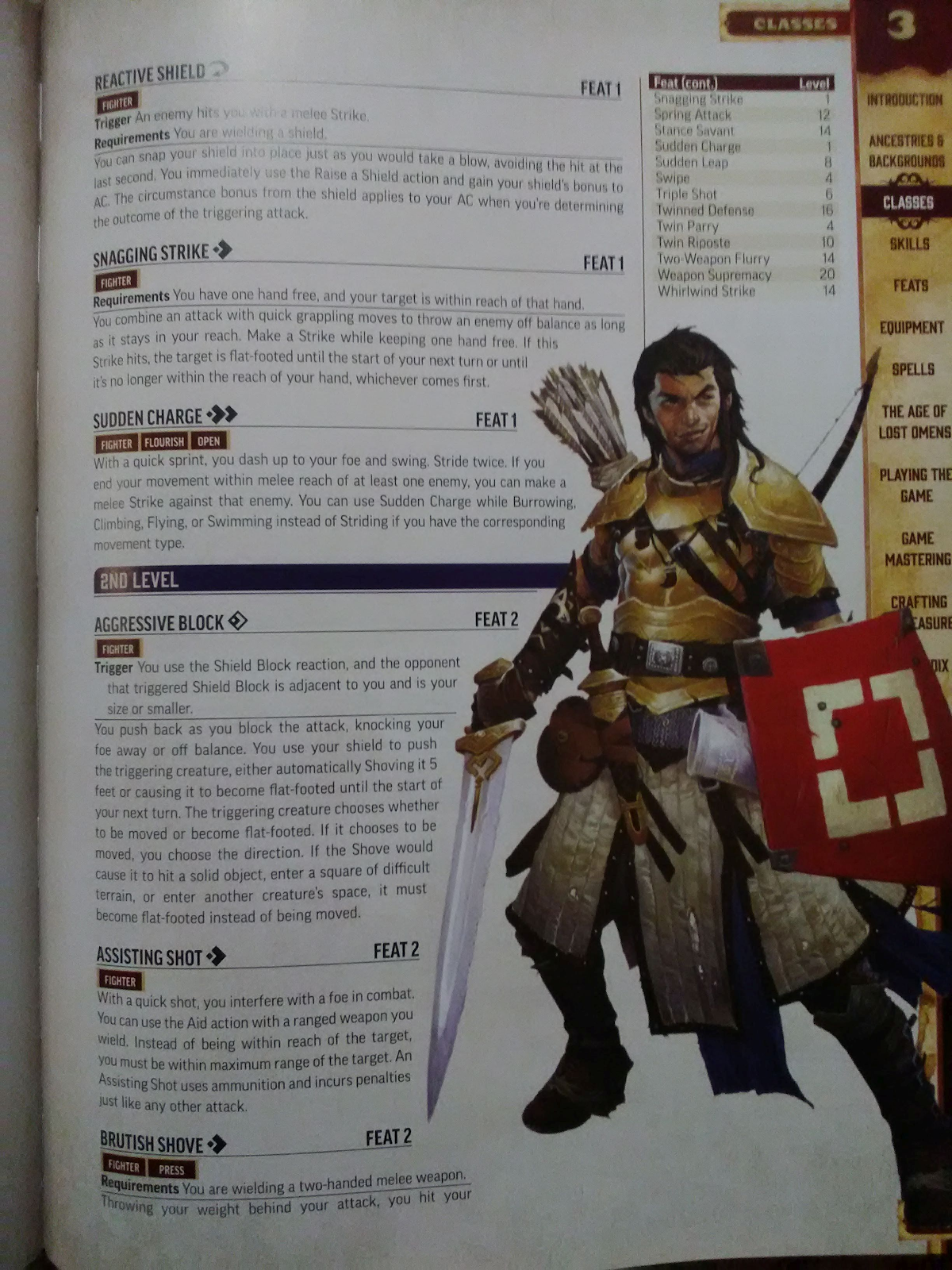
  • Reactive Shield - React when hit w-shield - auto Raise A Shield and gain the AC bonus on this attack and for rest of turn
  • Snagging Strike - have one hand free, 1 act - make a Strike, if hit target is flat-footed (-2 AC) until your next turn or it moves out of reach
  • Sudden Charge - Open, Flourish, 1 act - Stride (move up to your speed) twice and make a melee attack

    I am thinking about multi-classing this character with Cleric, but you have to be at least 2nd level to do that.  So something for the future.
    Everything I hate about 2nd edition is right in the Point-Blank Shot ability.  In 1st edition PBS was easy, you get +2 damage within 30' with a ranged weapon.  Simple.  Useful (to a degree, not accounting for HP bloat).  So did they keep it the same (ain't broke don't fix it principle) or did they improve it in 2nd?  No.  Instead we make it a hell of a lot more complicated and clutter it with weird pseudo-realism in our non-realistic high fantasy game.  The text defining the "Stance" trait says you need to take an action to activate the stance, but the ability itself says it takes an action to use - so did they duplicate the same action out of stupidity, or does it take one action to start and then another action for each shot, and is that action in place of the shot or in addition to it?  This does not have to be confusing - in point of fact it wasn't confusing before, instead 2e took something that worked and screwed it up.  And why the hell can't longbows shoot accurately within 30'?  I have shot a kid's bow in my younger days, so I'm not a professional archer, but from what I've done and people I've watched it seems that shooting closer things is easier since you don't have to account for gravity as much as with a far away target.  And why are we trying to inject some kind of realism with bow usage into a game with fireball-throwing elves?  This ain't Riddle of Steel Paizo!
    Otherwise, Double Slice seems to be okay, make two attacks but without the penalty, allright.  Exacting Strike seems stupid, it's a re-named version of the same ability I gave the original character, all it does is let you miss better.  Wow, that makes me feel special.  Power Attack is actually okay, it's like the original - a penalty to hit for extra damage - and it even levels up a little with you to stay relevant.  I'm good with that one, wish more abilities were like it.  Reactive Shield is stupid because everything we do with shields in the game is stupid.  Snagging Strike is also good, it's a simple ability that makes it easier for your friends to hit somebody, and party cooperation is a good thing.  Sudden Charge is also alright, kind of hate that you need a special ability to do it, I'd imagine I could run up to somebody and hit them with a stick, but it's not terrible.
    Since I hate the new shield rules so much, I'm thinking of making him a two-handed weapon fighter, so I'm going to take Power Attack.


Ability Scores

    According to the character creation checklist I'm now at Step 6- Determine Ability Scores.  So let's recap the ability scores so far:

Ancestry:  +2 Con, +2 Wis, free, -2 Cha
Background:  +2 Int or Wis, free
Class:  +2 Str

    I first need to decide on those "free" boosts, each is a +2 but cannot be applied twice.  Even though Dwarves are antisocial (Cha penalty) and he's lived apart from other Dwarves as a guard, I'm thinking I want him to be decent at talking to people (he likes to share the epic tales of old), so I'm putting the Ancestry free boost into Cha to offset that penalty.  I want him to Cleric later, so the Background boost is going into Wis and the free is going to Con because he's lived a spartan life of hardship as a tomb guard.  That leaves me with:

Str  12 (+1)
Dex  10 (0)
Con 14 (+2)
Int 10 (0)
Wis 12 (+1)
Cha 10 (0)

    Finally everybody gets 4 free boosts, like the others they cannot be applied to a score twice.  I'm going for Str, Con, Wis, Cha for my final attributes as:

Str  14 (+2)
Dex  10 (0)
Con  16 (+3)
Int  10 (0)
Wis  14 (+2)
Cha  12 (+1)


Odds and Ends

    Just some final numbers and things to figure out.

  • Hit Points - 10 Dwarf + 10 Fighter + 3 Con = 23
  • Bonus Languages - 0 Int mod means none (too bad, I'd like the flavor of him knowing an ancient language or something)
  • Skills - From my Dwarven Lore Ancestry feat I get: Crafting (Recall Knowledge, Repair, trained: Craft, Earn Income, Identify Alchemy), Religion (Recall Knowledge, trained: Decipher Writing, Identify Magic, Learn A Spell) which I think would cover his own and enemy pantheons and Dwarven Lore (Recall Knowledge and trained: Earn Income).  Scholar gives him Occultism (Recall Knowledge, Decipher Writing, Identify Magic, Learn A Spell - only the first untrained) and Academia Lore (Recall Knowledge and trained: Earn Income).  From Fighter I get, Acrobatics or Athletics.  Athletics is the Str one, so he can Climb, Force Open, Grapple, High Jump, Long Jump, Shove, Swim, Trip and Disarm (only the last needing to be skilled).  And he gets 3 + 0 Int bonus skills.  I'm going to take Diplomacy (Gather Information, Make an Impression, Request -no trained only actions), so I can ask people if they've seen the stolen McGuffin.  Arcana (Recall Knowledge, trained: Borrow an Arcane Spell, Decipher Writing, Identify Magic, Learn a Spell) since knowing about magic might be helpful?  Lastly Medicine (Administer first Aid, Recall Knowledge, trained: Treat Disease, Treat poison, Treat Wounds).

    I have to say that having actions anyone can do and actions only trained people can do makes sense to me, it's pretty much the definition of a skill as opposed to an attribute.  But you'd think that every skill would have trained-only actions then.  Stealth, Intimidation and Diplomacy don't.  Yet Diplomacy's actions are all personal - Gather Information, Make an Impression, Request.  Why not have Mediate (get two opposing groups to agree, which justifiably takes advanced knowledge of talking to people) or Whisper Campaign (to raise or lower the reputation of a group or person) as trained skills?


Equipment

    This is the last big step, once I get my gear I can fill out a character sheet and be good to go.  Of course I have to find a character sheet since I'm not using the backside-ugly one in the book.  One problem at a time.
    All characters get 150 SP (or 15 GP) to start, and I'm going to buy the following:

  • Scale Mail - 40sp, +3 AC, Dex Cap +2, no armor check penalty due to Str, no move penalty due to Str, Bulk 2 (3 carried), composite material
  • Greataxe - 20sp, 1d12 S dmg, 2 Bulk, 2 Hands, Axe group, Sweep (+1 cir attack against a different enemy)
  • Hatchet - 4sp, 1d6 S dmg, 0.1 Bulk, 1 Hand, Axe group, Agile (multi attack penalty -4/-8), Sweep, Thrown 10'
  • Adventurer's Pack - 7sp, 2 Bulk, contains: backpack, bedroll, 2 belt pouches, 10 pieces of chalk, flint and steel, 50 feet of rope, 2 weeks rations, soap, 5 torches, waterskin
  • Manacles, simple - 30sp, 3 DC 22 thievery checks to pick, 0 Bulk
  • Religious Text - 10sp
  • Repair Kit - 20sp, 1 Bulk

Spent - 131sp
Money: 19sp,  Bulk: 7.1, carry 7.9 w/o penalty, max 12 lift/carry


Final Thoughts

    My character's finished.  It was a lot harder process than I expected.  It is a new game, and with every new game comes the adjustment period until you get the hang of the system.  But there were also moments of screaming at the book and harassing my friends asking them to explain some baffling choices to me (which was unfair as I don't think even the designers know what they were doing).  I'm not excited to play this game, not looking forward to seeing what my character can do.  It's way too simple and way too complicated at the same time - which I'll grant is an impressive feat.
    I managed to find a fillable pdf, not from Paizo of course but at: https://queuetimes.com/fillable-character-sheet-for-pathfinder-2e/.  Big thanks to them for working it up!
    You can download Devi from my Google Drive here.


Tuesday, August 20, 2019

Pathfinder 2e - First Read-through


    So I broke down and got the new Pathfinder 2nd Edition Core Rulebook and the Monster Manual.  About $100 worth of books, though I was lucky and got a sale, on top of all the books my friends and me have purchased for the 1st Edition.  I have not yet had a chance to run it, but I want to do a few articles with my first impressions, and some character creation.

My Background With the Series

    I came to Pathfinder a little late, a few years after it came out.  I co-ran a rotating GM campaign that went from levels 1 to 12, played the Rise of the Runelords campaign all the way through (to level 18), and ran a lot of 1-shot adventures.  So I have a good amount of experience with the 1st Edition, and we have a communal pile of books that include every hardback that Paizo published, and the Ultimate Psionics because that book totally rocks.
    As for what I think about Pathfinder, I don't like it as much as I used to.  I initially liked it a lot, I thought it did a good job of building on the old Dungeons and Dragons 3.5.  And at first it was neat to see the new options in each book, but soon it started to become a lot to keep track of.  One of the turning points was when talking to a friend and one of us made the comment that, "it's more fun to make a character than to play a character."  With so many options, such intricate feat chains, it takes a lot of effort to plan out your character to be effective or take advantage of a particular mechanic - which makes actually playing them a bit of a letdown.  Worse, the proliferation of options means that the quality of those options varies wildly.  Some feats are so specific that you wonder if you'd ever use them - and others seem like things anybody should be able to do, or should be covered by a skill or part of another feat.  Which means you have to wade through a ton of options and throw out lots of them to try and find the little gold nuggets.
    Still, while it is not my favorite system (none is at the moment, I like DnD 5th overall but it has some serious problems in my opinion) I have run games for it recently, and keep up on what's happening.  When I heard about the playtest I was optimistic.  I would love a simpler, more streamlined Pathfinder.  I got the Playtest Pdf and I was not impressed.  Like with DnD 5e I think it's a great idea to have fewer abilities to keep track of (and plan for), but I also think that if you're going to have fewer abilities then they need to be broader and more generally useful so you don't feel like you're wasting anything.  Which neither DnD or the Playtest seem to agree with.  So I didn't follow all the twists and turns of the Playtest, and didn't run out to buy the new 2e book.  Still, I couldn't resist (I'm weak-willed, I'll admit it), and thus we are where we are.

What I Don't Like After Reading Over The 2e Core Rulebook

    In no particular order...

1) The layout is weird to me

    The 2e book is about the same size as the 1e book, 623 to 568 counting to just before the character sheets and index/glossary.  Now, the page count only matters to me because I'm paying for it - the bigger the book the more it costs.  So I really don't want to pay for anything useless.  Let's look at the new (left) and old (right) pages of class abilities side-by-side (and I apologize for my phone camera pics, I couldn't find a Pdf to screenshot so had to do it by hand)...

    Okay, so having the name of the ability larger is a good thing, but the space under the name for the keywords (which I'll rant about next) has a lot of wasted whitespace.  Here's another sample page, from the Fighter's class feats...


     Having artwork scattered throughout the book gives your eyes a break from all the text, but it also takes up space that could be used by the text.  The art doesn't tell you anything about the game or how to play it, so it is low-value to me as a GM.  Likewise the sidebar on every right-hand page listing the major chapters of the book is kind of useful, but it also takes up space.  This book is about $60, which is $10 more than the last book, but with the layout I feel like I've paid more for less game.

2) I am not a computer

    I mentioned the keywords above, they are on everything.  Every ancestry (race) and feat has them, take a look at some fighter feats...

    I really, really hate this.  This is computer-speak.  I, as a sentient being, know that if I am reading the list of Fighter Feats, then all of these feats belong to fighters.  I don't need you repeating it EVERY TIME.  The example above at least has some other keywords, the Concentrate, Stance and Flourish keywords do at least refer to specific rules.  It's kind of annoying to have to flip back to the page that defines those rules, but eventually they'll get memorized so that's not a big deal.
    What pisses me off is insulting my intelligence by telling me that Halflings have the keywords of "Halfling and Humanoid."  No s**t Sherlock.  It says Halfling on the box, and a Humanoid is anything human-shaped.  Maybe you might have to define humanoid in the glossary, but it is not hard to figure out.  If you want to write computer rules for your game, put them in a separate document.  One of the things I love about RPGs is the human element, so computer-speak is not welcome at all, in the slightest.  Again, I'm paying for each page, so me paying you to insult me is not cool bro.

3) People have said the book contains "everything you need to play" and that is incorrect

    NO MONSTER RULES, AT ALL.  So the 1e Core Rulebook didn't have any monster creation rules either, but it did at least have 7 pages on creating NPCs.  Not much, and I'm not saying it's praise-worthy, but at least it had something.  With this book I can only make monsters as PCs, which is more work than I want to do and I'm not sure how well it would balance in the long run.  In 2e, no monsters for you, go buy the $50 book with them (Spoiler Warning- there are no monster creation rules in there either, maybe those will be in the next $80 book).  Come on people, this is a basic thing you need to run a game.  If you're going to make one super-huge and expensive book then at least make it complete.
    I have a suggestion for where those monster rules could go - in the 25 pages of useless background.  Oh yeah, who cares about stupid rules for building monsters, what you really need is a broad and so-vague-it's-worthless setting.  Here is an image for the "Inner Sea" region, note the desert area called "Golden Road" in the middle-ish...


    Now here is the entry for the "Golden Road" country/region...

      This description is crammed into the bottom-half of the page (who needs more text or a close-up map when you can stare at the lovely picture of camels?) and is full of names that mean nothing and hints at story that boil down to "like Egypt and the Silk Road."  The little setting material here is not enough to do anything meaningful with - and totally zero value to me since I'm not paying another $100 for stuff I can write on my own (or with my players).  Even for those who do want a setting, this is not enough to start writing campaigns.

4) The art is different, but not in a good way

    This is a pretty small complaint, but I'm talking about all of my first impressions here so I'm including it.  Look at this...

     I know my phone picture is bad, but this has a kind of cartoon-y feel that is at odds with the more realistic style in the last book and elsewhere in this book.  Just a random, minor complaint.  Back to more pressing issues...

5) Who the hell designed that character sheet, and why haven't they been publicly beaten with a stick?

    This is the sample character sheet in the back of the book...

     (to mis-quote Crow T Robot) I'm a color-blind robot and even I know you don't use Burnt Umber as a background color!
   

6) I was really hoping for a lot more innovation, I'm not sure who this game is written for

    Here's a page out of the combat section...


    There's the good old grid.  Hope you don't like that artsy story-game "theater of the mind" crap.  Okay, so some out there are saying/ thinking, "well, the first edition only had a grid" and they are right.  So who is this game for?  Is it only for the people who liked the first edition? (and in that case, why would they re-spend all their money for this instead of playing the game they already like?)  Why can't it also accommodate new players and styles of play?
    Here's an easy example.  In 2e, just as in 1e, all living creatures move in exactly 5-foot increments.  And if you like that, great.  But what about this extra rule...

Gridless Combat (optional rule)
    If you don't use a grid, then divide all speeds by 5, so the standard 30' movement become a "Speed 6" value.
    When using skills, if multiple characters are racing each adds their Speed value to their Acrobatics roll.
    In combat, you can spend 1 action to move towards or away from a foe that is near you (GMs call), or 2 actions to close to melee if the foe is far away (again, ask your GM about this).  With or in place of that, you can spend one action and divide your Speed value as you see fit as a bonuses to either your AC, Attack roll or Damage roll (representing your moving for an advantageous position during the turn).


    There, simple, takes as much space as one picture and gives some options to those people who don't like playing on a grid.  So why can't Pazio do that?  Why isn't this edition trying to reach a broader audience and be better than the last?
    The funny thing about reading this rulebook is that I don't see why I would recommend this to someone who either hates or likes the first edition.  If you hate the crunch, this is still pretty crunchy and is likely not going to add anything new that your current game doesn't do.  If you liked the crunch then this is likely going to be too simple, and a lot of the new stuff you could house-rule yourself into your current game (take out the stupid rule to change all of an anchetype's abilities or none, instead pick and choose from the same level or lower - and bam, you're got almost all the extra flexibility in character creation; then simplify everything down to 1, 2 or 3 actions, maybe drop or consolidate any skills you don't like - there you have it) (ie, use the stuff in Pathfinder Unchained and some elbow grease).

7) If you're going to say that Encounters, Exploration and Downtime are the 3 major pillars of play then you should organize your rulebook around them

    This one really drives me nuts.  So the rules divide the game into those 3 phases above.  Which means the game is supposed to flow between them.  So you would think the rules would be laid out around them.  Nope.  Let's look at one phase, Downtime.  Now, the "official" Downtime section - the one with the chapter title of "Downtime Mode," is on page 481.  And just page 481, that's it.  not much to go on.  Well, those are not all the Downtime rules though.  Page 294 has the table with the Costs of Living.  Pages 236-237 have the "Earn Income" skill action and the table for how much you earn based on how well you roll.  Page 240 has the "Subsist" skill action.  Pages 244-245 have Crafting (pages 577-579 have the rules for normal and special materials).  Pages 500-502 have some more downtime rules in general.  And finally page 248 has "Treat Disease" and page 251 has "Create Forgery" and I don't know how many pages have downtime-related feats.  So that's at least 9 non-contiguous blocks of rules for what is supposed to be 1/3rd of the game.
     Who wrote this?  Who proof-read it and thought it was good?  You create a system to help guide the game, for both players and GMs, from the large background stuff to the moment-by-moment stuff and back, and you decide to cut it up and scatter it across your book instead of committing to it and build on it?  Why create it in the first place?  Again, not a computer, I know that crafting a sword and swinging a sword are two different time-frames, I don't need you to call them "Downtime" and "Encounter" - don't make up these divisions unless you want to actually use them.


What I Like After Reading Over The 2e Core Rulebook

    Okay, so the whole thing isn't bad, there is stuff I like (again, in the order it came to me)...
   

1) You Build Your Attributes Over Your Background

    Rolling for attributes is no longer the default method.  Instead all attributes start at 10.  When you pick your Ancestry (used to be called Race, I'm okay with that change too) you get a +2 bonus to 2 attributes, usually a -2 to one, and then one +2 that can't go in your boosts, but can go anywhere else.  So from your culture and your free time you built up some of your abilities.  Then you pick a Background and it gives you one boost chosen from two skills, and one more boost that can't go to the one you picked.  Again, your first job gave you some abilities.  Your Class has a key ability score that gets a boost.  And finally you have 4 more boosts, they just have to be applied to 4 different attributes.
    I really like this because your character's attributes now align with their history.  If your Wizard has an 18 Strength then it's because you've been sinking every free boost (and your character his/her free time) into developing Strength.  No more all-18s from the dice gods or rolling set after set after set trying to get the scores you want.  Love this, it will be mandatory in all games of 2e I GM.

2) Multiclassing is closer to my ideal

    I have always loved multiclass characters, but I've always hated the systems.  If I want to play a Fighter/Wizard hybrid it's because I want some of both classes - like the Fighter's Melee abilities and the Wizard's spells that enhance melee.  I don't care about Charm Person or Teleport, I'm a fighter who uses magic to be a better fighter.  But in 1e (and other systems) you have to take a whole level, getting all that Wizard stuff I don't want and diluting the character instead of enhancing it.
    Now, sadly the 2e system is not exactly at that ideal (actually I should have put some of it in the stuff I don't like, but I don't fell like editing this even more - I'll address it in another post), but it is a lot closer.  You can choose individual (mostly) abilities and combine them with fewer wasted options.

3) Things have been simplified

    Bulk is a good thing to import from Starfinder.  The 3 action system is pretty good (with some exceptions, "Raise A Shield" is a f***ing joke).  I like the Arcane, Divine, Occult, Primal divide of spells and some abilities (again, some issues with it).  Choosing an ability each level instead of a fixed class and interminable anchetypes is a good change (though as I said above, you could house rule it into 1e).


Mostly Though, It's A Mix

    From what I've read I've got a few "damn"s and a few "cool"s and a lot of "meh"s.  I don't think it's a bad game, I don't think it's a good game.  I think it's a confused game, that doesn't know who it wants to appeal to or what it wants to be good at.  I think some work and house rules could make it a lot better, I'm not sure if I would want to do that work though.  Going to keep reading it, not sure if I want to run it.


    So those are my first impressions, and I'm sure I left out a lot of stuff.  So I'm going to be making some characters and looking at the rules in more detail in the future.  Let me know in the comments if you've read or run it and what you think.


Wednesday, August 15, 2018

Pathfinder Playtest vs Pathfinder 1st - Elves

    Okay, while I have not been very encouraged from my reading of the new Pathfinder Playtest, I still can't seem to let it go.  So I thought I'd take a look at the new Elf Ancestry, and compare it to the old Elf race.  Why?  Why not?  So here we go...
    I'm going to pull this from the 1st ed Core Rulebook only.  Here is what they say about Elves:
   
Elf Racial Traits
    +2 Dexterity, +2 Intelligence, –2 Constitution: Elves are nimble, both in body and mind, but their form is frail.
    Medium: Elves are Medium creatures and have no bonuses or penalties due to their size.
    Normal Speed: Elves have a base speed of 30 feet.
    Low-Light Vision: Elves can see twice as far as humans in conditions of dim light. See Chapter 7.
    Elven Immunities: Elves are immune to magic sleep effects and get a +2 racial saving throw bonus against enchantment spells and effects.
    Elven Magic: Elves receive a +2 racial bonus on caster level checks made to overcome spell resistance. In addition, elves receive a +2 racial bonus on Spellcraft skill checks made to identify the properties of magic items.
    Keen Senses: Elves receive a +2 racial bonus on Perception skill checks.
    Weapon Familiarity: Elves are proficient with longbows (including composite longbows), longswords, rapiers, and shortbows (including composite shortbows), and treat any weapon with the word “elven” in its name as a martial weapon.
    Languages: Elves begin play speaking Common and Elven. Elves with high Intelligence scores can choose from the following: Celestial, Draconic, Gnoll, Gnome, Goblin, Orc, and Sylvan.

    Now, I'm omitting all the descriptive fluff since that will likely change in the Playtest going live.  So, what does the current playtest say about the Elves?...

Elf Ancestry
    Hit Points: 6
    Size: Medium
    Speed: 30 feet
    Ability Boosts: Dexterity, Intelligence, Free
    Ability Flaw: Constitution
    Languages: Common, Elven
    Bonus Languages: At 1st level, if your Intelligence score is 14 or higher, you can also select one of the following languages: Celestial, Draconic, Gnoll, Gnomish, Goblin, Orcish, or Sylvan.
    Traits: Elf, Humanoid
    Low-Light Vision: You can see in dim light as though it were bright light.

ANCESTRY FEATS
At 1st level, you gain one ancestry feat, and you gain an additional ancestry feat every 4 levels thereafter (at 5th, 9th, 13th, and 17th levels). As an elf, you select from among the following ancestry feats.

AGELESS PATIENCE FEAT 1
You move at a pace born from longevity that might infuriate your shorter-lived comrades but enhances your thoroughness. You can spend twice as much downtime as usual on a downtime activity to receive a +2 circumstance bonus to all checks related to that downtime activity. For more about downtime, see page 318.

ANCESTRAL LONGEVITY FEAT 1
You have accumulated a vast array of lived knowledge over your long life. During your daily preparations (see page 317), you can reflect upon your life experiences to become trained in one skill of your choice. This proficiency lasts until you prepare again. More about skills and proficiency can be found on page 142.

DEMON SKIRMISHER FEAT 1
You have served in the fight to reclaim your homeland from demons, and thus you have learned to mitigate those fiends’ strengths and amplify their weaknesses. Your attacks treat demons’ resistances as if they were 1 lower and demons’ weaknesses as if they were 1 higher. If you use the Stride action on your turn, you instead treat demons’ resistances as 2 lower and their weaknesses as 2 higher until the end of your turn.

FORLORN FEAT 1
Watching your friends age and die fills you with moroseness that girds you against harmful emotions. You gain a +1 circumstance bonus to saves against emotion effects. If you succeed at a saving throw against an emotion effect, treat it as a critical success instead.

KEEN HEARING FEAT 1 (heritage, can only select at 1st level and cannot change or gain another heritage feat)
Your ears are finely tuned to even the slightest whispers of sound. As long as you can hear normally, you can use the Seek action to sense unseen creatures in a 60-foot cone instead of a 30-foot cone. You also gain a +2 circumstance bonus to sense unseen creatures within 30 feet that you can hear with a Seek action.

NIMBLE FEAT 1
Your reflexes and lithe muscles are tightly honed. Your Speed increases by 5 feet. Additionally, when you use the Stride action, you can ignore difficult terrain in one square during that move.

OTHERWORLDLY MAGIC FEAT 1
Choose one cantrip from the arcane spell list (see page 199). You can cast this cantrip as an innate arcane spell at will. The cantrip is heightened to a spell level equal to half your level rounded up. You can learn more about spells on page 192.

UNWAVERING MIEN FEAT 1
Your mystic control and meditation allow you to resist external influences upon your consciousness. When you would be confused, frightened, or stupefied for at least 2 rounds, reduce the duration by 1 round. You still require natural sleep, but you are immune to effects
that would cause you to fall asleep. This protects only against the asleep condition, not against other forms of falling unconscious.

WEAPON ELEGANCE (ELF) FEAT 5
Prerequisites Weapon Familiarity (Elf)
You are attuned to the weapons of your elf ancestors and are particularly deadly when using them. Whenever you critically hit using a weapon of the bow or sword group, you apply the weapon’s critical specialization effect.

WEAPON FAMILIARITY (ELF) FEAT 1
You favor bows and elegant weapons. You are trained with longbows, composite longbows, longswords, rapiers, shortbows, and composite shortbows. In addition, you gain access to all uncommon elf weapons. For the purpose of proficiencies, you treat martial elf weapons as simple weapons and exotic elf weapons as martial weapons. More about weapons can be found on page 178.

So what's the same?
    Well, both get bonuses to Dex and Int, with a penalty to Con.  Medium-sized, 30' speed.  Low-light vision.
   
So what's different?
    The 1e Elves have 4 abilities at 1st level: Elven Immunities, Elven Magic, Keen Senses, and Weapon Familiarity.
    The 2e Elves get only 1 Ancestry Feat at 1st level, chosen from 9 available feats.  "Forlorn" is not quite the same bonuses as the 1e "Elven Immunities," but pretty much is plus some if you combine it with the "Unwavering Mien."  Likewise "Otherworldly Magic" is quite different from the 1e "Elven Magic."  The 2e "Keen Hearing" is more limited than the 1e "Keen Senses," since the 2e only improves hearing and not all senses.  "Weapon Familiarity" is about the same for both.  The biggest difference is that in 1e Elves have these 4 abilities at 1st level, while in 2e it takes until 13th level to have the closest comparable abilities, and at 17th level the 2e Elf gets their final Ancestry Feat.

    I kind of like a few things in the 2e Ancestries.  Speaking of the Elves specifically, the "Ancestral Longevity" is pretty cool as it lets you gain training in a skill of your choice, that you can change every day.  Kinda works for the "been there, done that" of a very long-lived race without just giving them training in everything.  Also the "Weapon Elegance" is neat as it lets you build on being trained with racial weapons, even if you weren't a fighter-type-class.
    But then some of them are weird, like "Ageless Patience" that lets you take twice as long on a downtime action to gain a bonus on the skill check.  Is that a)so useful that it deserves one of your few (and therefore precious) feats? and b)is it worth a feat and not something that anybody should be able to do?  I would say no to both of those, but apparently the designers disagree with me.
    The really weird thing to me is the timing.  Let's say you take Keen Hearing at 1st level, which you pretty much have to due to it being a heritage feat.  Then at 3rd level you take Otherwordly Magic, which gives you one cantrip that you can cast at will.  Well, if you're a Wizard then you've just gotten your 2nd level spells, so how is the racial ability anywhere near the same power of the other class feats and skill feats?  And think about the difference at 17th level, when you could gain a racial cantrip at the same time you get your 8th level spells.  All the Ancestry feats are so low-powered that they are a very small, likely insignificant, ability at the higher levels (which is when your character moves from being a skilled mortal into being a demigod).

    I like the idea of customizing your race, but I don't think making the ancestries weaker at the start to slowly and incrementally increase over time is a good idea.  Plus Pathfinder already has a system for building or customizing a race in the Advanced Race Guide that one imagines could be streamlined and re-used instead of being thrown out for a whole new system.
    By comparison here is the Elf in Dungeons and Dragons 5th Edition (again removing descriptive stuff):

Elf Traits
    Ability Score Increase. Your Dexterity score increases by 2.
    Size. Elves range from under 5 to over 6 feet tall and have slender builds. Your size is Medium.
    Speed. Your base walking speed is 30 feet.
    Darkvision. Accustomed to twilit forests and the night sky, you have superior vision in dark and dim conditions. You can see in dim light within 60 feet of you as if it were bright light, and in darkness as if it were dim light. You can’t discern color in darkness, only shades of gray.
    Keen Senses. You have proficiency in the Perception skill.
    Fey Ancestry. You have advantage on saving throws against being charmed, and magic can’t put you to sleep. Trance. Elves don’t need to sleep. Instead, they meditate deeply, remaining semiconscious, for 4 hours a day. (The Common word for such meditation is “trance.”) While meditating, you can dream after a fashion; such dreams are actually mental exercises that have become reflexive through years of practice. After resting in this way, you gain the same benefit that a human does from 8 hours of sleep.
    Languages. You can speak, read, and write Common and Elvish.

    Subrace. Ancient divides among the elven people resulted in three main subraces: high elves, wood elves, and dark elves, who are commonly called drow. Choose one of these subraces. In some worlds, these subraces are divided still further (such as the sun elves and moon elves of the Forgotten Realms), so if you wish, you can choose a narrower subrace.

High Elf
    Ability Score Increase. Your Intelligence score increases by 1.
    Elf Weapon Training. You have proficiency with the longsword, shortsword, shortbow, and longbow.
    Cantrip. You know one cantrip of your choice from the wizard spell list. Intelligence is your spellcasting ability for it.
    Extra Language. You can speak, read, and write one extra language of your choice.
   
Wood Elf
    Ability Score Increase. Your Wisdom score increases by 1.
    Elf Weapon Training. You have proficiency with the longsword, shortsword, shortbow, and longbow.
    Fleet of Foot. Your base walking speed increases to 35 feet.
    Mask of the Wild. You can attempt to hide even when you are only lightly obscured by foliage, heavy rain, falling snow, mist, and other natural phenomena.

Dark Elf
    Ability Score Increase. Your Charisma score increases by 1.
    Superior Darkvision. Your darkvision has a radius of 120 feet.
    Sunlight Sensitivity. You have disadvantage on attack rolls and on Wisdom (Perception) checks that rely on sight when you, the target of your attack, or whatever you are trying to perceive is in direct sunlight.
    Drow Magic. You know the dancing lights cantrip. When you reach 3rd level, you can cast the faerie fire spell once per day. When you reach 5th level, you can also cast the darkness spell once per day. Charisma is your spellcasting ability for these spells.
    Drow Weapon Training. You have proficiency with rapiers, shortswords, and hand crossbows.

    Overall I have to say that I like the Pathfinder 2e version the least.  Starting with fewer abilities and gaining them over a very long time, that are usually much weaker than the other abilities you'll be gaining - at 15th Level you can become Legendary in a skill, at 16th (or earlier) you can take the Legendary Skill Feat, which for Acrobatics means you can jump out of a plane and not take any damage (or orbit, it says that you take no falling damage from any height).  Then at 17th level you can gain a cantrip..... woo hoo.  Now, maybe and hopefully the finished 2e will have lots of higher-level Ancestry Feats, but even that is kind of a pain since you are constantly choosing feats at nearly every level.  Feats, feats, feats, feats, all feats all the time.  It really seems like too much customization, for something that I have a hard time understand how it works in the narrative of the game world, and doesn't seem like it's really going to define your character.  What is the reason for taking away abilities and scattering them over time?  And how are you developing your biological and cultural abilities while pursuing a career (Class)?  I don't know.  It isn't terrible, but I don't think it's better.


Tuesday, August 7, 2018

Pathfinder 2e Character - Devi Stoneson - part 2

    Okay, back again and let's finish our new Pathfinder 2e Playtest character, a Dwarf Warrior Fighter.  It has taken me way longer than I expected, even with learning a new system.  Sadly, that trend is going to continue today.  I downloaded the Paizo playtest bundle and at the back of the rulebook pdf there is a character sheet.  But I don't really want to print that out, fill it out with my sloppy handwriting (I've been told I should have been a doctor, and not for my brains), take a picture of that on my phone and post it.  So, I'm going to either write out this in a basic LibreOffice Writer doc, or bite the bullet and make my own character sheet, likely in LibreOffice Draw.  I hope that I can finish the character quickly, the character sheet part I expect to be time-consuming today.

What Have I Got Again?
    Let's recap, since I don't even remember my own character and I made him yesterday :)

Name: Devi Stoneson
Ancestry:  Dwarf [traits- dwarf, humanoid]
    Medium size, 20' speed (ignores 5' armor pnlty), Darkvision, 10 hit points
Languages: Common, Dwarf
Ancestry Feats:
    Hardy- poison resistance = 1/2 level (min 1), each successful save vs poison reduces its stage by 2 (1 if virulent), 3/2 if critical success
Background: Warrior
    Warfare Lore skill (trained)
    Quick Repair skill feat
Class: Fighter - level 1
    Key Ability- Str
    Hit Points- 10 + Con
    Perception (expert)
    Fortitude save (expert)
    Reflex save (expert)
    Will save (trained)
    Trained in 3 + Int skills
    Weapons- all simple and martial (expert), exotic (trained)
    Armor- all armor and shields (trained)
    Signature Skills- Acrobatics, Athlethics, Crafting
Class Abilities:
    Attack of Opportunity (reaction)
    Trigger: A creature within your reach uses a manipulate action or a move action, makes a ranged attack, or leaves a square during a move action it’s using.
    Make a melee Strike against the triggering creature at a –2 penalty. If the attack hits and the trigger was a manipulate action, you disrupt that action. This Strike doesn’t count toward your multiple attack penalty, and your multiple attack penalty doesn’t apply to it.
Fighter Feats:
    Furious Focus (1 action) [traits- attack, fighter, press]
    Requirements You are wielding a melee weapon without the agile trait.
    Make a Strike. The Strike gains the following failure effect.  Failure- This attack does not count toward your multiple attack penalty.
   
--okay, a side note here.  the "press" trait actually has a big effect on what this power means, and I hate that because it's listed like one tiny little keyword in this sea of verbiage.  Here's the definition of it: Press: Actions with this trait allow you to follow up earlier attacks. An action with the press trait can be used only if you are currently affected by a multiple attack penalty. Some actions with the press trait also grant an effect on a failure. Effects on a failure can be gained only if the action took a –4 multiple attack penalty or worse. The effects that are added on a failure don’t apply on a critical failure. If your press action succeeds or critically succeeds, but it deals no damage and causes no other effects (typically due to resistance), you can choose to apply the failure effect instead.  Honestly the more I read this edition the less I want to play it.  A part of me doesn't want to bother finishing this character.  But, strangely, none of the people I follow have been talking about 2e (it was Gen Con over the weekend, they may be sobering up ;) so I figured I'd throw something out there.  But this has not been a fun experience.  To me, Pathfinder 2e seems like they wanted to take everything from 1e and make it worse.  This is just stupid, what the hell does all this crap mean and how am I supposed to play it?  I never felt like I was stupid when reading a rulebook, I've been playing games for a lot years now, but while reading 2e I feel lost most of the time.  So when I read over "Furious Focus" yesterday I got the impression that it let me make multiple attacks without taking the to hit penalty for making multiple attacks.  Today, as I am reading all the details, I am not so sure.  The ability sounds easy enough, I have to be using a big-ish melee weapon (I'm assuming small-ish weapons have the 'agile' trait).  I spend an action.  I try to hit something (which I believe is the essence of "strike") and if I miss then that attempt does not increase my 'multiple attack penalty' which I'm assuming is something like the iterative attacks of 1e that had a stacking -5 after the first.  So I can try to hit it again at my full bonus.  But if I do hit, then any following attacks will be at my full bonus.  So this ability doesn't actually do something, it prevents something.  But then, reading the definition of the "press" keyword, it says that this ability cannot be used unless I'm already under the effects of taking a multiple attack, so I have to attack once, which I cannot use this power on, then I have to attack again, with the multiple attack penalty, now I can use this power, and if I miss I can attack a third time (3 action limit remember) with the same penalty of the 2rd attack instead of an even higher penalty.  That somehow doesn't really sound like a big advantage.  So this power doesn't let me make a multiple attack without penalty, it lets me make an attack with not as big of a penalty?  How is that a great thing?  With the penalty don't I have kind of bad odds to hit - so isn't saying I have bad odds instead of worse odds not really that great?
    This is why it took 6 hours to not finish making a character yesterday, this is why I don't know who this game is supposed to be written for, these convoluted writings and super-precise definitions are very hard to visualize.  So let me go hunting through the pdf and see if I can find the rules for "multiple attack" to make sure I understand this.  Having learned from the last time, I started in the Equipment section and found this (page 178):

MULTIPLE ATTACK PENALTY
    If you attack more than once on the same turn, your attacks after the first take a penalty called a multiple attack penalty. Your second attack takes a –5 penalty, and any subsequent attacks take a –10 penalty. This penalty is untyped and is cumulative with all other penalties.
    The penalty doesn’t apply to attacks you take when it isn’t your turn (such as attacks made as part of a reaction), though these attacks often have their own penalty. You can choose a weapon with the agile trait to reduce your multiple attack penalty (see page 182).


    And since "agile" has been mentioned, here's that:

Agile- The multiple attack penalty you take on the second attack each turn with this weapon is –4 instead of –5, and –8 instead of –10 on the third and subsequent attacks in the turn.

    This drives me nuts.  So I was almost right.  What this ability lets me do is make one attack at full bonus.  Then I use the ability to make a second attack, at the usual -5 to hit.  If that hits then this ability was wasted (I can't use it again because I can't make 4 attacks in one turn, the ability doesn't help the attack you're making, it helps the attack after you use it).  If I miss I can spend my 3rd and final action (assuming I'm not moving or doing anything else) to try again with the same -5 to hit.  What I hate is that this isn't an ability about doing something, it doesn't make my attack better, it just lets me do something badly a second time, maybe, or maybe it doesn't do anything at all.  Then look at "agile" - here we have a whole line of rules and an extra weapon ability to be one point less bad at multiple attacks.  Not to do anything good or useful, to be not as bad.  I totally do not understand what the designers of 2e were thinking, why they thought this was all worthwhile.  This ability does not make me a cooler, better fighter, it lets me not suck as badly.  Wow, that's something to write home about.  And it needs 19 paragraphs to tell me that I don't suck as much.  Man, DnD 5th's Advantage/Disadvantage does the same sort of thing in half the complexity.  I have not seen anything in these rules that are not either done better in 1e, or that couldn't just be house/alternate rules for 1e, or are done way better in another game.  This is the first character I have ever made that I have had no interest in playing.  But I said I was going to do this, so I'm going to finish it.
    Still, I have to honestly say, I don't like this game at all.
    So where was I...?  Oh yeah, attributes...

Attributes:
    Str  +3
    Dex  +0
    Con  +2
    Int  +0
    Wis  +2
    Cha  +2
Skills:
    Warfare Lore (trained)  +1 (=Int + lvl + 0 trained)
    Crafting (trained, signature)  +1 (=Int + lvl + 0 trained)
    Performance (trained)  +3 (=Cha + lvl + 0 trained)
    Religion (trained)  +3 (=Wis + lvl + 0 trained)
   
And I think that is almost everything.  Let me skim over the rules and see what I'm missing besides equipment...

Misc:
    Class DC: 14 (=10 + Str + Lvl)
    Hit Points: 22 [= 10 dwarf + ((10 ftr + Con) x lvl)]
    Alignment: Chaotic Good
    Melee Attacks: with simple or martial +5 hit (= Str + lvl + 1 expert) or +2 hit w/finesse (= Dex + lvl + 1 expert); exotic +4 hit (= Str + lvl + 0 trained) or +1 hit w/finesse (= Dex + lvl + 0 trained); +3 to damage
    Ranged attacks: simple or martial + 2 hit (= Dex + lvl + 1 expert), exotic +1 hit (= Dex + lvl + 0 trained); +3 damage if thrown
    Resonance Points: 3 (= Cha + lvl)
    Fortitude save: +4 (= Con + lvl + 1 expert)
    Reflex Save: +2 (= Dex + lvl + 1 expert)
    Will Save: +3 (= Wis + lvl + 0 trained)
    Hero Points: 1
    Perception: +4 (= Wis + lvl + 1 expert)

That is it for the general stuff, except for my armor class which I need to know if I'm wearing armor for.  So let's buy some stuff.  All characters get a flat 150 sp, so I'm off shopping...

Equipment:
    Chain Mail: 60sp, +4 AC (14 = 10 + Dex + armor + 0 trained), +1 TAC (11 = 10 + Dex + armor + 0 trained), +3 max Dex, -3 armor check, -5' speed (ignored as Dwarf), Bulk 2, Noisy (extra -1 to Stealth)
    Greataxe: 22sp, 1d12 Slash Dmg, Bulk 2, 2 hands to use, Axe group, Sweep (This weapon makes wide sweeping or spinning attacks,
making it easier to attack multiple enemies. When you attack with this weapon, you gain a +1 circumstance bonus to your attack roll if you already attempted an attack this turn against a creature other than the target of this attack.)
    Backpack: 1sp
    Bedroll: 1cp, Bulk 0.1
    Torch (10): 1cp, Bulk 0.1, 1 hand to use
    Flint and Steel: 5cp, 2 hands to use
    Rations (4 days): 20cp, Bulk 0.4, 1 hand to use
    Rope, hemp 50': 1sp, Bulk 1, 2 hands to use
    Waterskin: 5cp, Bulk 0.1, 1 hand to use
    cash: 63 silver, 7 copper
    Total Bulk: 5.7, Encumbered at 8 (= 5 + Str), Max Carry 13 (= 10 + Str)
   
    Thank goodness the rules told me that I needed 2 hands to use my rope and flint and steel and such, I might have thought I could just levitate them with my mind!
    That's it.  I have finished the character.  It's only taken me around 3 hours today, but I did stop to each lunch within that time.
    You know, given that there is a lack of character sheets for this game online I would normally sit down and work one up.  But as I mentioned before, I have no interest in playing this character, so I'm not going to.  In fact, I'm just going to re-print everything about him below, you can copy and paste it into a document if you want, I never want to see this guy or this game again.


Name: Devi Stoneson

Ancestry:  Dwarf [traits- dwarf, humanoid]
    Medium size, 20' speed (ignores 5' armor pnlty), Darkvision, 10 hit points

Languages: Common, Dwarf

Ancestry Feats:
    Hardy- poison resistance = 1/2 level (min 1), each successful save vs poison reduces its stage by 2 (1 if virulent), 3/2 if critical success

Background: Warrior
    Warfare Lore skill (trained)
    Quick Repair skill feat

Class: Fighter - level 1
    Key Ability- Str;  Class DC: 14 (=10 + Str + Lvl)
    Hit Points- 10 + Con

Senses:
    Perception (expert)  +4 (= Wis + lvl + 1 expert)
    Darkvision

Saving Throws:
    Fortitude save (expert) +4 (= Con + lvl + 1 expert)
    Reflex save (expert) +2 (= Dex + lvl + 1 expert)
    Will save (trained) +3 (= Wis + lvl + 0 trained)

Class Abilities:
    Attack of Opportunity (reaction)
    Trigger: A creature within your reach uses a manipulate action or a move action, makes a ranged attack, or leaves a square during a move action it’s using.
    Make a melee Strike against the triggering creature at a –2 penalty. If the attack hits and the trigger was a manipulate action, you disrupt that action. This Strike doesn’t count toward your multiple attack penalty, and your multiple attack penalty doesn’t apply to it.

Fighter Feats:
    Furious Focus (1 action) [traits- attack, fighter, press]
    Requirements You are wielding a melee weapon without the agile trait.
    (note: you must first make a Strike without this ability to trigger the multiple attack penalty, then you can use this) Make a Strike. The Strike gains the following failure effect.  Failure- This attack does not count toward your multiple attack penalty.

Attributes:
    Str  +3
    Dex  +0
    Con  +2
    Int  +0
    Wis  +2
    Cha  +2

Skills:
    Trained in 3 + Int skills
    Weapons- all simple and martial (expert), exotic (trained)
        Melee Attacks: with simple or martial +5 hit (= Str + lvl + 1 expert) or +2 hit w/finesse (= Dex + lvl + 1 expert); exotic +4 hit (= Str + lvl + 0 trained) or +1 hit w/finesse (= Dex + lvl + 0 trained); +3 to damage
        Ranged attacks: simple or martial + 2 hit (= Dex + lvl + 1 expert), exotic +1 hit (= Dex + lvl + 0 trained); +3 damage if thrown
    Armor- all armor and shields (trained)
    Signature Skills- Acrobatics, Athletics, Crafting
    --
    Warfare Lore (trained)  +1 (=Int + lvl + 0 trained)
    Crafting (trained, signature)  +1 (=Int + lvl + 0 trained)
        Quick Repair skill feat: can repair an item in 10 min instead of 1 hr at trained skill level
    Performance (trained)  +3 (=Cha + lvl + 0 trained)
    Religion (trained)  +3 (=Wis + lvl + 0 trained)

Misc:
    Alignment: Chaotic Good
    Resonance Points: 3 (= Cha + lvl)
    Hero Points: 1

Combat Stats:
    Hit Points: 22 [= 10 dwarf + ((10 ftr + Con) x lvl)]
    Greataxe: +5 hit, 1d12 + 3 Slashing damage
    Chain Mail:  AC  14,  TAC  11

Equipment:
    Chain Mail: 60sp, +4 AC (14 = 10 + Dex + armor + 0 trained), +1 TAC (11 = 10 + Dex + armor + 0 trained), +3 max Dex, -3 armor check, -5' speed (ignored as Dwarf), Bulk 2, Noisy (extra -1 to Stealth)
    Greataxe: 22sp, 1d12 Slash Dmg, Bulk 2, 2 hands to use, Axe group, Sweep (This weapon makes wide sweeping or spinning attacks, making it easier to attack multiple enemies. When you attack with this weapon, you gain a +1 circumstance bonus to your attack roll if you already attempted an attack this turn against a creature other than the target of this attack.)
    Backpack: 1sp, contains following:
        Bedroll: 1cp, Bulk 0.1
        Torch (10): 1cp, Bulk 0.1, 1 hand to use
        Flint and Steel: 5cp, 2 hands to use
        Rations (4 days): 20cp, Bulk 0.4, 1 hand to use
        Rope, hemp 50': 1sp, Bulk 1, 2 hands to use
        Waterskin: 5cp, Bulk 0.1, 1 hand to use
    cash: 63 silver, 7 copper
    Total Bulk: 5.7, Encumbered at 8 (= 5 + Str), Max Carry 13 (= 10 + Str)


Monday, August 6, 2018

Pathfinder 2e Character - Devi Stoneson - part 1

    Okay, so I'm going to make a new character for the Pathfinder 2nd Edition playtest, want to come along for the ride?

Character Concept
    I want to do something different for me.  I don't play Dwarf characters very much, so let's make a Dwarf.  I'm going to start with Fighter, but I like the idea that he's going to "multiclass" (2e is not the same with that term) with Cleric later.  I don't have a lot of specific details, so from that general base let's see what we can come up with.
    In the predominately Lawful Dwarven society the Chaotic Good Devi never fit in like a proper Dwarf.  Always curious about the outside world, after Devi spent some time in the military he then left his home to see the world.

Ancestry
    So step one is to start with the character's Ancestry, what was called 'race' in the previous edition.  As a Dwarf Devi has a few modifiers.
    Attributes: he gets a boost to Con, Wis and a free one I can choose.  I already know where I want to put it, Cha.  He also gets one flaw, in Cha, which is why I want to put the boost there to off-set that a little.
    Random stuff: so Dwarves are Med sized, with a 20' speed (and they ignore 5' of armor penalty to that).  And they have Darkvision, and start with 10 HP.
    Lastly I get to pick 1 Ancestry feat, so let me look over the list and see what I like.  I can't say any of them jump out at me, I'm going to go with "Hardy" - Your blood runs hearty and strong, and you can shake off toxins that would lay others low. You gain poison resistance equal to half your level (minimum 1), and each of your successful saving throws against an ongoing poison reduces its stage by 2, or 1 for a virulent poison. Each critical success against an ongoing poison reduces its stage by 3, or 2 for a virulent poison.
    And that's it.

Background
    Like DnD5e characters have a Background.  However, in the playtest there are not any real role-playing details or tables, in fact they are very, very sparse (I hope that will be fixed later).  Again nothing leaps to mind (given that I don't have much of a concept) but I this one works (I was going to say his class covered his military background, but I'll make it his background too), here's the full text:

Warrior
    As a warrior in a tribe or a member of a militia or army, you waded into battle in your younger days. You might have wanted to break out from the regimented structure of these forces, or could have always been as independent a warrior as you are now.
    Choose two ability boosts. One must be to Strength or Constitution, and one is a free ability boost.
    You gain the Quick Repair skill feat, and you’re trained in the Warfare Lore skill.


    I'm putting my attribute boosts in Str and Con (w/the free).  "Warfare Lore" is a new skill in 2e.  Lore is a general skill that basically combines the old Knowledge and Profession skills into one.  You have to pick a scope or specialization, and one thing I'm not fond of is that I can't find any guidelines on what kind of scope these skills should have.  Like, "Warfare" seems strange to me.  I would have expected the old "Soldier" from 1e, that I know how to be a soldier in a military.  Warfare sounds like it would include that, and perhaps strategy and tactics, maybe something about logistics, possibly how to form a phalanx or use a siege engine.  I think I know what this skill can be used for, but it's broad and vague enough that I'm not 100% sure what all I'd use this skill for (90-95% sure).  This isn't a problem, but at least the old Knowledge skills had a few types, and Profession skills were described by the job being done, but Lore seems to be in a slightly fuzzier in-between space.  Again, hopefully they will give some guidelines for defining and using these skills as the playtest develops.
    This is the feat:

Quick Repair
    Prerequisites- trained in Crafting
    You take only 10 minutes to Repair an item, rather than 1 hour. If you’re an expert, it takes 5 minutes; if you’re a master, it takes 1 minute; and if you’re legendary, it takes 3 rounds.


    This is a very weird thing that happens in a couple of places.  So I get this feat from my Background, but this feat requires me to be trained in the Crafting skill, but I didn't get that skill, I got the Warfare Lore skill instead?  Um.... Again I hope this gets fixed, either by granting the required skill or by choosing Backgrounds after Class so you at least have to take the skill as a preq for the Background.  I don't know, getting 2 skills, 1 Lore and 1 required for the feat sounds best to me.
    Also, I wish they had kept the Background style of Starfinder (one of the few things I liked from that game).  There you also choose a Background, but as you level up you gain additional abilities/benefits from that Background.  I like that because instead of being a footnote in your character's backstory it makes a Background something you do alongside your Class.  I also think that since your Class gives you most all of your Adventuring abilities then your Background should give you most of your Downtime abilities.  That would make both choices meaningful, and part of your character's development.
    Anyways, aside from my ramblings, this is everything for the Background.

Class
    Okay, so that leaves choosing our class, and then we'll have all the pieces in place and just a few more decisions to make to finish the character.  I'm going with Fighter.  So what does that give me?
    Key Ability: Str or Dex.  Okay, so every class has a key ability score, in 1e it was usually buried in the text somewhere, here it is explicitly stated (a change I highly approve of).  This is the score that's going to be used to create all the save DCs for your class abilities.  I'm going with Str because I plan on being a heavy armor fighter.  I like that you can choose.  Also, I get a free ability boost in that attribute.
   Hit Point: 10 + Con.  So I'm going to add these to the ones from my Ancestry to get my starting.  I like how it's a fixed number instead of a die, I honestly hate rolling hit points (they do determine weather you live or die, so trusting them to the Dice Gods seems crazy).
    Proficiencies: so instead of spending points individually in skills, now you are either trained in the skill or not.  There are different levels of training from least to greatest: Trained, Expert, Master, Legendary.  I'm okay with this, in Pathfinder 1e if you didn't increase a skill every level then by the time you got to the higher levels you had little to no chance of hitting the DCs needed.  So this should help keep skills relevant.  So, there are a coupe of things Fighters get trained in.
    Perception: I've got Expert training in perception.  Cool.
    Saving Throws: Expert in Fortitude and Reflex, Trained in Will.  Being "trained" in a saving throw feels weird, but okay.
    Skills: Trained in 3 + Int that can be chosen by the player.  So I can pick a few skills.  I'll go over those near the end.
    Weapons: Expert in all simple and martial weapons, Trained in all exotic weapons.  Like 1e fighters I know how to use everything.  The "Expert" means I get another +1, so it's kind of like getting Weapon Focus in a bunch of weapons for free.
    Armor: Trained in all armor and shields.
    Signature Skills: Acrobatics, Athletics and Crafting.  Okay, so a "signature skill" can be maxed out to Legendary over time, but all others skills are usually capped at Expert.  I get Acrobatics for Dex fighters, but that feels a little weird given that I choose to be a Str fighter.  Oh well, not a big.  Crafting also seems a little weird, just how many soldiers or warriors have you read in stories that made their own weapons?  Again, not a big deal, but I kind of wish they had the old 'class skills' list, but that this time I could choose the ones I wanted to be signature.
    There are some sections on playing and role-playing a fighter that I like.  I think they're a bit better than the 1e class descriptions.
    So lastly, what abilities do I get as a new fighter?  Well, there are 2.  One is that I get a bonus fighter feat at 1st level, and then every even level after that (which is the default for most classes).  The other is that I get the ability to make opportunity attacks.

Attack of Opportunity (reaction)
    Trigger- A creature within your reach uses a manipulate action or a move action, makes a ranged attack, or leaves a square during a move action it’s using.
    Make a melee Strike against the triggering creature at a –2 penalty. If the attack hits and the trigger was a manipulate action, you disrupt that action. This Strike doesn’t count toward your multiple attack penalty, and your multiple attack penalty doesn’t apply to it.


    I like this a lot.  I like that Fighters are the only ones who do AOOs, because quite frankly keeping track of that stuff for everybody was a pain in the neck.  Not to mention that getting a free attack on someone is a big deal at low levels where you might die from a hit or two, but at higher levels it isn't going to kill you and doesn't disrupt what you intended to do unless the attacker had some special ability.  So I am a big fan of getting rid of it and making it a cool thing that fighters can do.  Now, everyone gets 3 Actions they can take during their turn, and 1 Reaction they can take on their turn or another character's turn.  So you can only do this once.  I will say that I wished this levels up, like at 5th level if the AOO hits and the target was moving you stop their movement, and at 10th level if the target was casting you stop their casting.  I've mentioned elsewhere how I think that if you're going to give everyone fewer abilities then those abilities should be broadly useful or flexible somehow and grow over time.  This is pretty flexible since it has several triggering conditions, but the only way to enhance it is to take a feat, and you only get 10 of those over your entire career (and many of them are things that used to be free/core abilities in 1e).  So I hope they will look at how they define these abilities as the playtest unfolds.
    Alright, so the last thing to finish my class is to choose my bonus class feat.  Let me look over the list and see what we've got.  There are 7 total available at 1st level, a decently-sized list.  They all seem to create a fighting style (like 1h and shield, ranged, 2h) and at level 2 on you can take feats that will expand on that style.  But some of the abilities are a little confusing.  Take this one...

Reactive Shield (reaction)
    Trigger- An enemy succeeds or critically succeeds against you with a melee Strike.
    You use the Raise a Shield action and gain your shield’s bonuses to AC immediately. The circumstance bonus from the shield applies to your AC when you’re determining the outcome of the triggering attack.


    WOAH!!!! Wait, what, hang on a minute...?  Okay, the last few days of reading over the playtest rules have been giving me migraines and this is a great example of why.  I do not understand what this game is supposed to be.  Is it supposed to be a simpler version of the 1e rules for people who liked that edition but thought it was too big/complicated?  Is it supposed to be the new Pathfinder for the Dungeons and Dragons 5e crowd?  Because if the goal at all involved simplifying the game, they sure made a super complicated "simple" game!
    So, being confused about taking an action to use a shield, something very different from 1e, in fact very different from any RPG I can think of, I naturally tried to find the rules.  The playtest has a chapter on "Playing the Game" and a section for "Actions and Activities" starting on page 296, which says noting about specific actions, just talks abut them in general.  Okay, so next logical place is in the equipment tables, and there on page 177 it says...

Shields
    A shield requires the use of one of your hands. It grants its bonuses to AC and TAC only if you use an action to Raise a Shield. This grants the shield’s bonuses to AC and TAC as a circumstance bonus until your next turn starts. The shield’s check penalty applies whenever you’re wielding the shield, regardless of whether the shield is raised.
    While you have a shield raised, you can use the Shield Block reaction to reduce damage you take by the shield’s Hardness (3 for wooden shields or 5 for steel).


    Umm.... so let me see if I have this right.  I have a shield.  I get no bonus to my AC for holding it.  I have to take an action to "raise" it and get the AC bonus.  But only until the start of my next turn.  So out of the 3 actions I get, I have to spend one of them every turn just keeping my shield up.  So I really only have 2 actions.  And I have to do that as a Fighter as well, same as a Wizard, unless I spend one of my Fighter Feats to get the "free shield raise" ability above.  But, if I take the feat to rise my shield using my reaction, then I cannot use my reaction to use my fighter ability to make an Attack of Opportunity or get the DR against one attack that a shield also provides (and so shields are now both sources of AC and DR, thank god they simplified the game :)
    This baffles me.  So many parts of 2e have this same kind of deep precision and mechanical complexity (sure, having 3 actions and 1 reactions sounds simple, until you start reading about all the conditions apply to each type of action and have to juggle that one react against all the possible reactions you might end up with) that I did not expect at all.  I mean, I know that Pathfinder 1e is pretty darn complicated, but these 2e rules do not feel as if the designers wanted to simplify the game, it feels like they took some scissors and cut out parts of the game then duct taped the remaining bits into a new kind of Frankenstein's monster.
    Alright, so enough of this.   I have to pick a fighter feat.  I'm going to go with Furious Focus that sounds like it lets me make multiple attacks without taking a big penalty to hit.  I'm not even going to read the rules on multiple attacks right now because I suddenly find I have a headache, I'm going to hope this does what I think it does.  I kind of see Devi as an "the best defense is a good offense" kind of guy, so I think this will fit my character.

    With that I've finished all the core decisions of Ancestry, Background and Class.  Now there just remain some bits and pieces to make a final character.

Attributes
    Okay, so I'm using the default system of building my attributes through the boosts I've taken.  That means all my attributes will start at 10 as default and get a +2 for every boost.  Now, there is an optional rule to roll attributes, but I don't like that.  I kind of said it in an a-hole way in my last post, which a commenter rightly called me out on, so let me give the rational reason instead of "I'm feeling very grumpy right now" reason.  The thing with attributes is, either everyone picks or spends points somehow to keep each character balanced against each other (in general), or everyone rolls and balance is not an issue.  But those are two mutually exclusive things.  Way back in the days of DnD 1e it was roll 3d6 in order and play that character.  Which a lot of people started to house rule into roll 3d6 but put them where you want them.  And that eventually got house ruled into what most similar games made the default rule to roll 4d6, drop the lowest, and put them in order.  Alongside that, the idea of having points to distribute or a point buy chart (with higher scores costing more points proportionally).  So over the years that I've been a player attributes have had a ridiculous number of systems applied to them.  Why?  What benefit do we really get by having 99 ways to find our attribute scores?
    And, if one group is balanced with points/picks they will never be balanced (except by the intervention of the Dice Gods) with people who roll, by whatever method, so the end result is being not balanced in which case why make a rule designed to bring balance that doesn't?  It's just become way more words spent defining the rules than the benefit we get.  So I would love to see a game that just has one way, and only one way.  My personal preference is to do a point/pick method, I like balance (in general) even admitting it's quite the chimera to chase, but if the rule was roll that would be fine too.  I just think trying to do both is silly, you cannot be both balanced and unbalanced at the same time, you have to commit to being one or the other.  So either the game designers, IMHO, should say 'we value balance so pick,' or they should say 'we value randomness and discovery so roll,' but both is trying to have your fork-full of cake and let someone else eat it too.
    Anyways, so I'm going to use the boost system.  I also have not seen anywhere that needs to know my score, so I'm only going to list my modifier (and it's easier to find a score form a modifier than it is to find a modifier from a score).  So I start with a 0 in everything.  I have one penalty, -1 Cha from my ancestry.  I have +1 Str, Con, Cha from the same leaving me at +1 Str/Con.  Next my background gives me a +1 Str/Con, for a +2 in each.  Lastly as a Str-based Fighter I get another +1 Str.  And that ends my general choices.  Now, I have a +4 to distribute across all my attributes.  I think I'm going to spend them so I end with...

Str +3  Con +2  Wis +2  Cha +2

   The Wis and Cha might seem a little strange for a dwarf fighter, but I have an idea that I might want to later take on some Cleric abilities.  There is no multiclassing as in 1e.  I am a Fighter only, ever.  But, what I can do is use one of my class feats (and/or general feats, I have to double-check) to take a "Cleric Foundation" feat that will let me cast spells like a cleric.  Then I can take more feats to gain more cleric abilities, at the expense of course of losing the fighter feats I could have chosen.  But I kind of like the idea of him following the god/goddess of honesty and/or order, and so he becomes a cleric after seeing the lies and chaos of most other races.  That sounds like it might be an interesting way to develop the character, and let me see how the new multiclassing/archetype system works.
    So those are my attributes.

Skills
    The next big thing is to pick my skills.  Since they are effected by your attributes I've waited until those were finished.  So my 0 mod in Int means I get only the default 3 skills, but Acrobatics, Athletics and Crafting can all be increased the highest, and my Background did give me the feat that applies to Crafting, so that's going to be my first choice.  I have no Dex for Acrobatics, and I don't really feel a lot of love for Athletics, so what other skills are there?  Well, the list is about half the size of 1e, the new skills are...

Acrobatics
Arcana
Athletics
Crafting
Deception
Diplomacy
Intimidation
Lore
Medicine
Nature
Occultism
Performance
Religion
Society
Stealth
Survival
Thievery

    Hmmm.... since I want to go cleric later, I guess Religion might work.  Athletics does let you disarm people, there is no CMB/CMD like in 1e, it appears to be tied to skills now.  Intimidation seems like a good fit for a dwarf with charisma.  I never read the Occult Adventures book from 1e so I'm not sure how that's different from divine or arcane magic.  Weirdly, Performance kind of sounds like fun, if I liked to tell stories from the old days or something.
    Okay, bear with me as I drag out the soapbox.  Again, what is the purpose of this edition?  If it is meant in any way to be simpler than the 1st, this sidebar about Performance used in downtime (pg 157) doesn't seem like it...

    Lem is a 16th-level bard and legendary with his flute. He has a Performance bonus of +30 with his enchanted flute. With 30 days of downtime ahead of him, Lem wonders if he can find something that might excite him more than performing in front of a bunch of stuffy nobles. He decides to spend 7 days of downtime researching to see if he can find a more prestigious audience, and the GM decides that he finds a momentous offer indeed—a performance in a celestial realm, and Lem’s patron goddess Shelyn might even be in attendance! This is a 20th-level task, requiring Lem to spend 8 of his remaining 23 days for preparation and setup (since the task is 4 levels higher than him), but Lem accepts it in a heartbeat. The GM secretly sets the DC at 38.
    Lem rolls an 11 on his Performance check for a result of 41. Success! Performances continue for 7 more days, and at the end, the grateful celestials present Lem with a beautiful living diamond rose in constant bloom worth 16,000 silver pieces (2,000 silver pieces per day for 8 days).
    With 8 days of downtime left, Lem also accepts a 14th-level task performing at a prestigious bardic college for members of a royal court, which requires only 2 days of setup (since it’s 2 levels below Lem’s level). The GM secretly sets the DC at 30, and Lem critically succeeds, earning 350 silver pieces per day for 7 days, for a total of 2,450 silver pieces. Between the two performances, Lem earned nearly 20,000 silver pieces during his downtime, though he’s not sure if he’ll ever sell that rose.

   
    Wow.  So during downtime I have to count every single day of everything I do and total each day's earnings.  Yeah, the 1e crafting system had a thing about each individual day's progress - but that's my point.  If the first edition is just as complicated as the second edition, then what exactly is the purpose of the second edition?  If they wanted to make 2e simpler, more for the DnD 5e crown, then why not at least consolidate actions into weeks?  Something?  Again I wonder at what they edition wants to do.  Sure, the above makes for a cute little story, but it's the same kind of story that could be told in 1e.
     Oh hell, after that I think I am going to take Performance as my last skill, maybe I'll play for the gods too someday :)  In which case I might need that Religion.  So my 3 skills are going to be Crafting, Performance and Religion along with the Warfare Lore.


    Okay, I literally started this post 6 hours ago.  Now, I have been talking to a friend and there were some fun unexpected surprises this morning, but I've been at this for way too long.  I am going to stop here, and there will be a follow-up post that finished making the character tomorrow.