I have rarely run games from a module and I don't like reading most setting books.
This could be a problem now that I'm writing a setting of my own :)
I've always liked creating my own worlds. Once I started playing RPGs I discovered I also like tearing apart games and seeing how they work. I've mostly been the improv guy. You know the one, the guy you turn to when everyone wants to play but nobody knows what. I can't count how many adventures I've created while my players were creating characters. And I've got boxes of notebooks of game ideas and house rules. Most modules never really interested me. Most settings for that matter. Honestly I can only think of a few games where I've liked reading the setting material: Shadowrun, Exaulted and Earthdawn. I can remember reading all of those books and seeing story potential in my head, little bits and pieces that inspired me with adventure and campaign ideas. I loved Shadowrun for it's density in brevity- the rulebooks (3rd/ 4th ed I think, I haven't read the latest) had great section at the beginning that introduced the world just right. These sections were detailed, but not too detailed, they hit a sweet spot of saying a lot in the fewest words. Exaulted I read several books about, each major faction had it's own book - and I loved all the different kinds of stories they presented. With a neat fantasy-inspired-by-anime setting I could see so many different campaigns that you could run out of the same world. Earthdawn was like Shadowrun (maybe 'cause they were by the same company) in saying a lot with little, but I also love how they created their own magic system, and presented it in fantastic detail. But the best RPG book I've ever read was an Earthdawn supplement, The Adept's Way. This was basically a class guide, each chapter was one class from the game. The magic of it (to me at least) was how it was written as if one of the characters was talking to the player. It was like a member of this class was telling you how to play that class. I loved that style, how it drew you right into the world and the shoes of a member of your class. I have never read another book that did that, and I'm sad because I thought it was the best style of writing a player's guide.
The biggest problem I've had with setting books/ material is usability. The World of Darkness books used to have a short story at the beginning of each chapter. And that's cool and all, but what am I supposed to do with it? If the story isn't in the same style as the adventures I'm running, then it's not really helpful. Same with the story as a tool of building the setting, if I am making the same sort of campaign as your story then cool, but if not then I don't really get anything out of that story. On the flip side, a breakdown of the percentage of every race living in a city is the kind of detail that makes my eyes glaze over. Again, when I create the census campaign (in a fit of madness) then I might care about such minutia, but in the game all I need to know is if one race is dominate or if there is a good mix of races. And are any races in conflict? Knowing there are 80% Dwarves and 20% Elves is kind of useless ("mostly Dwarves" would have said the same thing without the scary math) (I'm easily scared) - but knowing that the Dwarves drove the Elves out of the community several generations ago and recently the Elves have tried to re-open ties to heal the old feuds; that's useful. Now I know that this town is a good place to set a story of racial tension.
That's the thing about a setting, I'm not reading it for my own entertainment, I'm reading it to figure out where to put my players for the story I want to tell. Or, I'm reading it to figure out what kinds of stories I can tell. I don't want the game material to entertain me, because of Paranoia. I love the Paranoia RPG, more than I have words for - I think I ran it once. I don't love it to play it, I love it to read the books and adventures. This is a hilarious game, reading anything for the system (the old 2nd ed at least) was like reading a comedy novel. I don't really care if I ever run it for actual players, because reading it was likely more entertaining than the players would ever be. It's a terrible system because it's so much fun to read the books that actually running the game is a bit of a let-down.
Okay, so I have a wee bit o' problem with writing my own game world given that I don't really like reading them. This is going to be a tricky situation. So what kind of guide do I want to write? What is this setting for? Well, I want this setting to be a tool, not a straitjacket. I want to create a world, of course, but I also want to leave enough wiggle room to let each GM customize the setting to their group. The kinds of stories I like are not going to be liked by everybody. So I want to make something, well no, I want to make a core for storytelling. I want to make the skeleton of a world, and help the GM with deciding where to build off of and change the world to fit their own group. Most setting material I've read is like a story, it's there telling it's own tale. I think instead I want to write 2 books, or two types of books, the GM books and the PC books. Both are going to have the same style, talking directly to the audience, but there are going to talk in the same way as the group they're written for. Argh... let me try to clarify what I'm thinking. As a GM I don't want a collection of stories and statistics. Their stories are not my stories, so they don't help. The statistics are minutia, tiny details that don't matter without a story in the first place. So for my GM books I am going to write GM to GM. I'm going to write as me, The d100 Mechanic and creator of this setting, and I'm going to talk directly to the GMs out there about how the setting is structured and what they can do with it. But for the PC books, I'm going to write like The Adept's Way, I'm going to talk to the PCs as if I was a member of this setting, teaching or telling them about the world. Because while the GM needs the Lego-pieces of the world to create, the PCs need to be able to put themselves in the world and feel it as if they lived there. So I think I need two different styles of writing, because I think both groups have different needs.
Which brings up another problem, the minutia. I started the crazy idea of writing my own setting because I wanted to work on my own game - and I think every game needs a setting. But while I'm currently working on something based off the 5e SRD, I don't want to lock my setting into that rule-set. So when it comes to the details things are going to get difficult. I may need a third set of books with specific numbers for each of the games I want this to be compatible with.
Okay, so that's the groundwork of what I'm thinking, the way I'm looking at writing this setting. Now comes the big question- does this sound good to any of you? I think this sort of layout would be useful, but does anyone else? I know it's hard to form an opinion off such vague musings, and I'm working on actually writing something, but just from first impressions does it sound good? Of is there another style you'd prefer? Let me know in the comments below, please!

Role-Playing Games, Interactive Narratives, plus anything science-fiction or fantasy
Showing posts with label Elemental Empire. Show all posts
Showing posts with label Elemental Empire. Show all posts
Wednesday, January 3, 2018

Wednesday, December 27, 2017
The Elemental Empire - part 6 - Technology and Fantasy
I talked before about the role of magic in the setting I'm building, and how it differed from technology. Let me revisit and expand on that by looking at the flip-side, what is technology?
Of course, I've got an answer for this too - if magic is the invisible emotions of a single individual made real, technology is the invisible foundations of the real lives of the individuals. Let me illustrate, while watching too much Crash Course World History it struck me about the "agricultural revolution" when people went from hunter/ gatherers to farmers (hi Wikipedia). A couple of thousand years later and we get the Industrial Revolution (why, hello again Wikipedia). And I love this last Wikipedia page because it has the quote that sums up all of technology for me: "The Industrial Revolution marks a major turning point in history; almost every aspect of daily life was influenced in some way." Oh ho, there it is, technology is that thing that influences daily life.
We humans are tool users. We didn't get a lot of innate abilities. We don't have wings or claws, fur or feathers, we don't have a lot of physical advantages when compared to all the other animals out there. We do have really big brains though, and we like to mess around with our environment. We use stuff. The old Star Frontiers game had a great quote about "Mr. Human and his indestructible junk show." (wow, I totally remembered it accurately too, page 7 of the Alpha Dawn Expanded book) That's us all right, we use stuff - but given that our lives are not based on our natural abilities but rather on using tools, then it seems to be that when we change our tools we change our lives.
Now, back in the day ovens were big and pretty hard to make. So (if I'm remembering my limited history knowledge right) some villages would have one big oven that everybody would use. A communal resource. But now ovens are much, much smaller, and everybody has their own. So cooking stopped being a communal resource and became a private resource. But, we still have communal ovens, we just call them restaurants. But, at the restaurant somebody else does the cooking for you, you don't have to know how to do it yourself, and so we get the people who rely on restaurants and have no idea about how to boil water. Technology changes society, and that changes people's lives. I have no idea about how to raise a cow or butcher it (I do at least know how to cook it), something that a less technologically developed person would have to know to survive.
This is also one of my pet peevs about Star Trek. In the Star Trek universe there are replicators that can create anything at will, holodecks that can simulate any reality, and characters make comments like "we don't use money anymore." Okay, it's the far future, so sure, I'll buy that. But wait a minute, with such reality altering technology at one's fingertips let me ask you a question: how many characters on Star Trek have tattoos? Yeah, not many, like 2 maybe 3. How many people on Star Trek have hair that is not a natural color? Again not many, if any actually. Why do I point out such mundane things after talking about super science? Well, do you honestly think in a future where anything can be created or imagined that everybody would look like a white middle-age middle-class convention? There is a Star Trek: The Next Generation episode where one of the characters creates a holodeck fantasy involving the other crew-members. I don't remember the details now, but what I do remember is thinking: this would totally be everybody's problem. If you could create your own physical, interactive reality at will - who the hell would stay in the real world? Jeez, even today we have the stereotypical kid in Mom's basement playing video games; how many thousands of times worse would it be in a fully-immersive VR world like the holodeck? That's what I hate about Star Trek, why I've lost my childhood love for it over the years: it presents all these super-technological advances and then acts like humanity and society would look like they do in our modern world. Hell no. Granted, the Enterprise is a military ship (spare me the science crap, they all wear uniforms), but the ship does have some civilians and they should be very flamboyant or exotic or incomprehensible by today's standards. (as a side note, I don't have the same problem with Star Wars because it is a fantasy with updated graphics, but I do hate Star Wars for the fact that it sucks at presenting magic as bad as Star Trek sucks at presenting technology)
As humans, without natural abilities we build our lives around tools, and when tools change (ie, technology develops) our lives and society changes as well.
Which then raises some big questions about how to handle technology in a fantasy RPG setting, and how that interacts with magic - because people with magic do have natural advantages and so would they even look at technology the same way? Hmmm.... that's a good question given my Humins all are innately magical and the other races all have some kinds of abilities (since I'm basing them off the standard fantasy races, and they always do something more than humans naturally). Magic seems like it would be the main force for society, which actually works since it explains why the setting has such low technology, why this is a medieval-based world, it never needed to rely on tools as much, it has relied on it's magic users instead and thus stayed smaller and less developed.
The big question though, the one that I hate to even contemplate but have to because somebody out there will want it, is guns.
Damn you Pathfinder for Ultimate Combat and guns. Not that it started with you, shoot there was the ancient original D&D module that had lasers if I remember right, but Pathfinder was the first mainstream fantasy setting to include guns. The problem with guns is that they changed everything. They totally revolutionized combat, making the armor and swords and bows that most RPGs are build on obsolete pretty quickly. So you just introduced the thing that is going to kill off most of your equipment tables. Why the hell would you throw a shuriken when you could shoot someone? But bigger than that, I hate the game for throwing in guns as if they were no big deal. Again, society and technology are linked, you can't change one without a change in the other. Guns do not grow on trees, they had to be developed, experimented, crafted. You need to harvest all the components for gunpowder, you need to shape the metal for the guns themselves. They are pretty big undertakings, not something that just anybody would be walking around with (and yes, granted you can say the same for plate armor and the like, RPGs are not good about modeling the scarcity of things (since we have to let every player do all the cool stuff)). And they are a major cultural shift. Running at the wizard with a sword is crazy-talk; but shooting him dead while he's babbling, oh hell yes! With a gun anybody can be a wizard, with a gun anybody can do super-human things. Do you think wizards would like that? Do you think kings would?
The gods heal right, not wizards (they can't do that healing thing they just kill everybody) (so are the gods blocking healing magic from wizards? that's the only thing that makes sense), but the gods can heal. So how are the gods going to react to modern surgical methods that heal people and save lives, CPR that brings back the dead, and when people no longer need to turn to them for healing? Will they be happy? Mad? Destroy the world?
Okay, so I've rambled for a while. And honestly, I don't have a lot of hard thoughts right now. I'm going over the factors in my brain, thinking about how magic and technology are going to react to each other. And more, the opportunities both offer for storytelling. I just finished reading David Weber's amazing Safehold series a few months back. It's an awesome story about far future technological humans who meet an alien species that wipes out all other species once they reach a certain level of development. The humans fight and lose, so they hide away enough colonists to populate one world, Safehold, and create a religion that prohibits technological development - that way, this last remnant of humanity will not also be wiped out down the road. But some of the settlers disagreed with that plan, they wanted to lay low and start over, but they also believed it would be possible to defeat the aliens if humans re-developed technology while knowing what they would someday face. So the books start with a church-controlled world of limited technology, and over the series we see technological developments introduced and how society is radically changed as a result. And some people take to that change, some hate it, but there is a lot of drama and compelling stories since the fate of the world is at stake. Not in a stupid superhero "big beam in the sky" way, but a really interesting "what world are these changes going to make for the future" way. I don't really want to set up this setting to tell the story of how technology changes the world - but at the same time I would be happy to leave some bits in that a GM and players who wanted to tell that story could use.
I'm going to end this rant here, since it segues well into what I want to explore next: what is a setting good for? What kind of a tool is it? Or, even better to say - what kind of a tool am I trying to build for GMs? I'll go over that next.
The details are slowly being expanded too, I'm actually getting close to writing some real story and not just all this theoretical stuff. That writing and revising is a part of what's been slowing down my posting, sorry about that. I am working on some material though and it will be out as soon as it's ready. Until next week!
Of course, I've got an answer for this too - if magic is the invisible emotions of a single individual made real, technology is the invisible foundations of the real lives of the individuals. Let me illustrate, while watching too much Crash Course World History it struck me about the "agricultural revolution" when people went from hunter/ gatherers to farmers (hi Wikipedia). A couple of thousand years later and we get the Industrial Revolution (why, hello again Wikipedia). And I love this last Wikipedia page because it has the quote that sums up all of technology for me: "The Industrial Revolution marks a major turning point in history; almost every aspect of daily life was influenced in some way." Oh ho, there it is, technology is that thing that influences daily life.
We humans are tool users. We didn't get a lot of innate abilities. We don't have wings or claws, fur or feathers, we don't have a lot of physical advantages when compared to all the other animals out there. We do have really big brains though, and we like to mess around with our environment. We use stuff. The old Star Frontiers game had a great quote about "Mr. Human and his indestructible junk show." (wow, I totally remembered it accurately too, page 7 of the Alpha Dawn Expanded book) That's us all right, we use stuff - but given that our lives are not based on our natural abilities but rather on using tools, then it seems to be that when we change our tools we change our lives.
Now, back in the day ovens were big and pretty hard to make. So (if I'm remembering my limited history knowledge right) some villages would have one big oven that everybody would use. A communal resource. But now ovens are much, much smaller, and everybody has their own. So cooking stopped being a communal resource and became a private resource. But, we still have communal ovens, we just call them restaurants. But, at the restaurant somebody else does the cooking for you, you don't have to know how to do it yourself, and so we get the people who rely on restaurants and have no idea about how to boil water. Technology changes society, and that changes people's lives. I have no idea about how to raise a cow or butcher it (I do at least know how to cook it), something that a less technologically developed person would have to know to survive.
This is also one of my pet peevs about Star Trek. In the Star Trek universe there are replicators that can create anything at will, holodecks that can simulate any reality, and characters make comments like "we don't use money anymore." Okay, it's the far future, so sure, I'll buy that. But wait a minute, with such reality altering technology at one's fingertips let me ask you a question: how many characters on Star Trek have tattoos? Yeah, not many, like 2 maybe 3. How many people on Star Trek have hair that is not a natural color? Again not many, if any actually. Why do I point out such mundane things after talking about super science? Well, do you honestly think in a future where anything can be created or imagined that everybody would look like a white middle-age middle-class convention? There is a Star Trek: The Next Generation episode where one of the characters creates a holodeck fantasy involving the other crew-members. I don't remember the details now, but what I do remember is thinking: this would totally be everybody's problem. If you could create your own physical, interactive reality at will - who the hell would stay in the real world? Jeez, even today we have the stereotypical kid in Mom's basement playing video games; how many thousands of times worse would it be in a fully-immersive VR world like the holodeck? That's what I hate about Star Trek, why I've lost my childhood love for it over the years: it presents all these super-technological advances and then acts like humanity and society would look like they do in our modern world. Hell no. Granted, the Enterprise is a military ship (spare me the science crap, they all wear uniforms), but the ship does have some civilians and they should be very flamboyant or exotic or incomprehensible by today's standards. (as a side note, I don't have the same problem with Star Wars because it is a fantasy with updated graphics, but I do hate Star Wars for the fact that it sucks at presenting magic as bad as Star Trek sucks at presenting technology)
As humans, without natural abilities we build our lives around tools, and when tools change (ie, technology develops) our lives and society changes as well.
Which then raises some big questions about how to handle technology in a fantasy RPG setting, and how that interacts with magic - because people with magic do have natural advantages and so would they even look at technology the same way? Hmmm.... that's a good question given my Humins all are innately magical and the other races all have some kinds of abilities (since I'm basing them off the standard fantasy races, and they always do something more than humans naturally). Magic seems like it would be the main force for society, which actually works since it explains why the setting has such low technology, why this is a medieval-based world, it never needed to rely on tools as much, it has relied on it's magic users instead and thus stayed smaller and less developed.
The big question though, the one that I hate to even contemplate but have to because somebody out there will want it, is guns.
Damn you Pathfinder for Ultimate Combat and guns. Not that it started with you, shoot there was the ancient original D&D module that had lasers if I remember right, but Pathfinder was the first mainstream fantasy setting to include guns. The problem with guns is that they changed everything. They totally revolutionized combat, making the armor and swords and bows that most RPGs are build on obsolete pretty quickly. So you just introduced the thing that is going to kill off most of your equipment tables. Why the hell would you throw a shuriken when you could shoot someone? But bigger than that, I hate the game for throwing in guns as if they were no big deal. Again, society and technology are linked, you can't change one without a change in the other. Guns do not grow on trees, they had to be developed, experimented, crafted. You need to harvest all the components for gunpowder, you need to shape the metal for the guns themselves. They are pretty big undertakings, not something that just anybody would be walking around with (and yes, granted you can say the same for plate armor and the like, RPGs are not good about modeling the scarcity of things (since we have to let every player do all the cool stuff)). And they are a major cultural shift. Running at the wizard with a sword is crazy-talk; but shooting him dead while he's babbling, oh hell yes! With a gun anybody can be a wizard, with a gun anybody can do super-human things. Do you think wizards would like that? Do you think kings would?
The gods heal right, not wizards (they can't do that healing thing they just kill everybody) (so are the gods blocking healing magic from wizards? that's the only thing that makes sense), but the gods can heal. So how are the gods going to react to modern surgical methods that heal people and save lives, CPR that brings back the dead, and when people no longer need to turn to them for healing? Will they be happy? Mad? Destroy the world?
Okay, so I've rambled for a while. And honestly, I don't have a lot of hard thoughts right now. I'm going over the factors in my brain, thinking about how magic and technology are going to react to each other. And more, the opportunities both offer for storytelling. I just finished reading David Weber's amazing Safehold series a few months back. It's an awesome story about far future technological humans who meet an alien species that wipes out all other species once they reach a certain level of development. The humans fight and lose, so they hide away enough colonists to populate one world, Safehold, and create a religion that prohibits technological development - that way, this last remnant of humanity will not also be wiped out down the road. But some of the settlers disagreed with that plan, they wanted to lay low and start over, but they also believed it would be possible to defeat the aliens if humans re-developed technology while knowing what they would someday face. So the books start with a church-controlled world of limited technology, and over the series we see technological developments introduced and how society is radically changed as a result. And some people take to that change, some hate it, but there is a lot of drama and compelling stories since the fate of the world is at stake. Not in a stupid superhero "big beam in the sky" way, but a really interesting "what world are these changes going to make for the future" way. I don't really want to set up this setting to tell the story of how technology changes the world - but at the same time I would be happy to leave some bits in that a GM and players who wanted to tell that story could use.
I'm going to end this rant here, since it segues well into what I want to explore next: what is a setting good for? What kind of a tool is it? Or, even better to say - what kind of a tool am I trying to build for GMs? I'll go over that next.
The details are slowly being expanded too, I'm actually getting close to writing some real story and not just all this theoretical stuff. That writing and revising is a part of what's been slowing down my posting, sorry about that. I am working on some material though and it will be out as soon as it's ready. Until next week!
Wednesday, December 13, 2017
The Elemental Empire - part 5 - Terrain Digressions
Okay, I meant to do a post on the technology I wanted in my new setting, but I'm not going to hit that today. I've had some ideas about the setting in general that may have me change some things in a pretty big way (while it may not seem like I have a lot of detail for this setting there is actually a lot in my head that I haven't posted yet). So while I'm re-evaluating things I'm just going to throw out a quick post on some work I've been doing.
I've been slowly adding terrain and detail to my world map so let me share some of that while I'm working on bigger things. This is the continent with the Elemental Empire as it currently stands...

I want a lot of different terrain types in the Empire. To the south is a mostly desert, though I'm thinking it'll be a region that is pure desert at the top and that is very fertile at the south, someplace that floods like Egypt/ The Nile.
There are two major mountain ranges to the West and East which divide the Empire. They are a little too wide proportionally right now, I am still working on this. They make up the forested lands. The central Empire is the capitol, inside the ring of magically-created forest (the capitol itself isn't on the map yet) and a lake. The surrounding farmland keeps the capitol fed, and there are only a few passes through the high mountains to the western and eastern halves of the Empire. The artic north is sparsely inhabited. On the south-eastern tip of the continent is a swampy area that may or may not be a part of the Empire (thinking it's uninhabited, with the forested northern parts being more inviting to live in). Now that I've started laying out the terrain I might have to go and re-draw the shape of the continent. The big landmass to the north of the capitol seems strange to me, and I'm thinking of adding a lot of islands to the western side.
I'm using the Sketchy Cartography Brushes by StarRaven on Deviantart (link here) which are awesome, a big thinks to him (her? never can tell online) for the great art.
I also found a couple of cool links on making terrain/ climate. There is this post on Mythcreants about coloring the map (which I mostly ignored :) and this other post on creating plausible maps. The Tao of D&D had a link to this cool Wikipedia post about the Koppen climate classification system too.
Okay, admittedly this is not a very big post, but I will have much more detailed stuff to come, promise :)
I've been slowly adding terrain and detail to my world map so let me share some of that while I'm working on bigger things. This is the continent with the Elemental Empire as it currently stands...
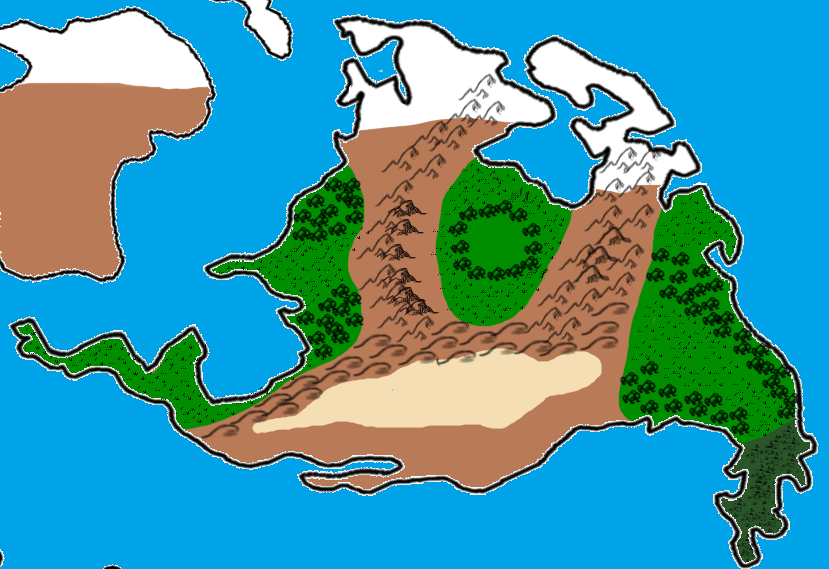
I want a lot of different terrain types in the Empire. To the south is a mostly desert, though I'm thinking it'll be a region that is pure desert at the top and that is very fertile at the south, someplace that floods like Egypt/ The Nile.
There are two major mountain ranges to the West and East which divide the Empire. They are a little too wide proportionally right now, I am still working on this. They make up the forested lands. The central Empire is the capitol, inside the ring of magically-created forest (the capitol itself isn't on the map yet) and a lake. The surrounding farmland keeps the capitol fed, and there are only a few passes through the high mountains to the western and eastern halves of the Empire. The artic north is sparsely inhabited. On the south-eastern tip of the continent is a swampy area that may or may not be a part of the Empire (thinking it's uninhabited, with the forested northern parts being more inviting to live in). Now that I've started laying out the terrain I might have to go and re-draw the shape of the continent. The big landmass to the north of the capitol seems strange to me, and I'm thinking of adding a lot of islands to the western side.
I'm using the Sketchy Cartography Brushes by StarRaven on Deviantart (link here) which are awesome, a big thinks to him (her? never can tell online) for the great art.
I also found a couple of cool links on making terrain/ climate. There is this post on Mythcreants about coloring the map (which I mostly ignored :) and this other post on creating plausible maps. The Tao of D&D had a link to this cool Wikipedia post about the Koppen climate classification system too.
Okay, admittedly this is not a very big post, but I will have much more detailed stuff to come, promise :)
Wednesday, November 15, 2017
The Elemental Empire - part 4 - What is Magic?
One of the biggest things I have to consider for the Elemental Empire setting is, what is magic? Magic is a big, wonderful, pain-in-the-***. I love magic, I love playing wizards. From a design standpoint however, I hate magic. Magic is one of those things that is so hard to do well, it can easily become too over- or under-powered and destroy everything else you've created. Just do a Google search on "wizards vs fighters" (ah, the liner fighter and quadratic wizard, I've read so many of those posts) and see the never-ending arguments about magic and how it works in the game. Any game, while this is a favorite past-time of D&D players, any game with magic has the same potential problems. So magic is something that needs to be carefully weighed and purposefully designed. And it starts with a simple question: what is magic?
Well, there are so many ways to answer that question, but let me posit there is one fundamental core to any definition of magic: the ability to do super-human things. Yeah, this covers a lot of things that are not considered "magic" per se, like super-powers and psionics and super-science. Anything that is beyond the human normal is "magic" by this definition - but I think it's a vital starting point. There is the famous Arthur C Clark quote that "any sufficiently advanced technology is indistinguishable from magic" which hits it on the head. The thing that makes magic such a nightmare to design is that it allows the players to do things beyond the normal for humans - which means that the world we all know and expect and make decisions based on gets thrown out the window. Highly advanced technology and comic book powers are magic for all intents and purposes, because they all take you out of the familiar and predictable world and take you somewhere else. They break reality, and breaking reality is a tricky thing. While choosing the Roman Empire for an inspiration is going to take players out of the world they know (if I do it right, of course) adding magic is an even bigger shift. Changing how people act and think is a lot smaller than changing the definition of reality itself.
Since I'm creating a setting with magic, I'm allowing reality to be broken, then how do I want it to break? Having some good, strong, logical and consistent rules is going to be vital here. Since this is a story first, it is a setting after all and all RPGs are Interactive Narratives at heart, then it might be good to ask: what story purpose does magic serve? And that is a very interesting question.
I've always thought that the D&D system of magic, typically called "Vancian magic" was a great and terrible fit for a role-playing game. For the few who might not know, D&D magic is very similar (I've never heard that it was directly adapted, just similar) to magic in the "Dying Earth" stories by Jack Vance. In this system, fundamentally, mages can only know a limited number of spells and they lose the spell when it is cast. Think of spells as grenades: they are very powerful, they take skill to use properly, you can only carry so many, there are multiple types, and after you use one it's gone- but you can get more if you have the right supply. Yeah, spells are grenades, I had never thought of that metaphor until just now but it actually works really well. This feels like a great fit for D&D because of it's war-gaming roots. Spells are artillery, fighters are infantry, it works. But it feels like a bad choice to me for a role-playing game for one reason: in the RPG magic is common, but in the stories and the system itself, magic is rare. Vance's stories are called the "Dying Earth" for a reason. This is a far-far-far-future Earth of magic and super-technology, and both of those are being completely lost. The spellbooks that hold magic have vanished, and once a wizard casts a spell it's gone, so magic has mostly disappeared from the world. Nobody remembers how to use technology. The world is decaying, and the "fire-and-forget" style of magic fits that theme perfectly. If magic was a renewable resource then it wouldn't be dying, it would still be around and viable. Which would kill the theme that Vance had set up. So it's odd to fit that system into a world where magic is common, or like in the Eberron setting (which I like by the way) where it is literally everywhere in civilization. The narratives don't quite seem to line up. Want more proof of that, try playing the old computer games like the "Gold Box" SSI games Pool of Radiance or Neverwinter Nights and count just how many days really pass while you play. Mages have to sleep to refresh their grenade supply, so there is a lot of sleeping in those games that faithfully reproduce the system. Thank god there's no real time limit to defeat the evil dragon. In the 4th Edition of D&D or the Neverwinter MMO they dropped the whole memorizing thing altogether to facilitate a more active style of play. The mechanics of magic, the definition of how it operates, encourages a certain style of narrative.
So I ask myself, what kind of narrative do I want? Why is magic in the game, what kind of stories is it designed to tell?
For me, magic is human emotion made real.
While we often take it personally, Nature is impersonal. There is no such thing as "Mother Earth." Mothers have feelings, they care for their progeny because they feel love and nurturing. While Nature does provide for us (would suck to not have food and air and stuff) it does not do this out of any feeling or desire, it just does it. It would do it even if we didn't exist. It, the world and the laws that drive it, doesn't care about us. If you say it does, then you've just created magic - the literal existence of human emotion. Emotions drive us, sometimes when we wish they wouldn't. There is no such thing really as anger, because emotions are not things, they are movement. You are angry at something, you feel fear towards or away from something. Having an emotion pretty much by definition moves you, being hungry drives you towards food, being afraid of spiders drives you away from them, feeling angry provokes certain actions. Emotions are dynamic, and they are targeted. People often say they would "work any job" or "eat anything" but those statements are pretty much never true. Would you work as a human crash test dummy? Or a roller-coaser mechanic if you're afraid of heights? Would you eat a human being? Odds are not. With that emotion comes the target, the thing we want to have or do to fully satisfy that emotion, though we might settle for something else if we can't get what we want.
So why is magic in my game? To tell the stories of when someone's emotions change the world.
This happens anyways, right? I mean the dictator's desire for power leads him to take over the country and create a repressive regime instead of a land of milk and honey. Yeah, it does. The only reason we change the world is because of some feeling to do so. Because we want to do so. But the nice thing about magic is how quickly we can show that impact, and how broadly we can create connections. How many unexpected and unfamiliar ways we can change reality. Because while taking people out of the world can be dangerous from a design standpoint, it can be great for creating feelings of wonder.
Okay, with that really broad starting point let's start refining magic. Another key question to ask is: what's the difference between magic and technology?
As I mentioned above, it's quite possible to push technology into the realm of magic, so what's the fundamental difference between them? I have some strong ideas about this. While the "magic grenades" analogy works for D&D magic, I really wish it didn't. If magic and technology work in the same ways, then why bother calling them different things? Why bother having both of them? There needs to be some fundamental differences between the two. What do I want to be different?
Technology is impersonal - it's possible to accidentally shoot someone with a gun, it's impossible to accidentally cast a fireball.
Technology is repetitive/ mass produced - there are a million swords, there is only one Excalibur.
Technology is stable, reliable and repeatable - a hammer always acts like a hammer, a spell changes depending on the caster's identity and emotional state.
Technology is governed by scarcity, magic is governed by cost.
That last one deserves more explanation. A gun shoots until you run out of bullets. You cast fireballs as long as you're willing to pay the price. This is the biggest thing I think is missing in RPG magic. In the Vancian system magic is governed by scarcity, you have so many spell slots/ grenades that you can use. But there is no cost. You automatically gain those slots and they automatically replenish. I don't like that model because I think all the best stories about magic focus on the cost of using magic. Just think about Faust and the "selling your soul to the devil" theme. If magic is emotion, then what price are you willing to pay for your emotions? So magic needs to be governed by price, by cost. There has to be a cost to gain it, and a cost to use it. And you have to be able to do anything as long as you can pay the price. I think that's the most critical thing to bake into the system.
Here's the thing that really ties my brain in knots though: does everyone need magic?
If magic is emotion made real, then doesn't that make non-magical classes or characters somehow lesser, or more restricted? It is possible to say that all player characters/ classes use magic, the Earthdawn game does that just fine. And you could say that the fighter-types just use a more limited or less-cost system of magic compared to full wizards/ casters. And that would make sense, not everyone wants to sell their soul, maybe just lease it, with an option to buy :) If magic comes with a price, then some might want to only pay for a sensible, small car and not a full-blown luxury yacht. And since I'm defining my Humins to be innately magical (to justify the half-breeds) then saying they all use magic to a lesser or greater degree works. And the other races may not have the same flexibility in using magic, but might still have innate magic, more like limited super-powers instead of the "can do anything I imagine" of a caster.
Okay, I think that gives me a good foundation for thinking about magic. Well, to start with. So let me wrap this up and let those ideas percolate though my unconscious, and next week we'll take a look at the other side if the coin: what kinds of technology do I want in this world? Until then!
Well, there are so many ways to answer that question, but let me posit there is one fundamental core to any definition of magic: the ability to do super-human things. Yeah, this covers a lot of things that are not considered "magic" per se, like super-powers and psionics and super-science. Anything that is beyond the human normal is "magic" by this definition - but I think it's a vital starting point. There is the famous Arthur C Clark quote that "any sufficiently advanced technology is indistinguishable from magic" which hits it on the head. The thing that makes magic such a nightmare to design is that it allows the players to do things beyond the normal for humans - which means that the world we all know and expect and make decisions based on gets thrown out the window. Highly advanced technology and comic book powers are magic for all intents and purposes, because they all take you out of the familiar and predictable world and take you somewhere else. They break reality, and breaking reality is a tricky thing. While choosing the Roman Empire for an inspiration is going to take players out of the world they know (if I do it right, of course) adding magic is an even bigger shift. Changing how people act and think is a lot smaller than changing the definition of reality itself.
Since I'm creating a setting with magic, I'm allowing reality to be broken, then how do I want it to break? Having some good, strong, logical and consistent rules is going to be vital here. Since this is a story first, it is a setting after all and all RPGs are Interactive Narratives at heart, then it might be good to ask: what story purpose does magic serve? And that is a very interesting question.
I've always thought that the D&D system of magic, typically called "Vancian magic" was a great and terrible fit for a role-playing game. For the few who might not know, D&D magic is very similar (I've never heard that it was directly adapted, just similar) to magic in the "Dying Earth" stories by Jack Vance. In this system, fundamentally, mages can only know a limited number of spells and they lose the spell when it is cast. Think of spells as grenades: they are very powerful, they take skill to use properly, you can only carry so many, there are multiple types, and after you use one it's gone- but you can get more if you have the right supply. Yeah, spells are grenades, I had never thought of that metaphor until just now but it actually works really well. This feels like a great fit for D&D because of it's war-gaming roots. Spells are artillery, fighters are infantry, it works. But it feels like a bad choice to me for a role-playing game for one reason: in the RPG magic is common, but in the stories and the system itself, magic is rare. Vance's stories are called the "Dying Earth" for a reason. This is a far-far-far-future Earth of magic and super-technology, and both of those are being completely lost. The spellbooks that hold magic have vanished, and once a wizard casts a spell it's gone, so magic has mostly disappeared from the world. Nobody remembers how to use technology. The world is decaying, and the "fire-and-forget" style of magic fits that theme perfectly. If magic was a renewable resource then it wouldn't be dying, it would still be around and viable. Which would kill the theme that Vance had set up. So it's odd to fit that system into a world where magic is common, or like in the Eberron setting (which I like by the way) where it is literally everywhere in civilization. The narratives don't quite seem to line up. Want more proof of that, try playing the old computer games like the "Gold Box" SSI games Pool of Radiance or Neverwinter Nights and count just how many days really pass while you play. Mages have to sleep to refresh their grenade supply, so there is a lot of sleeping in those games that faithfully reproduce the system. Thank god there's no real time limit to defeat the evil dragon. In the 4th Edition of D&D or the Neverwinter MMO they dropped the whole memorizing thing altogether to facilitate a more active style of play. The mechanics of magic, the definition of how it operates, encourages a certain style of narrative.
So I ask myself, what kind of narrative do I want? Why is magic in the game, what kind of stories is it designed to tell?
For me, magic is human emotion made real.
While we often take it personally, Nature is impersonal. There is no such thing as "Mother Earth." Mothers have feelings, they care for their progeny because they feel love and nurturing. While Nature does provide for us (would suck to not have food and air and stuff) it does not do this out of any feeling or desire, it just does it. It would do it even if we didn't exist. It, the world and the laws that drive it, doesn't care about us. If you say it does, then you've just created magic - the literal existence of human emotion. Emotions drive us, sometimes when we wish they wouldn't. There is no such thing really as anger, because emotions are not things, they are movement. You are angry at something, you feel fear towards or away from something. Having an emotion pretty much by definition moves you, being hungry drives you towards food, being afraid of spiders drives you away from them, feeling angry provokes certain actions. Emotions are dynamic, and they are targeted. People often say they would "work any job" or "eat anything" but those statements are pretty much never true. Would you work as a human crash test dummy? Or a roller-coaser mechanic if you're afraid of heights? Would you eat a human being? Odds are not. With that emotion comes the target, the thing we want to have or do to fully satisfy that emotion, though we might settle for something else if we can't get what we want.
So why is magic in my game? To tell the stories of when someone's emotions change the world.
This happens anyways, right? I mean the dictator's desire for power leads him to take over the country and create a repressive regime instead of a land of milk and honey. Yeah, it does. The only reason we change the world is because of some feeling to do so. Because we want to do so. But the nice thing about magic is how quickly we can show that impact, and how broadly we can create connections. How many unexpected and unfamiliar ways we can change reality. Because while taking people out of the world can be dangerous from a design standpoint, it can be great for creating feelings of wonder.
Okay, with that really broad starting point let's start refining magic. Another key question to ask is: what's the difference between magic and technology?
As I mentioned above, it's quite possible to push technology into the realm of magic, so what's the fundamental difference between them? I have some strong ideas about this. While the "magic grenades" analogy works for D&D magic, I really wish it didn't. If magic and technology work in the same ways, then why bother calling them different things? Why bother having both of them? There needs to be some fundamental differences between the two. What do I want to be different?
Technology is impersonal - it's possible to accidentally shoot someone with a gun, it's impossible to accidentally cast a fireball.
Technology is repetitive/ mass produced - there are a million swords, there is only one Excalibur.
Technology is stable, reliable and repeatable - a hammer always acts like a hammer, a spell changes depending on the caster's identity and emotional state.
Technology is governed by scarcity, magic is governed by cost.
That last one deserves more explanation. A gun shoots until you run out of bullets. You cast fireballs as long as you're willing to pay the price. This is the biggest thing I think is missing in RPG magic. In the Vancian system magic is governed by scarcity, you have so many spell slots/ grenades that you can use. But there is no cost. You automatically gain those slots and they automatically replenish. I don't like that model because I think all the best stories about magic focus on the cost of using magic. Just think about Faust and the "selling your soul to the devil" theme. If magic is emotion, then what price are you willing to pay for your emotions? So magic needs to be governed by price, by cost. There has to be a cost to gain it, and a cost to use it. And you have to be able to do anything as long as you can pay the price. I think that's the most critical thing to bake into the system.
Here's the thing that really ties my brain in knots though: does everyone need magic?
If magic is emotion made real, then doesn't that make non-magical classes or characters somehow lesser, or more restricted? It is possible to say that all player characters/ classes use magic, the Earthdawn game does that just fine. And you could say that the fighter-types just use a more limited or less-cost system of magic compared to full wizards/ casters. And that would make sense, not everyone wants to sell their soul, maybe just lease it, with an option to buy :) If magic comes with a price, then some might want to only pay for a sensible, small car and not a full-blown luxury yacht. And since I'm defining my Humins to be innately magical (to justify the half-breeds) then saying they all use magic to a lesser or greater degree works. And the other races may not have the same flexibility in using magic, but might still have innate magic, more like limited super-powers instead of the "can do anything I imagine" of a caster.
Okay, I think that gives me a good foundation for thinking about magic. Well, to start with. So let me wrap this up and let those ideas percolate though my unconscious, and next week we'll take a look at the other side if the coin: what kinds of technology do I want in this world? Until then!
Wednesday, November 8, 2017
The Elemental Empire - part 3 - Inspirations
Having laid out a starting map in my last post I've now got all (or at least most, nothing's really final yet) of the major powers in my world. Each of them comes from some of the Crash Course World History videos I've been watching - so I thought I'd go ahead and link those videos and talk about my ideas in some depth. Here's a look at the map I'm working from again...

The Elemental Empire
The Empire is going to be the first location in the world that I develop, just because I have the clearest ideas for what it is and what I want to explore with it (though 'most' does not imply 'a lot'). It's basic inspiration is from the Roman Empire of history - and this CCWH video...
I like the idea of a major power in turmoil, and at a turning point in its evolution. The Elemental Empire is pretty much split into two halves, Western and Eastern, that are the same civilization in name only. The threats to the West of the Beastmen and the Demons in the East are driving the Empire's halves in different directions. The Empire itself is a descendant of the ancient Wizard's Kingdom, which was destroyed in a magical disaster that turned most of the Humin population at the time into undead, creating the undead (which had not existed before then) and the Silent King, the ruler of the undead from the sunken city south of the Empire.
One of the themes I like from this video, and Rome's history, is the division of power between one person (or a small group) and many people or the population at large. Like the video says about Rome being a "Monarchy, Aristocracy and Democracy" - which makes for a complicated balance of power. That also makes a dynamic tipping point for campaigns, do the adventurers want to support one side or another in that complicated balance of power - or do they want to destroy it altogether?
A big theme of the Elemental Empire is that it's a martial culture, it was founded to protect everyone from another disaster like the fall of the Wizard Kingdom, and the periodic disasters that befall the world. I want it to be a more enlightened warrior society though, a little closer to the ideals of chivalry and Bushido and not so tyrannical (of course, that could also be an option for a GMs setting - I have to think about how to call out, or write/ format, all the different ways a group can slant the setting for the stories they want to tell). That warrior heritage can lead to civil war under a charismatic general, as in the example of Rome, which is another cool potential campaign plot point.
The Oligarchy
To the East of the Elemental Empire, on the neighboring continent, is what I'm calling The Oligarchy (at the moment) that was inspired by this video on the Greeks and Persians...
What I want to do with the Oligarchy is create a religious government, a complicated but mostly benevolent one. I'm not calling this the Theocracy because I want this government to embrace the idea of religious tolerance, thus it is not ruled by one single religion but a consortium of several. It's also it's own Athens and Persia, it was a scattered group of warring city-states during the period of the Wizard Kingdom, was attacked and nearly destroyed by the WK, and then suffered a civil war when it's own "Spartans" who were shamanistic and embraced the wild, un-tameable power of nature migrated (or were driven) to the south of the continent. The remaining people in the north banded together under the guidance of their gods, and found a way to build a common cause through their religions (yeah, this is a fantasy world since I'm having separate groups of people find common cause through their different religions instead of using those differences as a reason to kill each other, which is all too common in our real world).
I really like the idea of a tolerant empire, one that is the "melting pot" ideal. I also want a civilization that is driven by religion, since in most of human history religion in one form or another has played a major part of society - but in most RPG settings the gods are just a convenient way to get healed or brought back from the dead. The Oligarchy is also a contrast to the Elemental Empire, where the Empire is martial and expansionist, the Oligarchy really just wants to be left alone. A sort-of-crusade by the Empire coupled with an attack from the southern mystics led to a war that ended the last age, and the final disaster of the age's turning was the arrival of demons in the world.
The Mystics
I really hate this name, but I'm not sure what to use yet. This civilization is inspired by this video on China, in a general way...
The idea I have right now, which is very much a work in progress, is to actually take the broad theme of a "mandate of heaven" or a way to live and rigid social structure that is defined and imposed by an outside power, and combine it with the sort of "pack leadership" of wolves. Yeah, I'm getting really weird here. The mystics are a group of barbarians and druids in D&D terms, and they live according to how they see nature as revealed by nature spirits and patterns in nature. Unlike the Oligarchy, their neighbors to the north (and separated by a really big wall or other barrier) they do not directly commune with any gods, instead they believe that life and nature itself is structured in a certain way and it is their duty to live in accordance with those principles. I also want to go against stereotypes and make this a female-focused society. These people revere nature and life, and women are the half of the species that create life, so women are the ones in power and control overall, and are valued more than men. So this is going to be a matriarchal society. I don't have a lot of solid ideas for this group yet, so it's going to take some heavy thinking to flesh them out, but I want them to contrast with the Oligarchy - the Mystics are individualistic, wild, have a single unified outlook on life while the Oligarchy are communal, orderly and embrace many different viewpoints.
The Wildlands
A small continent populated by animal-like races attacking the Empire to the east sounds like a good place to draw inspiration from the Mongols...
One thing I'm having trouble deciding is if these "Mongols" are on the verge of expanding into the Empire (and maybe rest of the world) just prior to the sorts of things described in this video, or if they did do those things in the past, likely being the reason for the downfall of the Wizard Kingdom. Or both, hard to decide. What I like about this video is how it clearly shows the Mongols as both a force for good and a force for bad - history, and life in general, is complicated and rarely is anything all good or all evil. Something I want to keep in mind for all of these civilizations, they all need to have their good and bad points, and that is not only interesting writing it also opens the door for a group to slant somebody if they want a clear "good guy" or "bad guy." I think having a complex core will make it easier for each table to develop the setting they want to explore. And it sets a good precedent of thinking about both the good and bad of civilizations, organizations and people.
The Five Kingdoms
This is going to be my Medieval Europe, so here's a CCWH video on it...
Honestly though, this is the one video that is the least inspirational - I've just set the pattern of positing videos so I wanted to continue it. Really, I'm not sure what to do with this continent. It's meant to be the stereotypical western fantasy setting, something a bit more familiar to most gamers than my Romanesque Elemental Empire. Exactly what to do with this place I'm not sure though, beyond "it's the feudal kingdoms." I'm wondering if it might be a power that has been untapped globally, and so the other major civilizations are eager to make it an ally in their struggles - or if maybe it's a new power on the scene that is beginning to expand and eager to crush all the other civilizations... choices, choices.
The Broken Lands
I don't currently envision this landmass having an actual civilization. I'm thinking it might be the uninhabited remains of the first civilization, a land of ruins and wreckage from an ancient disaster. It might also hold some secrets to developing new magic or technologies, or it might be full of lessons from the failed actions of past governments. I don't know what to do with it exactly.
Some Final Thoughts
That wraps up the major powers that I've developed at the moment, and some of the inspirations behind them, along with a little I've posted about my races before this is the foundation of my world. There are a couple of other things that have inspired my thinking on this new setting, so I want to leave you with two more videos...
As the above video talks about, history is not just people and governments but also processes and systems. And it's something to remember that there was a lot of trade and contact between different civilizations in the past, even though my own home of North America was not as tied into the global civilization before the modern age. For my world I think I want most of these cultures to be trading with and connected to each other in some way.
And another thing to consider is that those background processes and systems can also lead to disaster, like this two videos talk about...
This systemic disaster is not just interesting in a historical perspective, but it could also make a cool element for creating impending doom in a campaign. You can kill a dragon terrorizing a town, but fighting the world itself, either nature or hidden systemic collapse, is a lot harder. For a certain type of game that might be fun, so it's something to remember.
Okay, so that's a lot of stuff. This is going to end up being a really big world. Which is good, it's easier to ignore parts of a setting you don't want to use than to create all new stuff. This gives me a lot to think about in terms of society and history, but this is a fantasy setting - so next week I'm going to look at the fantasy part, magic. Until then!

The Elemental Empire
The Empire is going to be the first location in the world that I develop, just because I have the clearest ideas for what it is and what I want to explore with it (though 'most' does not imply 'a lot'). It's basic inspiration is from the Roman Empire of history - and this CCWH video...
I like the idea of a major power in turmoil, and at a turning point in its evolution. The Elemental Empire is pretty much split into two halves, Western and Eastern, that are the same civilization in name only. The threats to the West of the Beastmen and the Demons in the East are driving the Empire's halves in different directions. The Empire itself is a descendant of the ancient Wizard's Kingdom, which was destroyed in a magical disaster that turned most of the Humin population at the time into undead, creating the undead (which had not existed before then) and the Silent King, the ruler of the undead from the sunken city south of the Empire.
One of the themes I like from this video, and Rome's history, is the division of power between one person (or a small group) and many people or the population at large. Like the video says about Rome being a "Monarchy, Aristocracy and Democracy" - which makes for a complicated balance of power. That also makes a dynamic tipping point for campaigns, do the adventurers want to support one side or another in that complicated balance of power - or do they want to destroy it altogether?
A big theme of the Elemental Empire is that it's a martial culture, it was founded to protect everyone from another disaster like the fall of the Wizard Kingdom, and the periodic disasters that befall the world. I want it to be a more enlightened warrior society though, a little closer to the ideals of chivalry and Bushido and not so tyrannical (of course, that could also be an option for a GMs setting - I have to think about how to call out, or write/ format, all the different ways a group can slant the setting for the stories they want to tell). That warrior heritage can lead to civil war under a charismatic general, as in the example of Rome, which is another cool potential campaign plot point.
The Oligarchy
To the East of the Elemental Empire, on the neighboring continent, is what I'm calling The Oligarchy (at the moment) that was inspired by this video on the Greeks and Persians...
What I want to do with the Oligarchy is create a religious government, a complicated but mostly benevolent one. I'm not calling this the Theocracy because I want this government to embrace the idea of religious tolerance, thus it is not ruled by one single religion but a consortium of several. It's also it's own Athens and Persia, it was a scattered group of warring city-states during the period of the Wizard Kingdom, was attacked and nearly destroyed by the WK, and then suffered a civil war when it's own "Spartans" who were shamanistic and embraced the wild, un-tameable power of nature migrated (or were driven) to the south of the continent. The remaining people in the north banded together under the guidance of their gods, and found a way to build a common cause through their religions (yeah, this is a fantasy world since I'm having separate groups of people find common cause through their different religions instead of using those differences as a reason to kill each other, which is all too common in our real world).
I really like the idea of a tolerant empire, one that is the "melting pot" ideal. I also want a civilization that is driven by religion, since in most of human history religion in one form or another has played a major part of society - but in most RPG settings the gods are just a convenient way to get healed or brought back from the dead. The Oligarchy is also a contrast to the Elemental Empire, where the Empire is martial and expansionist, the Oligarchy really just wants to be left alone. A sort-of-crusade by the Empire coupled with an attack from the southern mystics led to a war that ended the last age, and the final disaster of the age's turning was the arrival of demons in the world.
The Mystics
I really hate this name, but I'm not sure what to use yet. This civilization is inspired by this video on China, in a general way...
The idea I have right now, which is very much a work in progress, is to actually take the broad theme of a "mandate of heaven" or a way to live and rigid social structure that is defined and imposed by an outside power, and combine it with the sort of "pack leadership" of wolves. Yeah, I'm getting really weird here. The mystics are a group of barbarians and druids in D&D terms, and they live according to how they see nature as revealed by nature spirits and patterns in nature. Unlike the Oligarchy, their neighbors to the north (and separated by a really big wall or other barrier) they do not directly commune with any gods, instead they believe that life and nature itself is structured in a certain way and it is their duty to live in accordance with those principles. I also want to go against stereotypes and make this a female-focused society. These people revere nature and life, and women are the half of the species that create life, so women are the ones in power and control overall, and are valued more than men. So this is going to be a matriarchal society. I don't have a lot of solid ideas for this group yet, so it's going to take some heavy thinking to flesh them out, but I want them to contrast with the Oligarchy - the Mystics are individualistic, wild, have a single unified outlook on life while the Oligarchy are communal, orderly and embrace many different viewpoints.
The Wildlands
A small continent populated by animal-like races attacking the Empire to the east sounds like a good place to draw inspiration from the Mongols...
One thing I'm having trouble deciding is if these "Mongols" are on the verge of expanding into the Empire (and maybe rest of the world) just prior to the sorts of things described in this video, or if they did do those things in the past, likely being the reason for the downfall of the Wizard Kingdom. Or both, hard to decide. What I like about this video is how it clearly shows the Mongols as both a force for good and a force for bad - history, and life in general, is complicated and rarely is anything all good or all evil. Something I want to keep in mind for all of these civilizations, they all need to have their good and bad points, and that is not only interesting writing it also opens the door for a group to slant somebody if they want a clear "good guy" or "bad guy." I think having a complex core will make it easier for each table to develop the setting they want to explore. And it sets a good precedent of thinking about both the good and bad of civilizations, organizations and people.
The Five Kingdoms
This is going to be my Medieval Europe, so here's a CCWH video on it...
Honestly though, this is the one video that is the least inspirational - I've just set the pattern of positing videos so I wanted to continue it. Really, I'm not sure what to do with this continent. It's meant to be the stereotypical western fantasy setting, something a bit more familiar to most gamers than my Romanesque Elemental Empire. Exactly what to do with this place I'm not sure though, beyond "it's the feudal kingdoms." I'm wondering if it might be a power that has been untapped globally, and so the other major civilizations are eager to make it an ally in their struggles - or if maybe it's a new power on the scene that is beginning to expand and eager to crush all the other civilizations... choices, choices.
The Broken Lands
I don't currently envision this landmass having an actual civilization. I'm thinking it might be the uninhabited remains of the first civilization, a land of ruins and wreckage from an ancient disaster. It might also hold some secrets to developing new magic or technologies, or it might be full of lessons from the failed actions of past governments. I don't know what to do with it exactly.
Some Final Thoughts
That wraps up the major powers that I've developed at the moment, and some of the inspirations behind them, along with a little I've posted about my races before this is the foundation of my world. There are a couple of other things that have inspired my thinking on this new setting, so I want to leave you with two more videos...
As the above video talks about, history is not just people and governments but also processes and systems. And it's something to remember that there was a lot of trade and contact between different civilizations in the past, even though my own home of North America was not as tied into the global civilization before the modern age. For my world I think I want most of these cultures to be trading with and connected to each other in some way.
And another thing to consider is that those background processes and systems can also lead to disaster, like this two videos talk about...
This systemic disaster is not just interesting in a historical perspective, but it could also make a cool element for creating impending doom in a campaign. You can kill a dragon terrorizing a town, but fighting the world itself, either nature or hidden systemic collapse, is a lot harder. For a certain type of game that might be fun, so it's something to remember.
Okay, so that's a lot of stuff. This is going to end up being a really big world. Which is good, it's easier to ignore parts of a setting you don't want to use than to create all new stuff. This gives me a lot to think about in terms of society and history, but this is a fantasy setting - so next week I'm going to look at the fantasy part, magic. Until then!
Wednesday, November 1, 2017
The Elemental Empire - part 2 - a rough map
My last attempts at making some random maps created some interesting things, but getting a layout I like would mean creating dozens of maps to finally get one that spoke to me. So I decided on a new track. I got a blank map of the world, then loaded that image in the GIMP, where I did a hand-tracing of the continents. Drawing with the map is not an easy thing, but I think I got something workable. By re-arranging and scaling things I ended up with a map that while it was based on the real world, doesn't look like the real world. And having an image to look at gave me the inspiration I expected it would to start filling in the larger world. So here's the map, rough and subject to change as it is...

There is that big stretch of ocean at the top-right, which I think I'm going to fill in with something later. But for now, the central-north continent is the home of the Elemental Empire. The western half of the Empire is fighting the "barbarians," which are going to be animal races like Centaurs and Gryphons - those come from (or are somehow related to) the top-left continent (which is totally not Australia ;). The right-most continent is home to two major powers, one a religious empire of sorts and the other a "pagan" civilization - the wars between the two are what sparked the demon invasion of the Empire. South-central lies the Five Kingdoms, whom I have no idea about at all. And south-west is a lost continent, uninhabited by any major civilizations, that was the home of a race from antiquity, it's full of ruins and the aftermath of a magickal disaster.
Thematic Elements
So the world was meant to have some elements for story-building:
So the world is slowly but surely taking shape. A short update this week since crafting the map took up a fair amount of time. More details next week.

There is that big stretch of ocean at the top-right, which I think I'm going to fill in with something later. But for now, the central-north continent is the home of the Elemental Empire. The western half of the Empire is fighting the "barbarians," which are going to be animal races like Centaurs and Gryphons - those come from (or are somehow related to) the top-left continent (which is totally not Australia ;). The right-most continent is home to two major powers, one a religious empire of sorts and the other a "pagan" civilization - the wars between the two are what sparked the demon invasion of the Empire. South-central lies the Five Kingdoms, whom I have no idea about at all. And south-west is a lost continent, uninhabited by any major civilizations, that was the home of a race from antiquity, it's full of ruins and the aftermath of a magickal disaster.
Thematic Elements
So the world was meant to have some elements for story-building:
- The Elemental Empire - martial society, mixed races living together, major power on the brink of either collapse or change, enemies all around
- The Wildlands -tribalism, nomads, rich races and societies but no central authority, misunderstood and outcast
- The Oligarchy -faith and religion, mingling of different faiths
- The Mystics -individualism, spirituality, anarchy, passion
- The Broken Lands -lost/ forgotten history, disaster
- The Five Kingdoms -politics, intrigue, shifting alliances and betrayals
So the world is slowly but surely taking shape. A short update this week since crafting the map took up a fair amount of time. More details next week.
Friday, October 20, 2017
The Elemental Empire - part 1 - The Grand Sweep of History
Okay, enough world-building theory, let's start writing something and throwing out ideas. No doubt some (or even all :) of these ideas will get re-named, revised and quite possibly thrown out altogether - but I feel like it's time to start brainstorming. First off, I do have to say that the world of 13th Age struck a chord with me when I first read it, so I'm going to take some loose inspiration from it; though I'm also going to significantly shake things up. I don't want or intend to step on anyone's copyright, I just mention it first to say to any 13th Age players out there that yes, I really liked the game's setting, and second to remind myself to watch my thinking so I don't cross that line. Thus, let's start building the Elemental Empire.
I like the idea of Ages, or periods of history that are clearly defined. Now, in real life things are not so neat, and one culture's Age is another's inconsequential period. So for my new world I'm going to force "ages" - which I'm currently calling "Conjunctions." In the night sky there are several lights, colored so they stand out from the basically white stars, that move at erratic and unpredictable intervals. Eventually they align, say there are 5 or 7 of them (enough to form a distinctive pattern), and with each alignment (called a conjunction) something terrible happens. A magical catastrophe, plague, mass death, famine/ drought - something really bad. No one has been able to predict exactly when it will happen, but it does get more obvious as time passes (and the lights draw closer together, I'm thinking they don't line up but rather make a shape of some kind) (I'm also debating making them disappear instead - in this initial idea they are symbols of disaster, but maybe they should be symbols of hope/ good and as they disappear they signal oncoming disaster? I think I'm going to switch it to that, not sure yet though). I like this idea as "something to fear" events, a powerful force that is not understood and unstoppable - the only hope is to mitigate it. I want to leave the interval open (hence it's being a random number of years/ amount of time) so that GMs who don't want to use this can just set their stories in-between the conjunctions and not worry about it. And while they cannot be stopped, let's say they can be mitigated, that either people have been able to divine the oncoming doom and take steps to lessen it, or that the player's have the potential to be the first to do so.
So, this is going to be a fantasy setting, vaguely medieval, and I also want it to be big. I've been watching a lot of Crash Course's World History on YouTube (for fun and in preparation to write this) and it's struck my by just how many different empires and kingdoms have all been active and interacting at the same time. There seem to have been few periods of history that did not have a lot of different civilizations that all had some degree of contact. So I want this to be a big world, with several different societies. We've got to have magic of course, and I'm still up in the air about gunpowder and steampunk/magitech - I'm not sure just how advanced I want tech to be - though I am leaning towards having at least one society be more technologically advanced that the rest (both to give the option of tech to players/GMs and because it does sound cool to have a gun-slinging wizard [though I was not impressed by Pathfinder's archetype in Ultimate Combat]).
My main society, one of if not the biggest, is going to be Roman Empire-esque, though also split into Western and Eastern halves that are fairly different. It needs some "barbarians" to fight, which are going to be in the East. Demons and Devils are in the West. And South of it are the remains of the old empire. Okay, let's shift gears before I go into more history - lets talk races. I want to use the available races, but I also want to really mix them up. The stereotypical elves, dwarves and humans have been done to death since Tolkien and while creating new versions of them means loosing out on the collective culture built around them, I just want something different. I'm thinking that I'm not going to make completely new races (though that's tempting, another one of my favorite settings is Talislanta, who's tag line was "no elves" because it made it's own races - which creates a kind of steep learning curve, but also makes a fresh, new world to explore), but I am going to change them from some of the stereotypes that I've read.
So first we have the Dwarvin, Nomin, Elvin, and Giatin: these are the oldest races. Dwarves become Dwarvin, they are still shorter, extremely durable, and craftsmen. They are physically related to stone, I'm not sure if I want to say they're essentially living stone, which sounds kinda cool but is going to little too far I think, rather maybe they are stone-like, which stone bones and tough skin (maybe even with stone plates as a kind of exoskeleton). They are family and clan focused. They are amazing singers, because they don't have darkvision, instead they have echolocation like bats (or "blindsight" in Pathfinder terms), and their mouths are formed in a way that gives them that ability and also makes them incredible singers (maybe magically enhanced). They are also consummate liars, exaggerators, hagglers, and braggarts. Gnomes become the Nomin, they are the shortest race (or one of the shortest races) and while Dwarvin are craftsmen like blacksmiths, Nomin are craftsmen in engraving and fine detail. They are secretive, quite and taciturn among outsiders - they like to listen and watch. They are nimble and intelligent, natural scientists, researchers, inventors and detectives. Not cartoon-ish buffoons like in the Dragonlance series (which other settings seem to emulate as well), but rather smart, clever and crafty. Elves become the Elvin, who are tied to the land and nature. Like the Dwarvin I'm debating having the Elvin be living plants (maybe like the Sylvari in Guild Wars 2). Elvin are master herbalists, weavers, astronomers. They were the first Druids. They are very serious, and hold oaths to be sacred and unbreakable. Last of the oldest or original races are the Giants, or Giatin. I'm thinking they're 10-15 feet tall, which is around the 12-20 they seem to be in most editions of D&D. I don't really want to go with the "large, slow and stupid" trope, but I'm not sure what kind of unique identity to hang onto these guys. I think they're the architects and city-builders of the setting (maybe also administrators and bureaucrats).
These are the oldest races, the first in the world, and the first few Conjunctions/ages had them fighting with each other, which culminated in a magical war and disaster that created the Humin. Humans, err... Humin are creatures of magic. They take to spellcasting like breathing, and all have some minor aptitude with magic at least. They have the shortest lives, living to just 50 years or so compared to the hundreds of the first races, but Humin also live the most with what they've got. They grow and reproduce the fastest, which over time has led them to become the dominate species on the planet because their population can bounce back the quickest from the periodic disasters of the Conjunctions. Physically Humin are weakest of the races, they have no special innate abilities like the First Races, but the Humin gift for magic (or magick ? I do kind of like spelling it with the "k" for some reason) - the Humin gift for magick means they can be very powerful. The First Races broke the laws of magick in the disaster that created the Humin. A side effect of being so tied to magick is that Humin are highly unique. There is no "DNA inheritance" like we Humans have, a Humin child can have nothing in common with it's parents physically. This "wild magick" also means that Humin can breed with virtually any other living beings, creating the "crossbreeds." (there has to be some damn explanation for why the only half-whatever races are human-based :)
So the earliest Conjunctions/ ages were ruled by the First Races, until they nearly wiped themselves out in magickal warfare and created the Humin. The next several ages saw the Humin rise to power, culminating the the Wizard Kingdom - which then caused another magickal disaster that almost destroyed everybody. After two near-extinction events based on magick, the Humin and First Races grew closer and began to restrict and control magick (outlawing it was not an option, Humin are innately magickal after all) and together (for the first time) formed the Elemental Empire, which would seek to create and maintain balance in the magick of the world, and between all the races (which had mostly been warring with each other so far).
The same Conjunction that created the Humin (or shortly thereafter) also created the "Barbarian Races." These are generally split into the Bestial Races, hybrid animal creatures like the Pegasi and Gryphons, and the Elemental Races, humanoid elementals (not cross-breeds, but rather advanced elementals with sentience). The disaster that destroyed the Wizard Kingdom also created the undead, minions of the Silent King. The Elemental Empire would spend the next few Conjunctions fighting these three forces. After a few conjunctions the Prismatic Dragons would rise (so named because they were multi-colored), leading to the conjunction that ended with the Draconic Sundering (a dragon civil war that nearly wiped out the Empire). The following conjunctions would see the invasion of the Demons and the intervention of the Pantheon (the general term for all the gods of light/ goodness), which would split the expanding Empire into two halves, each technically the same Empire but with significantly different customs and development. The Western Empire, the closest to the Demonic Invasion, began to develop and rely on technology - the first major culture to do so - because the Demons are able to twist and warp magick (the Infernal are incapable of directly using magick, they can only manipulate it).
Which is about where I want the setting to start. This is all focused on one continent, the northern half of the map, and I'm working on filling out the rest of the world (since I want a variety of cultures and civilizations). I've rambled on for quite a while (well, this is feeling kind of long to me at least :), so I'm going to wrap it up here and be back next week with some more broad brush-strokes of the world, then I'll start writing some specific details. Until then, if you have any thoughts or comments feel free to make them below - you can find my email address in my Google Profile on the right and I'm @d100mechanic on Twitter.
I like the idea of Ages, or periods of history that are clearly defined. Now, in real life things are not so neat, and one culture's Age is another's inconsequential period. So for my new world I'm going to force "ages" - which I'm currently calling "Conjunctions." In the night sky there are several lights, colored so they stand out from the basically white stars, that move at erratic and unpredictable intervals. Eventually they align, say there are 5 or 7 of them (enough to form a distinctive pattern), and with each alignment (called a conjunction) something terrible happens. A magical catastrophe, plague, mass death, famine/ drought - something really bad. No one has been able to predict exactly when it will happen, but it does get more obvious as time passes (and the lights draw closer together, I'm thinking they don't line up but rather make a shape of some kind) (I'm also debating making them disappear instead - in this initial idea they are symbols of disaster, but maybe they should be symbols of hope/ good and as they disappear they signal oncoming disaster? I think I'm going to switch it to that, not sure yet though). I like this idea as "something to fear" events, a powerful force that is not understood and unstoppable - the only hope is to mitigate it. I want to leave the interval open (hence it's being a random number of years/ amount of time) so that GMs who don't want to use this can just set their stories in-between the conjunctions and not worry about it. And while they cannot be stopped, let's say they can be mitigated, that either people have been able to divine the oncoming doom and take steps to lessen it, or that the player's have the potential to be the first to do so.
So, this is going to be a fantasy setting, vaguely medieval, and I also want it to be big. I've been watching a lot of Crash Course's World History on YouTube (for fun and in preparation to write this) and it's struck my by just how many different empires and kingdoms have all been active and interacting at the same time. There seem to have been few periods of history that did not have a lot of different civilizations that all had some degree of contact. So I want this to be a big world, with several different societies. We've got to have magic of course, and I'm still up in the air about gunpowder and steampunk/magitech - I'm not sure just how advanced I want tech to be - though I am leaning towards having at least one society be more technologically advanced that the rest (both to give the option of tech to players/GMs and because it does sound cool to have a gun-slinging wizard [though I was not impressed by Pathfinder's archetype in Ultimate Combat]).
My main society, one of if not the biggest, is going to be Roman Empire-esque, though also split into Western and Eastern halves that are fairly different. It needs some "barbarians" to fight, which are going to be in the East. Demons and Devils are in the West. And South of it are the remains of the old empire. Okay, let's shift gears before I go into more history - lets talk races. I want to use the available races, but I also want to really mix them up. The stereotypical elves, dwarves and humans have been done to death since Tolkien and while creating new versions of them means loosing out on the collective culture built around them, I just want something different. I'm thinking that I'm not going to make completely new races (though that's tempting, another one of my favorite settings is Talislanta, who's tag line was "no elves" because it made it's own races - which creates a kind of steep learning curve, but also makes a fresh, new world to explore), but I am going to change them from some of the stereotypes that I've read.
So first we have the Dwarvin, Nomin, Elvin, and Giatin: these are the oldest races. Dwarves become Dwarvin, they are still shorter, extremely durable, and craftsmen. They are physically related to stone, I'm not sure if I want to say they're essentially living stone, which sounds kinda cool but is going to little too far I think, rather maybe they are stone-like, which stone bones and tough skin (maybe even with stone plates as a kind of exoskeleton). They are family and clan focused. They are amazing singers, because they don't have darkvision, instead they have echolocation like bats (or "blindsight" in Pathfinder terms), and their mouths are formed in a way that gives them that ability and also makes them incredible singers (maybe magically enhanced). They are also consummate liars, exaggerators, hagglers, and braggarts. Gnomes become the Nomin, they are the shortest race (or one of the shortest races) and while Dwarvin are craftsmen like blacksmiths, Nomin are craftsmen in engraving and fine detail. They are secretive, quite and taciturn among outsiders - they like to listen and watch. They are nimble and intelligent, natural scientists, researchers, inventors and detectives. Not cartoon-ish buffoons like in the Dragonlance series (which other settings seem to emulate as well), but rather smart, clever and crafty. Elves become the Elvin, who are tied to the land and nature. Like the Dwarvin I'm debating having the Elvin be living plants (maybe like the Sylvari in Guild Wars 2). Elvin are master herbalists, weavers, astronomers. They were the first Druids. They are very serious, and hold oaths to be sacred and unbreakable. Last of the oldest or original races are the Giants, or Giatin. I'm thinking they're 10-15 feet tall, which is around the 12-20 they seem to be in most editions of D&D. I don't really want to go with the "large, slow and stupid" trope, but I'm not sure what kind of unique identity to hang onto these guys. I think they're the architects and city-builders of the setting (maybe also administrators and bureaucrats).
These are the oldest races, the first in the world, and the first few Conjunctions/ages had them fighting with each other, which culminated in a magical war and disaster that created the Humin. Humans, err... Humin are creatures of magic. They take to spellcasting like breathing, and all have some minor aptitude with magic at least. They have the shortest lives, living to just 50 years or so compared to the hundreds of the first races, but Humin also live the most with what they've got. They grow and reproduce the fastest, which over time has led them to become the dominate species on the planet because their population can bounce back the quickest from the periodic disasters of the Conjunctions. Physically Humin are weakest of the races, they have no special innate abilities like the First Races, but the Humin gift for magic (or magick ? I do kind of like spelling it with the "k" for some reason) - the Humin gift for magick means they can be very powerful. The First Races broke the laws of magick in the disaster that created the Humin. A side effect of being so tied to magick is that Humin are highly unique. There is no "DNA inheritance" like we Humans have, a Humin child can have nothing in common with it's parents physically. This "wild magick" also means that Humin can breed with virtually any other living beings, creating the "crossbreeds." (there has to be some damn explanation for why the only half-whatever races are human-based :)
So the earliest Conjunctions/ ages were ruled by the First Races, until they nearly wiped themselves out in magickal warfare and created the Humin. The next several ages saw the Humin rise to power, culminating the the Wizard Kingdom - which then caused another magickal disaster that almost destroyed everybody. After two near-extinction events based on magick, the Humin and First Races grew closer and began to restrict and control magick (outlawing it was not an option, Humin are innately magickal after all) and together (for the first time) formed the Elemental Empire, which would seek to create and maintain balance in the magick of the world, and between all the races (which had mostly been warring with each other so far).
The same Conjunction that created the Humin (or shortly thereafter) also created the "Barbarian Races." These are generally split into the Bestial Races, hybrid animal creatures like the Pegasi and Gryphons, and the Elemental Races, humanoid elementals (not cross-breeds, but rather advanced elementals with sentience). The disaster that destroyed the Wizard Kingdom also created the undead, minions of the Silent King. The Elemental Empire would spend the next few Conjunctions fighting these three forces. After a few conjunctions the Prismatic Dragons would rise (so named because they were multi-colored), leading to the conjunction that ended with the Draconic Sundering (a dragon civil war that nearly wiped out the Empire). The following conjunctions would see the invasion of the Demons and the intervention of the Pantheon (the general term for all the gods of light/ goodness), which would split the expanding Empire into two halves, each technically the same Empire but with significantly different customs and development. The Western Empire, the closest to the Demonic Invasion, began to develop and rely on technology - the first major culture to do so - because the Demons are able to twist and warp magick (the Infernal are incapable of directly using magick, they can only manipulate it).
Which is about where I want the setting to start. This is all focused on one continent, the northern half of the map, and I'm working on filling out the rest of the world (since I want a variety of cultures and civilizations). I've rambled on for quite a while (well, this is feeling kind of long to me at least :), so I'm going to wrap it up here and be back next week with some more broad brush-strokes of the world, then I'll start writing some specific details. Until then, if you have any thoughts or comments feel free to make them below - you can find my email address in my Google Profile on the right and I'm @d100mechanic on Twitter.
Subscribe to:
Posts (Atom)